

Table of Contents
- The CLO’s Role Is Expanding Beyond Learning
- Why Traditional L&D Is Failing to Support Workforce Upskilling in the Age of AI
- Architecting Adaptive Organizations Through Workforce Upskilling: A New-Age Operating Model for CLOs
- What Leading CLOs Are Doing Differently
- The 8-Step CLO Guide to Get Started with Building Adaptive Organizations
- The Road Ahead for Learning Leadership
- Conclusion: Workforce Upskilling as a Business Imperative
The CLO’s Role Is Expanding Beyond Learning
According to McKinsey’s 2025 State of AI report, 88% of organizations now use AI in at least one of the core business functions. Yet, workforce upskilling remains one of the biggest barriers to successful AI adoption. Organizations struggle to close emerging skills gaps fast enough to keep pace with technological change. One of the major reasons for this gap is that many learning organizations still rely on static systems, yearly planning cycles, and outdated content delivery approaches.
That challenge now falls directly under the CLO’s role.
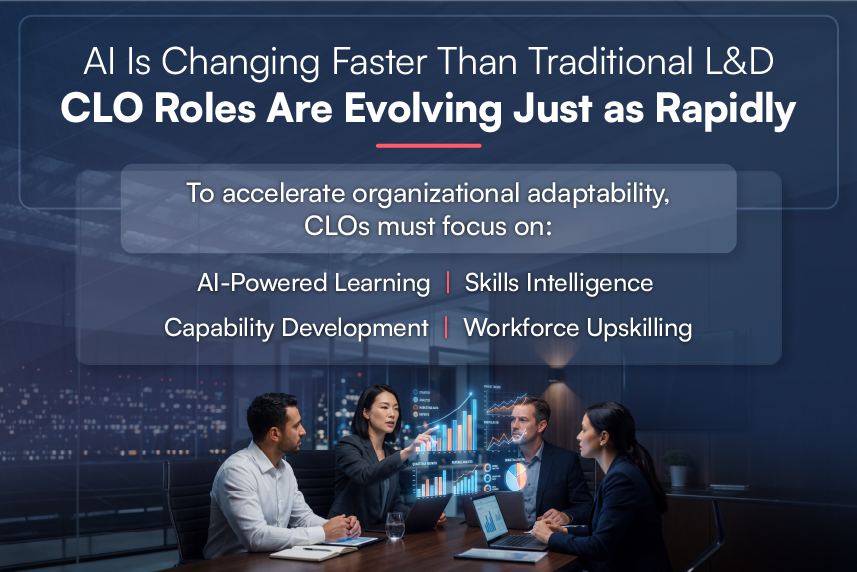
For decades, the CLOs operated within a defined perimeter: designing programs, tracking completions, and reporting to HR. That perimeter has changed drastically as AI evolved. So, the CLOs today are not just learning leaders. They are expected to act as capability architects, workforce intelligence officers, and drivers of organizational agility, all at once.
Why Traditional L&D Is Failing to Support Workforce Upskilling in the Age of AI
Traditional L&D was designed for a comparatively less dynamic world. Annual skill audits, multi-month content development cycles, LMS dashboards focused on completions instead of capability, etc., were never built for today’s pace of change. As a result, many organizations struggle to scale workforce upskilling at the speed required by AI-driven transformation.
Today, “AI velocity gap” is the core problem. It describes the widening distance between how fast AI is reshaping work and how quickly L&D can respond to it. For instance, a new AI tool can rewire a business process in six weeks, but a manual content development cycle takes four months; that’s called the AI velocity gap. Even job roles are shifting in months, not years.
Gartner projects that generative AI will require 80% of the engineering workforce to upskill through 2027. The World Economic Forum adds that 39% of core skills will change by 2030, with AI and big data topping the list.
Development of adaptive organizations requires a fundamentally different approach. Business leaders are not looking only for learning metrics. They now want capability metrics:
- How quickly can we build the skills we need?
- Which teams are most at risk?
- What is the ROI of learning investment on actual performance outcomes?
These are strategic questions, and they require a strategic operating model in response.
Architecting Adaptive Organizations Through Workforce Upskilling: A New-Age Operating Model for CLOs
Building an adaptive organization is not about rolling out a new platform or launching a reskilling initiative. It is about redesigning legacy models for an AI-driven environment. Below are five interlocking pillars of a modern operating model:

Pillar 1: Scalable Learning Infrastructure for Workforce Upskilling
The infrastructure layer must support rapid content updates, AI-driven personalization, multilingual delivery, and interoperability across organizations. This requires cloud-native LXPs, modular content architectures, and API-connected ecosystems that allow learning to reach employees in the flow of work, not just inside a formal training environment. Such infrastructure creates the foundation for scalable workforce transformation by enabling organizations to respond quickly to evolving skill demands and business priorities.
Organizations should increasingly invest in:
- Talent intelligence systems
- AI-assisted content generation
- Adaptive learning systems
- Integrated workforce analytics
Pillar 2: Capability-Focused Learning Design
Leading CLOs no longer design learning around courses alone. They design around measurable business capabilities. Instead of asking how many employees completed a program, they focus on whether employees can perform critical tasks, make better decisions, and contribute to business outcomes. This shift helps organizations align learning investments more closely with strategic priorities and workforce performances.
This means:
- Shorter learning cycles
- Role-specific pathways
- Embedded performance support
- Scenario-based simulations
- Outcome-driven credentialing
Pillar 3: Evolving Learning Teams
Learning teams themselves must evolve. Traditional instructional design structures are being replaced by multidisciplinary teams that combine business, technology, and learning expertise. As AI becomes deeply embedded in workforce upskilling, learning functions must operate more like capability-building centers than content production teams:
- Learning strategy
- Data analytics
- AI operations
- Experience design
- Workforce intelligence
- Content engineering
Pillar 4: AI-Driven Learning Operations
GenAI and Agentic AI are transforming learning operations across the entire life cycle of systems. Beyond improving efficiency, these technologies help organizations scale personalization, accelerate content delivery, and generate actionable insights from learning data. Forward-looking CLOs are using AI to reduce operational friction while improving learning relevance and speed. So, the forward-looking CLOs are deploying:
- Intelligent tutoring systems
- Learning copilots
- Automated assessment generation
- Predictive skills analytics
Pillar 5: Continuous Learning Ecosystems
Adaptive organizations integrate learning into daily work rather than separating it from operations, creating always-on learning ecosystems. In this model, learning becomes a continuous process that evolves alongside changing business priorities, technologies, and employee roles. The objective is to create an environment where capability development happens naturally within the flow of work:
- nudge learning
- peer learning networks
- embedded performance support
- AI-driven recommendation engines
- real-time capability mapping
What Leading CLOs Are Doing Differently
What separates high-performing learning organizations isn’t spending, it’s where CLOs direct strategic attention. Leading CLOs are replacing static competency models with AI-driven capability mapping that analyzes role data and market trends to identify emerging gaps in real time. Automating skills gap analysis with AI shifts organizations from reactive training to proactive talent development.
Beyond visibility, forward-looking CLOs are deploying agentic systems that assign learning, adapt pathways, and surface content automatically, removing manual curation entirely. We, at Harbinger, have already deployed agentic AI solutions for automated analysis across global skilling platforms and custom leadership coaching initiatives. The initiative enabled 50% quicker access to relevant coaching content, saved approximately 20 hours per month through automation, and reduced manual effort in coaching plan development by 30%.
To explore the strategies leading CLOs are using to navigate AI-driven change, explore ‘The CLO’s Playbook: AI Workforce Transformation Strategies for Building Adaptive Organizations’. The eBook offers practical insights for strengthening workforce capabilities and building more adaptive organizations.
The 8-Step CLO Guide to Get Started with Building Adaptive Organizations

Step 1: Audit Current State
Map your existing learning infrastructure, team capabilities, content inventory, and technology stack against the five pillars above. Identify the highest-priority gaps relative to your organization’s near-term business strategy.
Step 2: Build a Skills Ontology (AI-Assisted)
Create a structured, dynamic taxonomy of the skills your organization needs: by role, function, and business priority. Use AI tools to keep the ontology current as roles evolve. This is the data foundation that everything else depends on. Here’s a guide for doing industrial skills gap analysis, which provides a strong starting framework for organizations.
Step 3: Consider Governance Needs
Before deploying AI in learning, define ethical guardrails. Organizations must create frameworks that address AI accountability, regulatory compliance, content accuracy, risk management, and human review processes before scaling AI-powered learning initiatives.
Step 4: Deploy an AI-Powered Micro-Credential Engine
Build or adopt a system that delivers modular, verifiable credentials tied to specific capability outcomes. Micro-credentials keep employees motivated, give managers real-time visibility into skill development, and create a structured record of organizational growth.
Step 5: Activate an Agentic Learning Mesh
Connect your learning systems, content sources, performance data, and skills ontology through an agentic layer. This mesh continuously routes the right learning to the right person at the right moment, without manual curation.
Step 6: Create an Internal Skills Marketplace
Give employees visibility into their own skill profiles and create pathways for internal mobility based on demonstrated capabilities rather than tenure or title. Internal skills marketplaces support digital skilling, reskilling, and upskilling of workforce by connecting employees to relevant learning and growth opportunities while reducing attrition by giving high performers a reason to grow within the organization.
Step 7: Implement Predictive Allocation for A Future-Ready Workforce
Use your skills-related data and workforce simulations to align L&D investment with future requirements. Stop distributing training resources based on historical enrollment patterns and start directing them based on forward-looking business demand.
Step 8: Measure Capability ROI
Replace completion rates and satisfaction scores with capability metrics. Track skill acquisition velocity, time-to-competency, internal mobility rates, and the correlation between learning investment and performance outcomes. These are the numbers that earn CLOs a seat at the strategy table.
The Road Ahead for Learning Leadership
The future of learning will not be defined by larger content libraries or more LMS features. It will be defined by organizational agility. As AI continues reshaping workflows, job structures, and business models, CLO mandate is expanding beyond learning delivery into capability forecasting, workforce enablement, and talent transformation to help organizations adapt to the fast-moving AI landscape. CLOs who move with intention and structure will define the next era of talent advantage.
Conclusion: Workforce Upskilling as a Business Imperative
In an AI-driven world, workforce upskilling is no longer just an L&D priority, it’s a business imperative. As skills requirements evolve faster than ever, CLOs must move beyond training delivery to build a future-ready workforce, drive workforce agility, and foster a culture of continuous learning.
Organizations that invest in AI-powered learning, skills intelligence, and workforce transformation will be better positioned to adapt, innovate, and stay competitive.
Ready to Build a Future-Ready Workforce?
If you as learning leaders want to strengthen your workforce upskill strategy to build continuous learning organizations, connect with Harbinger Group for expert guidance.
Harbinger Group helps organizations accelerate workforce upskilling through AI-powered learning solutions, skills intelligence frameworks, and learning transformation strategies. Connect with our experts at Harbinger Group | Contact Us to strengthen employee capabilities and drive measurable business impact.
With extensive domain expertise and a consulting-led digital engineering approach, we support end-to-end learning transformation journeys. For more, write to us at: contact@harbingergroup.com.

Additional Perspectives on the FDE Model
Forward-deployed engineering is gaining attention as a way to bring engineers closer to customer problems and real-world implementation. Several organizations describe this model as a way to align engineering work with customer needs, systems, and workflows. Here are a few resources that offer additional perspectives on the FDE model:https://www.griddynamics.com/glossary/forward-deployed-engineering
https://miragemetrics.com/guides/forward-deployed-engineering
https://www.cognizant.com/us/en/glossary/forward-deployed-engineer
Frequently Asked Questions (FAQs)
1. What is workforce upskilling, and why is it important for organizations?
Workforce upskilling is the process of helping existing employees develop new skills or strengthen current capabilities to meet evolving business needs. As AI, automation, and digital technologies reshape jobs, organizations must continuously invest in workforce upskilling to close skill gaps and maintain competitiveness. Effective upskilling improves productivity, employee retention, innovation, and organizational agility. It also enables companies to adapt more quickly to changing market demands and workforce expectations.
2. What is the difference between workforce upskilling and reskilling programs?
Workforce upskilling and reskilling programs serve different but complementary purposes. Upskilling helps employees enhance their current capabilities so they can perform their existing roles more effectively or take on advanced responsibilities. Reskilling prepares employees for entirely new roles when job requirements change significantly due to technology, business transformation, or workforce restructuring. Organizations often use both strategies to build a future-ready workforce.
3. What are some examples of workforce upskilling initiatives?
Common workforce upskilling examples include AI literacy training, data analytics programs, cybersecurity certifications, leadership development, cloud computing courses, and digital collaboration training. Many organizations also use microlearning, mentoring programs, simulation-based learning, and role-specific learning pathways. For example, a company implementing AI tools may provide employees with prompt engineering, AI-assisted decision-making, and data interpretation training. These initiatives help employees stay productive while adapting to new technologies.
4. How can organizations assess workforce upskilling readiness?
Workforce upskilling readiness begins with understanding current capabilities and future skill requirements. Organizations should conduct skills assessments, identify capability gaps, evaluate technology infrastructure, and align learning priorities with business objectives. Workforce analytics, skills intelligence platforms, and AI-powered talent assessments can help leaders gain visibility into workforce readiness. This approach enables organizations to prioritize investments and build targeted development plans.
5. What role do CLOs play in workforce upskilling strategies?
Today’s Chief Learning Officers (CLOs) play a strategic role in driving workforce upskilling across the enterprise. Their responsibilities extend beyond delivering training programs to include capability forecasting, skills intelligence, workforce planning, and learning transformation. CLOs help align learning investments with business goals while ensuring employees have the skills needed to support digital transformation and AI adoption. They increasingly serve as workforce capability architects and organizational agility leaders for upskilling the workforce.
6. How can organizations measure the success of workforce upskilling programs?
Organizations should evaluate workforce upskilling efforts using capability-focused metrics rather than relying solely on course completion rates. Key measures include time-to-competency, skill acquisition velocity, internal mobility, employee retention, productivity improvements, and business performance outcomes. Advanced organizations also use workforce analytics to connect learning investments with operational results. Measuring capability growth helps leaders demonstrate the ROI of workforce upskilling initiatives and make data-driven decisions.