


Table of Contents
- Introduction: Why Integration Strategy Matters for Enterprise Learning
- Why Integration Complexity Is Rising
- The Hidden Cost of Treating Integrations as One-Off Projects
- Three Industry Shifts Reshaping Integration Strategy
- The Evolution of Integration Maturity
- What Modern Enterprise Learning Organizations Do Differently
- Questions Every Enterprise Technology and Learning Leader Should Be Asking
- How Mature Is Your Enterprise Learning Ecosystem? A Self-Check Framework
- Conclusion: Integration Strategy as a Business Growth Lever
Introduction: Why Integration Strategy Matters for Enterprise Learning
Enterprise learning has evolved beyond standalone platforms. Today, enterprise technology, HR technology, and learning technology leaders must build connected learning ecosystems that support workforce growth, business agility, and AI adoption.
As learning, HR, collaboration, business, and AI platforms become increasingly interconnected, integration strategy has emerged as a strategic business capability. For many enterprises, it influences faster onboarding, global expansion, workforce scalability, technology modernization, and long-term business growth.
This shift raises an important question:
Can our integration architecture scale alongside our workforce, business priorities, and AI ambitions?
Why Integration Complexity Is Rising
Enterprise learning ecosystems have changed significantly over the past decade. Many organizations once relied on a single LMS connected to an HRIS for compliance training. Today, learning happens across collaboration tools, business applications, and workflow platforms, embedding development directly into daily work routines.
As a result, modern learning environments exchange data across an array of specialized tools: LMS, LXP, HRIS, CRM, collaboration platforms, skills intelligence engines, and security systems. The challenge is no longer connecting these systems. It is orchestrating how they exchange information to support workforce experiences and business operations.
Consider an employee joining a newly acquired regional sales team.The onboarding process begins on Workday, where the employee profile is created. Identity management provisions system access based on the employee’s role. Required sales training appears automatically in Microsoft Teams, while the LMS tracks learning progress and certifications.
As training is completed, certification status is updated in the CRM, while role eligibility is reflected in the relevant workforce or talent system. To the employee, this feels like one connected experience. Behind the scenes, multiple systems continuously exchange workforce, learning, and business data.
The same orchestration accelerates broader business priorities. Organizations can onboard acquired business units faster, roll out workforce initiatives across new geographies, adopt new learning technologies with less effort, and integrate AI capabilities without disrupting existing workflows.
Enterprise leaders increasingly recognize that business value depends not on the number of platforms they own, but on how effectively those platforms operate as a connected enterprise learning ecosystem.

The Hidden Cost of Treating Integrations as One-Off Projects
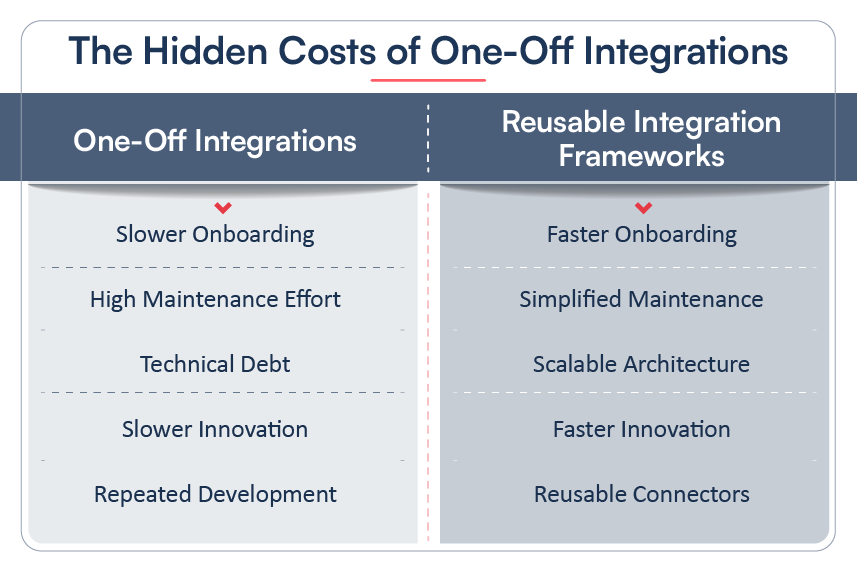
As enterprise learning ecosystems expand, another challenge quietly emerges. Many organizations still approach integrations as isolated implementation projects rather than strategic enterprise capabilities. The costs rarely arise during initial deployment. Instead, they accumulate over time and affect workforce agility, technology modernization, and business growth.
The Onboarding Tax
Every new learning platform, collaboration tool, HR system, or business system adds another custom integration, increasing development and maintenance effort. This challenge becomes more pronounced during mergers and acquisitions, global expansion, or new business unit onboarding.
For example, integrating SAP SuccessFactors with an existing LMS after an acquisition often requires separate validation of employee data, learning assignments, and reporting workflows, delaying workforce onboarding and operational readiness.
The Maintenance Drag
Point-to-point integrations become harder to manage as enterprise ecosystems evolve. Changes to APIs, authentication methods, business rules, or security requirements often affect multiple connected systems.
As maintenance efforts grow, technology teams spend more time preserving integrations than improving employee experience or delivering new workforce initiatives. Modernizing architecture enables organizations to adapt faster and support continuous workforce transformation.
The Innovation Tax
Many organizations invest in AI, advanced analytics, or new workforce applications before strengthening the integration foundation they require. As a result, disconnected data limits AI recommendations, delays automation, and weakens skills intelligence.
Business initiatives, such as product launches, policy changes, and compliance updates, cannot automatically trigger learning across disconnected systems. Organizations with reusable integration capabilities can adopt new technologies, automate workforce processes, and respond to changing business priorities more efficiently.
For a deeper perspective on why enterprise integration has become a strategic business capability, explore our blog on Significance of Enterprise Integration in Today’s HR Landscape.
Three Industry Shifts Reshaping Integration Strategy
As enterprise learning ecosystems become more connected, several industry trends are reshaping what organizations expect from their integration strategy. These shifts extend beyond technology modernization. They directly influence workforce agility, business responsiveness, and long-term organizational growth.
1. Learning Moves into the Flow of Work
Employees increasingly expect learning to be available within the tools they already use, rather than requiring them to switch between multiple applications.
Platforms such as Microsoft Teams and Slack now serve as important learning touchpoints. Employees receive onboarding resources, compliance reminders, product updates, and performance support directly within their daily workflows. This approach reduces context switching and helps employees apply knowledge when they need it most.
For example, a product launch can automatically trigger role-based enablement for sales teams. Similarly, a policy update can notify managers and assign mandatory learning without requiring manual intervention. These experiences depend on connected workflows across HR, collaboration, and learning systems rather than standalone learning platforms.
The objective is no longer to deliver more learning. It is to deliver learning at the right moment, in the right context, through the systems employees already use.
2. AI Requires Connected, Trusted, and Governed Data
Organizations continue to invest in AI, but AI capabilities are only as effective as the data available to them.
Many enterprise learning platforms now include recommendation engines, skills intelligence, and personalized learning experiences. These capabilities rely on connected workforce data from HR systems, learning platforms, performance management tools, collaboration applications, and business systems. Connected data alone is not enough. AI also depends on trusted, well-governed data with clear ownership and consistent definitions, so recommendations stay accurate and defensible.
Consider a manager preparing an employee for a new customer-facing role. Instead of recommending generic courses, an AI-enabled learning platform can combine performance data, completed certifications, current skills, and role requirements to recommend targeted learning pathways. This creates more relevant workforce development while reducing manual effort.
Organizations that strengthen their data foundation before expanding AI initiatives are better positioned to deliver accurate recommendations, reliable workforce insights, and meaningful automation.
3. Enterprise Learning Has Become a Connected Business Ecosystem
The final shift is architectural.
Enterprise learning no longer operates as an isolated technology stack. It functions as part of a broader business ecosystem where workforce, operational, and learning data continuously interact.
For example, certification completion within the LMS can automatically update workforce scheduling systems, ensuring only qualified employees are assigned to regulated tasks. Likewise, skills assessments can inform talent marketplaces, succession planning, and internal mobility programs without requiring duplicate data entry.
These business scenarios require more than APIs. They require interoperability, orchestration, and shared data standards across enterprise systems.
Enterprise architecture decisions determine future scalability. Organizations that invest in connected ecosystems today can adapt more easily to new technologies, evolving workforce requirements, and future business priorities.
The Evolution of Integration Maturity
As enterprise learning ecosystems expand, organizations typically progress through three distinct stages of integration maturity. Each stage reflects a broader shift in how integration supports workforce capability and business outcomes.
Stage 1: System Connectivity
Most organizations begin with point-to-point integrations that connect systems such as the HRIS, LMS, CRM, collaboration platforms, and identity management. While effective for smaller environments, this system-centric approach requires custom integrations for every new application or business capability, making enterprise-wide orchestration increasingly difficult as the ecosystem expands.
Stage 2: Reusable Integration Capability
As enterprise ecosystems grow, organizations transition from custom integrations to reusable integration capabilities. They adopt standardized APIs, reusable connectors, common data models, interoperability standards such as LTI, SCORM, and xAPI, and Integration Platform as a Service (iPaaS) solutions.
This approach simplifies onboarding, supports mergers and acquisitions, reduces operational complexity, and enables consistent, scalable integration across the enterprise.
Stage 3: Business and Experience Orchestration
The most mature organizations treat integration as a business capability rather than a technical implementation. At this stage, business events automatically trigger learning experiences, workforce actions, and operational workflows across multiple systems.
For example:
- A new role assignment automatically provisions learning pathways.
- A product release launches role-specific enablement.
- Certification completion updates workforce scheduling.
- Skills assessments inform career mobility recommendations.
- Policy changes trigger contextual learning and compliance workflows.
This approach enables workforce automation, contextual experiences, and future AI capabilities while ensuring integration maturity evolves alongside changing business priorities.
What Modern Enterprise Learning Organizations Do Differently
As enterprise learning ecosystems grow, technology decisions increasingly influence workforce agility and business performance. Mature organizations distinguish themselves not by the number of platforms they deploy, but by how intentionally they design, govern, and evolve their integration capabilities. Four practices consistently support long-term scalability.
They Establish Integration Ownership and a Strategic Roadmap
Successful organizations treat integration as an enterprise capability rather than a series of implementation projects. They define ownership for integration architecture, establish clear priorities, and align their roadmap with business initiatives such as global expansion, workforce transformation, mergers and acquisitions, and technology modernization.
This approach reduces duplication, improves decision-making, and ensures integration investments continue to support changing business priorities.
They Build Reusable Architecture and Common Data Models
Instead of creating custom integrations for every new platform, mature organizations invest in reusable APIs, standardized connectors, and common workforce data models. Common data models establish consistent definitions for core entities such as employee, role, skill, certification, assignment, and completion data, so information carries the same meaning across every connected system.
A consistent integration foundation allows organizations to onboard new business units, introduce additional learning technologies, and modernize legacy applications with significantly less effort. More importantly, it creates a reliable data foundation that supports workforce reporting, automation, and future innovation.
They Design Around Business Events and Workforce Experiences
Leading organizations no longer design integrations around individual systems. They design around business events that connect learning with workforce processes and operational workflows. This event-driven approach enables systems to respond automatically to changes across the enterprise, reducing manual effort while delivering timely, relevant learning experiences.
They Govern Data, APIs, Security, and AI Access
Scalable integration requires governance as much as connectivity.
Mature organizations establish clear ownership for enterprise data, APIs, and integration services. They define security policies, manage sensitive workforce information, monitor integration performance, govern AI access to enterprise data, and establish standards for integration design, monitoring, updates, and retirement. Strong governance enables organizations to scale confidently while protecting workforce data and ensuring consistent business operations.
Questions Every Enterprise Technology and Learning Leader Should Be Asking
As enterprise learning platforms become more interconnected, learning and technology leaders should regularly evaluate whether their integration foundation can support future workforce priorities, business growth, and AI adoption, not just current operational requirements.
Five Key Questions to Evaluate Your Integration Strategy
- How much custom work is required every time we add a new platform, business unit, or workforce use case?
- Can learning, skills, performance, and workforce data move across systems with consistent meaning?
- Can business events automatically trigger learning, certification, or performance support?
- Do our integrations have clear ownership, monitoring, and a long-term roadmap?
- Can we introduce AI capabilities without rebuilding our integration foundation?
The answers can help leaders identify whether their integration strategy supports scalable workforce capability, technology modernization, and long-term business growth, or whether it continues to rely on fragmented, project-based integrations.
How Mature Is Your Enterprise Learning Ecosystem? A Self-Check Framework
As enterprise learning ecosystems become increasingly interconnected, organizations should periodically evaluate whether their technology landscape can support future workforce needs. Benchmark your organization against the following maturity framework to understand where your integration capabilities stand today and where they should evolve next:
| CAPABILITY | EMERGING | DEVELOPING | MATURE |
|---|---|---|---|
| Workforce Experience | Learning occurs in separate systems | Learning integrates with key business workflows | Learning is embedded seamlessly into everyday work |
| Integration Architecture | Point-to-point integrations | Reusable APIs and connectors | Enterprise-wide orchestration across platforms and business workflows |
| Data Foundation | Workforce data remains siloed | Core systems share trusted data | Connected, trusted, and governed data supports enterprise decision-making |
| AI Readiness | AI uses limited learning data | AI accesses connected workforce information | AI delivers context-aware recommendations and workforce insights |
| Operating Model & Governance | Integration ownership is project-specific | Governance standards are emerging | Enterprise-wide ownership, monitoring, security, and AI access controls |
| Scalability | New platforms require custom development | Integration frameworks simplify expansion | New technologies, business units, and acquisitions integrate with minimal effort |
Organizations with multiple emerging or developing capabilities should strengthen their integration architecture before expanding AI initiatives or workforce technologies. In practice, this means prioritizing high-value workflows, establishing clear integration ownership, standardizing data and APIs, and building governance and monitoring into everyday operations.
This is where an experienced technology partner can help organizations turn these principles into a scalable architecture. Harbinger Group works with enterprises to modernize learning ecosystems, combining deep learning-domain expertise with enterprise integration engineering, standards-based interoperability, reusable integration frameworks, iPaaS-enabled orchestration, AI-ready data foundations, and governance-led architecture design.
To learn how Harbinger helps enterprises modernize learning ecosystems, explore our Enterprise Learning Solutions.
Conclusion: Integration Strategy as a Business Growth Lever
The question is no longer whether enterprise learning systems can exchange data. The real question is whether the integration foundation can support the workforce experiences, business intelligence, and organizational agility that enterprises will require next.
Organizations that strengthen this foundation today will be better positioned to scale workforce capability, adopt emerging technologies, and respond to changing business priorities with confidence.
If your organization is modernizing its enterprise learning platform or strengthening its integration strategy, Harbinger can help. To learn more, connect with us at https://www.harbingergroup.com/contact-us/. For booking a consultation, write to us at contact@harbingergroup.com.

Additional Perspectives on the FDE Model
Forward-deployed engineering is gaining attention as a way to bring engineers closer to customer problems and real-world implementation. Several organizations describe this model as a way to align engineering work with customer needs, systems, and workflows. Here are a few resources that offer additional perspectives on the FDE model:https://www.griddynamics.com/glossary/forward-deployed-engineering
https://miragemetrics.com/guides/forward-deployed-engineering
https://www.cognizant.com/us/en/glossary/forward-deployed-engineer


