


Digital learning publishers are hearing a new question from their customers: can you show us evidence that your content is accessible? Procurement teams are asking for conformance reports. Renewal conversations now include accessibility clauses. And behind every one of those requests sits an aging catalog of thousands of SCORM packages, videos, PDFs, assessments, simulations, and legacy courses created over years using different authoring tools and production workflows, where every remediation decision competes with new content production, customer commitments, and release schedules.
The urgency behind these requests is regulatory. The U.S. Department of Justice has extended the ADA Title II digital accessibility deadlines, with compliance dates of April 26, 2027, or April 26, 2028, depending on the public entity’s population and type. The U.S. Department of Health and Human Services has similarly extended its Section 504 deadlines to May 11, 2027, for recipients with 15 or more employees and May 10, 2028, for those with fewer. Both regulations recognize the Web Content Accessibility Guidelines (WCAG) 2.1 Level AA as the benchmark for digital accessibility.
These mandates apply directly to public entities, not to publishers. But publishers serving public-sector, healthcare, higher education, and workforce development customers are feeling them anyway, because those customers cannot meet their obligations unless every content vendor in their ecosystem supports them. As a result, WCAG 2.1 Level AA compliance is becoming a standard requirement in RFPs, procurement reviews, and contract renewals.
How WCAG 2.1 Level AA Compliance Is Changing Digital Learning Procurement
The Seventh Annual State of Digital Accessibility Report: 2025-2026 found that 91% of organizations believe accessibility improves user experience, 89% see it as a competitive advantage, and 75% associate it with measurable revenue impact.
For publishers, those numbers translate into concrete commercial stakes: accessibility readiness protects renewals, speeds up RFP responses, and determines whether regulated markets are open at all. Procurement teams now expect publishers to demonstrate accessibility before contracts are signed, not after products are deployed. They ask whether you can prove it.
- Can you demonstrate WCAG 2.1 AA conformance?
- Do you provide Accessibility Conformance Reports (ACRs)?
- Has your content been tested with screen readers and keyboard navigation?
- What is your remediation process when issues are identified?
- How do you address legacy content?
- How do you manage third-party content and integrations?
Content quality still matters. Increasingly, so does the evidence behind it. Publishers that can answer these questions confidently enter procurement discussions from a much stronger position.
Where Most Publishers Stand Today
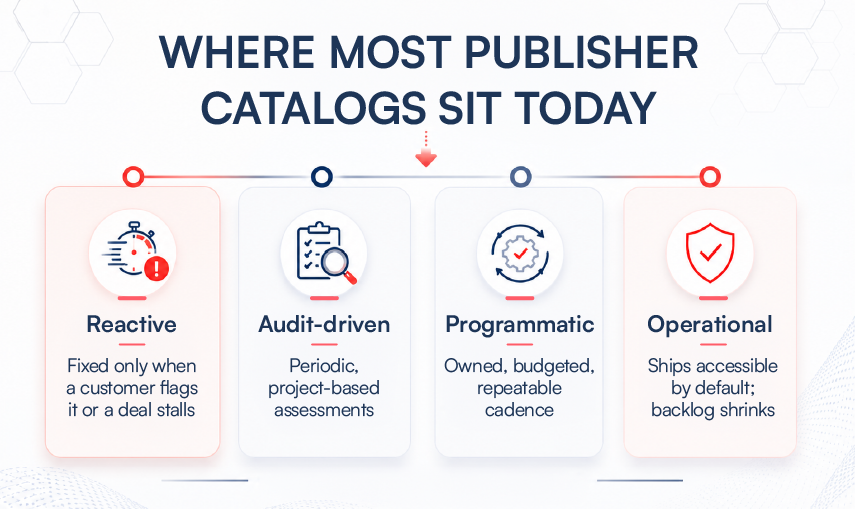
In Harbinger’s work with digital learning publishers, we see catalogs move through four stages of accessibility maturity. Below is the Harbinger Accessibility Maturity Model:
- Reactive: Issues get fixed only when a customer highlights or a deal stalls.
- Audit-Driven: Assessments happen periodically, but each one is a project with an end date.
- Programmatic: Remediation, testing, and documentation have owners, budgets, and a repeatable cadence.
- Operational: New content ships accessible by default and the backlog shrinks each year.
Most publisher catalogs we assess sit between the first two stages. For a publisher with thousands of legacy assets, even a modest remediation backlog can quickly stretch into months of work. Understanding the size of that backlog and the capacity available to address it is essential for realistic planning.
What Digital Publishers Must Do to Prepare
The difference between publishers that treat accessibility as a procurement requirement and those that operationalize it comes down to a few engineering and governance decisions.
1. Strengthen the Evidence Behind Your ACR
A Voluntary Product Accessibility Template (VPAT) is the reporting framework. Once completed for a specific product, it becomes an Accessibility Conformance Report (ACR). Buyers don’t evaluate the document in isolation. They evaluate the evidence behind it: what was tested, how it was tested, which product version was assessed, and when the assessment was completed.
Scope matters just as much. An ACR reflects the accessibility of a defined product, version, and testing scope, so a report covering the delivery platform does not establish that every course, PDF, video, interaction, or assessment delivered through it is accessible. Platform accessibility and content accessibility are separate claims, and publishers managing mixed-format catalogs need evidence for both. Procurement teams are increasingly examining whether the scope of an ACR matches the accessibility claims being made.
2. Prevent AI-Generated Accessibility Debt
AI can accelerate caption generation, alternative text creation, content conversion, and remediation. It can also replicate the same accessibility issue across hundreds of assets just as quickly. The failures are specific and easy to miss: alt text that describes an image but misses its instructional meaning, captions that garble technical vocabulary, reading-order errors introduced during document conversion, and inaccessible interaction patterns reproduced across a catalog through automated templates.
AI-generated output still needs human validation to verify meaning, instructional accuracy, assistive technology behavior, and learner usability before content is released.
3. Make Your Vendor Ecosystem Contractually Accountable
Accessibility doesn’t stop at internally developed content. Third-party content, tools, and integrations become part of the learner experience, and buyers hold publishers accountable for them as well. Accessibility expectations belong in vendor agreements as concrete terms: current ACRs, accessibility acceptance criteria, remediation timelines, notification of material changes, testing rights, and responsibility for issues introduced through upgrades or integrations. Reviewing this documentation before customers ask for it turns a procurement risk into a ready answer.
A Catalog Accessibility Roadmap for Digital Learning Publishers
These engineering and governance decisions don’t translate into execution on their own. At catalog scale, meeting the WCAG 2.1 AA guidelines needs a sequenced roadmap with owners, outputs, and decision gates, not a one-time project. The five steps below follow a rough arc:
First 60 to 90 days: inventory, sample audit, risk segmentation, and a pilot;
Next 3 to 6 months: priority remediation and template correction;
The next 6 to 12 months: scaled remediation, governance, and accessible-by-design production.
These timelines are illustrative; the actual pace will depend on catalog size, content formats, source-file availability, and customer commitments.
| Step | Key activities | Owner | Output | Decision gate |
|---|---|---|---|---|
| 1. Assess the portfolio (First 60 to 90 days) | Inventory every asset (authoring tool, template, age, usage, customer commitments, source-file availability, current status, third-party dependencies); run a sample audit across content types | Content operations, with customer-facing input | Segmented inventory with risk ratings | Leadership agrees on the size of the problem before budgets are set |
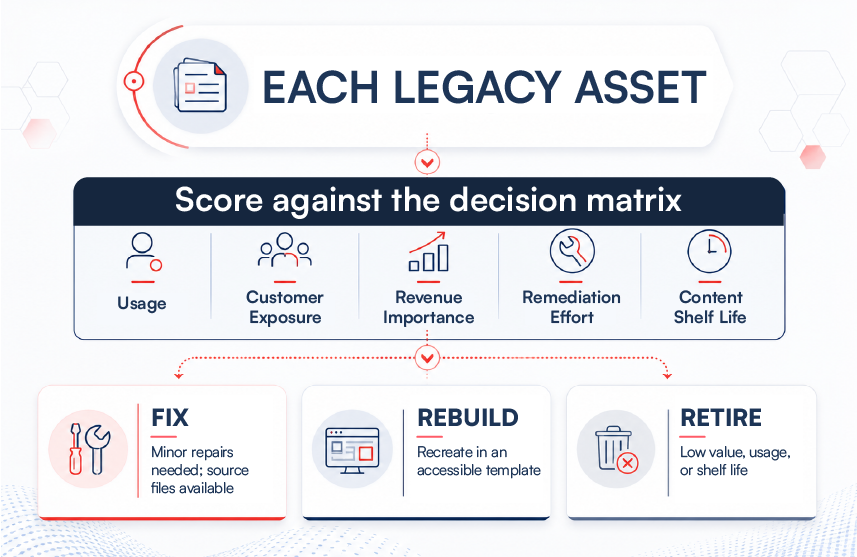
| 2. Prioritize (First 60 to 90 days) | Score the portfolio on usage, customer exposure, revenue importance, remediation effort, and shelf life; make a fix, rebuild, or retire call per asset | Content leadership with sales and customer success input | Ranked remediation backlog with a decision per segment | Priority list matches actual customer commitments and renewal dates |
| 3. Remediate and modernize (Months 3 to 6, scaling through 12) | Rebuild inaccessible interactions, improve keyboard and screen reader support, remediate PDFs and documents, add captions and transcripts, fix assessment accessibility, update legacy templates; work in batches; start with a pilot | Production teams, internal or partnered | Remediated batches plus corrected templates | Pilot results confirm cost and pace before full-scale commitment |
| 4. Validate and document (Continuous from first remediated batch) | Manual testing with assistive technologies (JAWS, NVDA, VoiceOver) and representative users; maintain ACRs, remediation records, validation outcomes, and methodologies | Quality assurance with accessibility specialists | Evidence base that answers procurement questions | Every remediated batch is validated before it is claimed as conformant |
| 5. Operationalize (Months 6 to 12 and ongoing) | Build accessibility into storyboarding, content standards, authoring templates, workflows, QA, and vendor governance | Content operations leadership | Accessible-by-design production standards | New content passes accessibility checks at the same rate as other quality checks |
Publishers designing new content may also consider aligning with WCAG 2.2 as a forward-looking standard, while documenting conformance against the version their customers and applicable regulations require.
Building Accessible Content Operations at Scale
For publishers, the challenge is rarely understanding what needs to be done. It is finding the capacity and operating model to do it without disrupting current production. Remediating last year’s catalog competes for the same production capacity as shipping this year’s roadmap, and that is where accessibility programs stall.
Harbinger’s end-to-end eLearning accessibility solutions support publishers across this entire roadmap, and the work falls into three outcomes:
- Understand the portfolio: catalog discovery, sample audits, risk assessment, and the segmented inventory that remediation planning depends on.
- Reduce the backlog: course and template remediation, accessible interaction design, video and document accessibility, and assistive technology testing, run in batches so throughput stays predictable.
- Prevent new accessibility debt: accessible-by-design production standards, VPAT and ACR documentation support, vendor governance, and accessibility training for content teams.
We have delivered this work at scale, including multi-year catalog remediation programs for a global learning content provider and an engagement standardizing a professional training provider’s course portfolio for WCAG 2.1 AA conformance, spanning multiple authoring tools and content formats.
Conclusion
Accessibility is becoming part of how buyers evaluate the long-term quality and sustainability of digital learning products, not simply whether they meet technical requirements. The publishers who come out ahead will not be the ones rushing remediation in the final quarters; they will be the ones who used this window to modernize their portfolios and walk into every RFP with evidence in hand.
You do not have to solve the whole catalog to start. Begin with a representative portfolio assessment or a pilot remediation batch, and let the results size the rest of the program. Connect with Harbinger Group to scope that first step.


