

An agent that performs well in a pilot can still fail in production. During the pilot, a small team reviews every answer. In production, the agent works with live data, more users, and access rules that no one wrote down for it. It has to know who can see which data, what a correct answer looks like, and what to do when the data changes. When those decisions are missing, even a capable model gives unreliable results.
Agents behave differently from people. When an engineer makes a mistake, it happens once and someone catches it. When an agent makes a mistake, it can repeat it thousands of times before anyone notices. That is why AI-native engineering is less about choosing a model and more about implementing the right blueprints, so agents function correctly from day one and keep doing so at scale. For enterprise technology leaders, the priority is to establish reliability, accountability, and measurable performance before scaling AI agents across business-critical workflows.
What is AI-Native Engineering?
AI-native engineering treats the specification and the evaluation suite as the most important artifacts in the lifecycle, more important than the code itself, because code can now be regenerated in minutes. At Harbinger, it is a advisory-led practice that takes product teams from strategy to scaled adoption through agentic consulting, an AI-native SDLC, platform engineering, and managed AI operations.
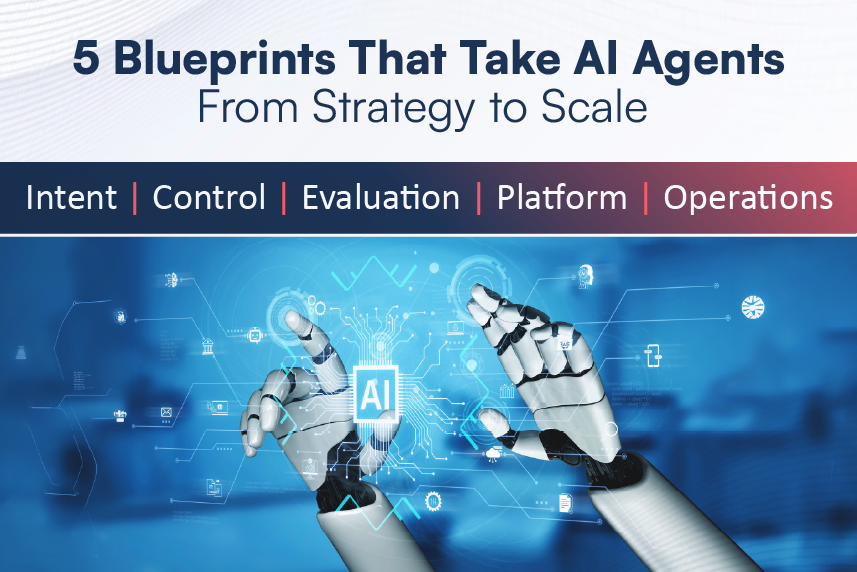
In this blog, we look at the five blueprints that make that journey work.
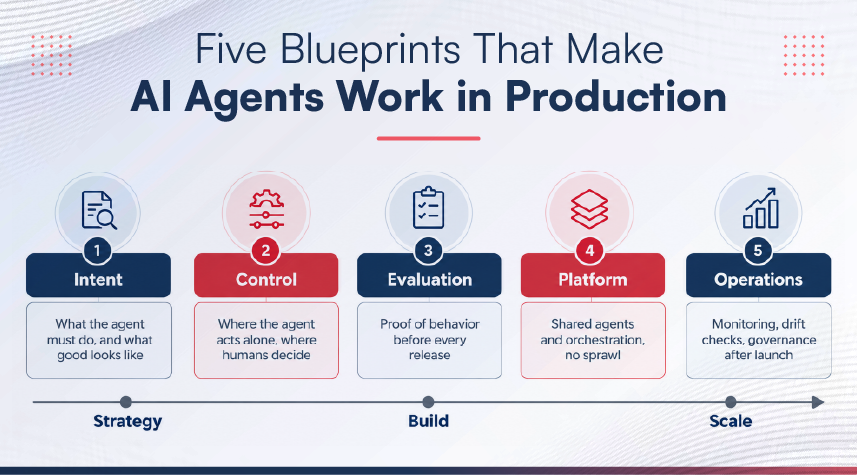
1. The Intent Blueprint: Specifications Before Code
Every agent starts with a clear statement of what it must do and what good looks like. Our AI-Native Requirements Template captures this, and our reusable Agent Blueprints and iWorkflow patterns bring HR and learning domain knowledge in from the start, so agents are domain-fluent rather than generic.
2. The Control Blueprint: Deciding Where Humans Stay in Control
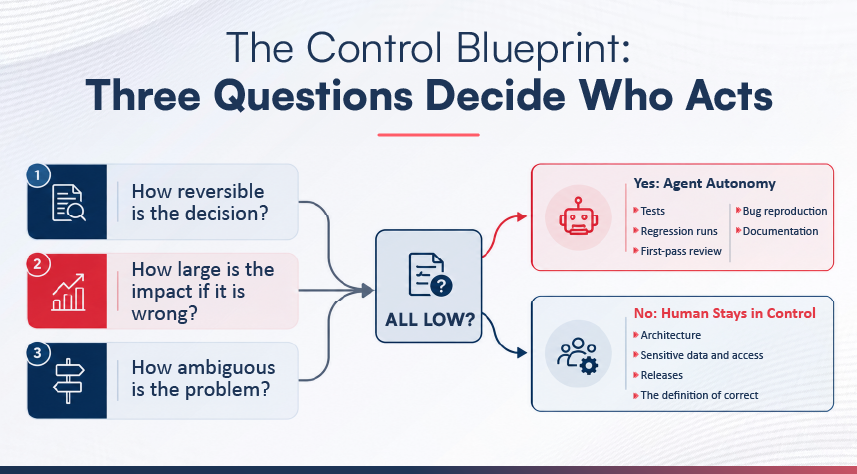
We decide where agents act alone with three questions: how reversible is the decision, how large is the impact if it is wrong, and how ambiguous is the problem? If any answer is high, a human stays in control. When we built a chatbot for a healthcare provider with complex geo-residency and access-control requirements, humans owned every design decision: who can see which data, where that data can live, and how the system behaves at the edges.
3. The Evaluation Blueprint: Evaluation-Driven Development for AI Agents
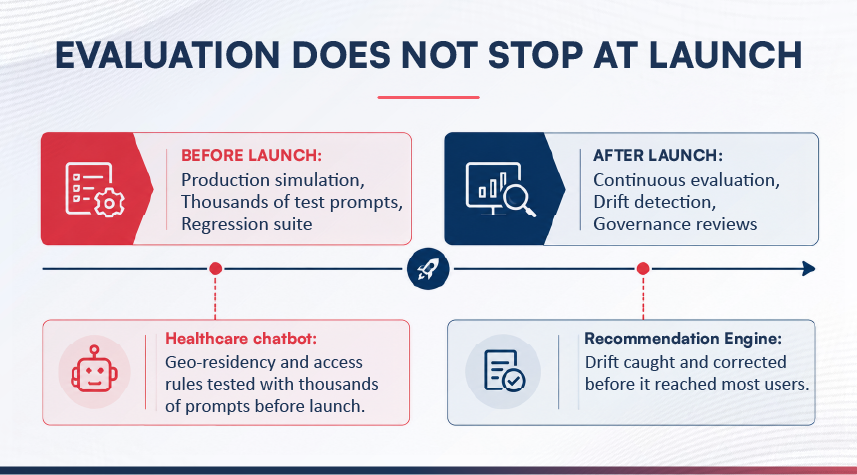
Evaluation-driven development means every agent and every change ships with proof of behavior, not just a good demo. For the healthcare chatbot, we built a production simulation that tested thousands of prompts before launch. Humans defined what correct looked like, and the machine checked it thousands of times.
Our goal was to break the old saying that AI projects work flawlessly until they hit production.
AI-Powered Payroll Decision Support: Building Trustworthy, Auditable AI for Federal Payroll Decision-Making
See how a federal payroll technology provider applied Rules-as-Code, mandatory source citations, and independent validation to reach at least 80% source-citation accuracy against a curated set of known-correct scenarios.
4. The Platform Blueprint: Agent Orchestration at Scale
Twenty disconnected point agents create more coordination work, not less. Scalable architecture and agent orchestration give teams one coordinated workflow and a shared layer of engineering agents that keeps quality consistent.
5. The Operations Blueprint: AI Agent Monitoring and Governance
Launch is not the finish line. One recommendation engine we built performed well at launch, then began to drift as new data flowed in. Because continuous monitoring and evaluation were in place, we caught and corrected the drift before it reached a large number of users. Today, our EvalPRO platform and GenAI Monitoring and Governance Blueprint make this continuous testing part of every managed engagement.
Operationalizing AI Governance for Skills Intelligence and Career Recommendations
See how a leading global digital learning platform provider placed AI-generated skills under curator approval, audit logs, and ongoing monitoring for drift and inconsistencies across career recommendations.
What Enterprise Technology Leaders Should Take Away
- Blueprints before models: Intent, control, and evaluation decide whether an agent works in production.
- Humans own correctness: Agents check it thousands of times; people define it.
- Production is a new kind of testing: Evaluation must continue after release.
Conclusion
AI-native engineering is how promising pilots become dependable products. The model supplies capability; the blueprints supply reliability. Harbinger’s AI-Native Product Engineering practice brings these blueprints, our domain expertise in HR and learning technology, and our evaluation platforms together in one path from strategy to scale. To design the blueprints for your next agent, talk to our experts at contact@harbingergroup.com.
Frequently Asked Questions
What does an AI-native SDLC include?
An AI-native SDLC is built on Evaluation-Driven Development. It covers several practices:
- Agent evaluation suite design
- Regression testing for agents
- Pre-release scenario testing
- CI/CD for agentic workflows
- Prompt and model versioning
What do managed AI operations cover after launch?
Managed AI operations keep production agents performing as models drift and usage patterns shift. They cover continuous performance monitoring, drift detection and correction, model and prompt tuning, cost and latency optimization, and on-call support for production agents.
Why do agentic platforms stall after the first use case?
Architectures built for a single agent break down as usage and use cases multiply. Scaling requires a few platform foundations designed from the outset:
- Agentic AI platform architecture
- Agent orchestration frameworks
- Multi-agent workflow design
- API and data layer design for agents
Should engineering, governance, and AI operations be planned separately?
Planning them separately creates gaps and rework. A single roadmap that brings engineering, governance, and managed AI operations together keeps every workstream aligned from strategy through scale.
Which HR and learning use cases can AI agents support?
mployee experience and culture, learning and skills intelligence, and people analytics. Grounding agents in Talent and Learning domain knowledge from day one produces materially more accurate outcomes than off-the-shelf tooling.
What is EvalPRO?
EvalPRO is Harbinger’s own platform for continuous monitoring, testing, and scoring of AI agents and models in production. It operationalizes Evaluation-Driven Development end to end.