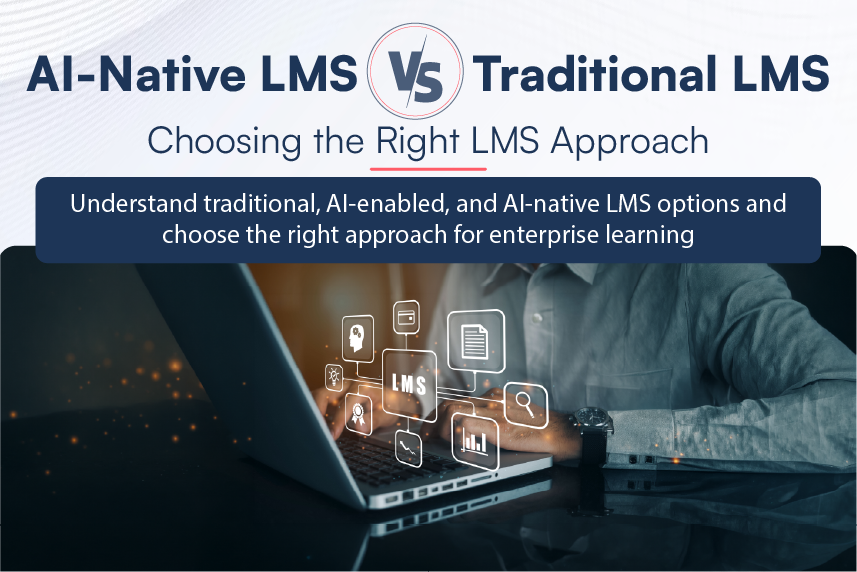
- Introduction: Why the AI-native LMS vs. Traditional LMS Debate Matters Now
- How AI Is Changing the Role of the LMS
- What Is a Traditional LMS?
- What Is an AI-native LMS?
- AI-native LMS vs. Traditional LMS: At a Glance
- Five Key Differences That Matter
- Assessing Your LMS’s AI-native Readiness: Seven Questions to Ask
- Common Misconceptions and Adoption Challenges
- Should You Replace Your Traditional LMS?
- Enterprise Decision Framework: Choosing the Right LMS Approach
- How to Prepare Your LMS for an AI-native Future: Harbinger’s Point of View
- Conclusion
- FAQs
Introduction: Why the AI-native LMS vs. Traditional LMS Debate Matters Now
Enterprise learning is undergoing a major transition as workforce needs, technologies, and business priorities are evolving rapidly. AI is constantly reshaping how employees work, learn, and access knowledge.
LinkedIn’s 2025 Workplace Learning Report found that 91% of surveyed learning and development professionals considered continuous learning more important than ever for career success.
Today, employees increasingly expect relevant learning, guidance, and recommendations within their workflows. To meet these expectations, learning systems must evolve to support changing business needs and faster capability development. This shift presents new challenges for learning leaders as they evaluate their existing systems and explore new approaches.
A traditional LMS manages essential operations, including enrollment, compliance, certifications, and course administration. An AI-native LMS integrates AI and context into the core learning architecture. Depending on its design and integrations, it can support contextual learning, enterprise knowledge access, adaptive experiences, and intelligent workflows. An AI-enabled traditional LMS offers a middle ground, adding selected AI capabilities to an existing system.
For technology and learning leaders, this is more than a software decision. It concerns how enterprise learning should evolve to support workforce capabilities and business goals.
How AI Is Changing the Role of the LMS
Traditional learning often follows a predictable sequence. For instance, an administrator assigns training, an employee completes the training, and the LMS records completion.
AI can help organizations make this model more responsive to learner needs and business priorities. Based on the available data and integrations, AI can help identify capability gaps and recommend targeted interventions. It can also support more adaptive learning experiences. This approach can help organizations connect capability development with workforce readiness and performance.
What Is a Traditional LMS?
A traditional LMS provides the operational foundation for managing learning. It organizes learning content and manages learner activity. It also supports structured training programs across the organization.
Common capabilities can include:
- Course catalog management
- Enrollment and assignment
- Learning paths
- Assessments and evaluations
- Certification management
- Compliance training
- Learner records
- Completion tracking
- Standard learning reports
- Instructor and administrator workflows
These capabilities remain essential for enterprise learning. They provide structure, consistency, and administrative control across regulated and structured programs.
What Is an AI-native LMS?
An AI-native LMS is a learning management system designed with AI, data, and contextual intelligence as foundational architectural capabilities rather than optional add-ons. Depending on its architecture and integrations, it may extend beyond traditional LMS functions to support adaptive learning, enterprise knowledge access, skills intelligence, and intelligent workflows.
Depending on the platform and available integrations, relevant context can include:
- Learner roles
- Skills and proficiency
- Learning history
- Business priorities
- Workflow activity
- Enterprise policies
- Standard operating procedures
- Performance data
- Assessment results
- Organizational permissions
For example, consider a compliance-heavy organization. Once the organization connects approved regulatory or policy sources to the learning ecosystem, a policy change may prompt a review of potentially affected content and learner groups. Based on the platform, AI can help identify relevant learning assets and recommend targeted interventions. Governed workflows may support assignments and notifications, while approvals and audit logs can help organizations maintain oversight. This example illustrates how AI-native capabilities may extend beyond routine learning administration.
AI-native LMS vs. Traditional LMS: At a Glance
| Evaluation Criteria | Traditional LMS | AI-enabled Traditional LMS | AI-native Learning Platform |
|---|---|---|---|
| Core model | Learning administration and course management | Traditional LMS with selected AI capabilities | Learning architecture designed to integrate AI and context |
| Personalization | Predefined rules and learner profiles | AI-supported recommendations | Can support context-aware personalization, depending on available data |
| Learning paths | Mostly predefined | AI can support recommendations | Can support adaptive pathways based on context |
| Knowledge access | Course and catalog focused | AI-supported search and retrieval | Can connect learning with approved enterprise knowledge |
| Content | Packaged learning assets | AI-assisted content capabilities | Can support contextual, reusable, AI-ready content |
| Analytics | Completion and engagement reporting | Enhanced analytics and recommendations | Can connect learning signals with relevant business-performance data, subject to integrations and permissions |
| Skills | Often separate or limited | AI-supported skills capabilities | Can integrate skills intelligence, depending on architecture and available data |
| AI role | Limited or add-on | Feature or capability layer | AI and relevant context can form part of the core architecture |
| Workflow | Human-led and rule-based | AI-assisted workflows | Can support governed, intelligent workflows |
| Governance | Platform security and access controls | AI controls added to existing architecture | Organizations can incorporate AI governance into the architecture |
| Business connection | Learning activity | Learning plus selected business signals | Can connect learning with relevant workforce and business data, subject to integrations and permissions |
In short, a traditional LMS prioritizes administration, an AI-enabled LMS adds selected capabilities, and an AI-native platform integrates AI and context into its core architecture. The right approach depends on business needs, existing investments, and readiness.
Example: Improving Sales Readiness
Consider an organization that wants to improve sales readiness. Its sales teams need product knowledge, negotiation skills, and timely guidance during customer interactions. Here is how the three LMS approaches could address this business need.
| Approach | How it could work |
|---|---|
| Traditional LMS | Assigns product and sales training, tracks assessments, and records completion. |
| AI-enabled traditional LMS | Recommends relevant courses based on learner profiles, assessment results, and available skills data. |
| AI-native learning platform | Can combine learner context, sales knowledge, skills data, and workflow signals to recommend targeted practice and support sales readiness, where integrations and permissions permit. |
The key difference is how much learner, sales, and workflow context each approach can use. Actual capabilities depend on the platform’s architecture, available data, integrations, and governance.
Five Key Differences That Matter
1. From Course Completion to Continuous Capability Development
Traditional LMSs often focus on course completion and participation. While useful for compliance, completion does not always demonstrate capability. Learning leaders can also assess proficiency, readiness, application, and performance, using relevant skills and business data where available.
2. From Static Learning Paths to Context-aware, Adaptive Learning
Traditional learning paths typically follow predefined rules and sequences. AI can support more adaptive learning pathways when the platform can access relevant data on skills, roles, goals, performance, and prior learning. For example, two sales employees may share the same role but have different needs. One may need negotiation practice, while another needs product knowledge. AI can use these differences to recommend more relevant learning experiences.
3. From Course Libraries to Enterprise-grounded Knowledge
Enterprise knowledge extends beyond courses into policies, SOPs, documentation, business applications, workflow systems, and collaboration platforms. Employees often need this information while performing their roles, not only while completing formal learning.
AI-native learning platforms can connect approved knowledge sources with learning experiences. They may use retrieval, metadata, permissions, and contextual signals to surface relevant information.
Consider a global organization with thousands of procedures. Employees may struggle to locate the latest approved guidance. An AI-enabled learning experience may surface relevant information and link it to required learning, provided the platform can access approved sources. This can make approved knowledge available closer to the point of need.
4. From Learning Analytics to Continuous Intelligence and Business Insights
Traditional LMS analytics typically show enrollment, completion, and assessment results. When integrations, data architecture, and permissions provide access to relevant signals, AI can analyze feedback, learner interactions, selected business-performance data, and workflow activity. These signals may help organizations identify emerging capability gaps and refine learning interventions. This can extend analytics beyond learning activity and inform learning and business decisions.
5. From AI Assistance to Governed, Intelligent Action
AI assistants can answer questions, summarize content, and provide recommendations. An AI-native learning platform may support governed actions when its architecture includes appropriate permissions and workflow controls. Depending on the use case, AI can help flag potentially outdated content, suggest learning pathways, or support targeted interventions. Organizations should define suitable permissions, approvals, security controls, traceability, and audit requirements for these actions.
Is Your LMS Really AI-native? Seven Questions to Ask
Before investing in an AI-native LMS, learning leaders should assess more than visible AI features. These questions can help determine whether AI is added as a standalone feature or integrated into the learning ecosystem.
Assess Your LMS’s AI-native Readiness: Seven Questions to Ask
- Does AI operate across core learning workflows?
- Can the platform understand learner and organizational context?
- Can it use approved enterprise knowledge for recommendations?
- Can it connect learning signals with skills and business outcomes?
- Can it support governed actions across learning workflows?
- Can the organization audit, explain, and govern AI decisions?
- Does the AI improve through governed feedback and changing enterprise context?
Common Misconceptions and Adoption Challenges
Misconception 1: Adding a Chatbot Makes an LMS AI-native
A chatbot can improve information access, but it does not really change the underlying platform architecture. AI-native learning involves broader considerations, including integration, context, governance, and continuous feedback.
Misconception 2: AI-native Means Replacing the Existing LMS
An AI-native approach does not automatically require a full LMS replacement. Organizations can extend existing systems when targeted AI capabilities and integrations meet their needs.
Misconception 3: AI Can Fix Poor Content Automatically
AI alone may not address weaknesses in content foundations or outdated knowledge. Poor metadata can reduce retrieval quality, while outdated content can affect the relevance of AI-generated responses. Organizations benefit from structured content, clear metadata, and appropriate governance as they scale AI capabilities.
Adoption Challenge 1: Fragmented Enterprise Data: Learning data often exists across multiple systems. Connecting these sources calls for a well-planned integration architecture.
Adoption Challenge 2: Governance and Trust: Enterprise AI needs clear governance from the beginning. Organizations need defined permissions, validation, and audit mechanisms.
Adoption Challenge 3: Integration Complexity: AI-native learning may involve multiple systems, including HRIS, CRM, talent, and workflow platforms. Connecting them requires suitable integration architecture, appropriate APIs, and compatible data flows.
Should You Replace Your Traditional LMS?
For many enterprises, a gradual transition may be more practical than replacing the entire LMS. The existing platform can continue managing structured learning, compliance, enrollment, certifications, and reporting. Organizations can add AI capabilities for personalization, enterprise knowledge access, skills intelligence, or workflow integration where these address specific needs. They can then modernize further as data architecture, business priorities, and AI readiness evolve.
Enterprise Decision Framework: Choosing the Right LMS Approach
Use the framework below to match business needs with the capabilities and architecture required to address them.
| Business Scenario | Capabilities to Consider | LMS Approach to Consider | Potential Business Value |
|---|---|---|---|
| Learning requires personalization and adaptive experiences | Learner context, skills-based recommendations, adaptive pathways | AI-enabled traditional LMS or AI-native learning platform | More relevant learning experiences |
| Skills gaps change rapidly | Skills intelligence, proficiency data, gap analysis, recommendations | AI-enabled traditional LMS with skills capabilities | Faster identification of capability needs |
| Knowledge is fragmented across the enterprise | Knowledge integration, retrieval, metadata, permissions, contextual access | Traditional LMS with AI knowledge capabilities or AI-native learning platform | Faster access to trusted knowledge |
| Employees need learning within workflows | Embedded learning, contextual guidance, performance support, workflow integration | AI-enabled LMS or AI-native learning platform | Timely support within the flow of work |
| Learning must connect with business systems and signals | APIs, integrations, connected data, appropriate permissions | Modernized LMS or AI-native learning platform | Better connection between learning and business context |
| Leaders need deeper capability insights | Learning analytics, skills intelligence, business-data integration | Analytics-enhanced LMS or AI-native learning platform | Better visibility into capability needs |
| Leaders need deeper capability insights | Learning analytics, skills intelligence, business-data integration | Analytics-enhanced LMS or AI-native learning platform | Better visibility into capability needs |
| Learning remains structured and compliance-focused | Course management, certifications, compliance tracking, reporting | Traditional LMS may remain sufficient | Reliable administration and oversight |
| AI adoption remains experimental | Targeted AI features, controlled pilots, governance controls | Traditional LMS with targeted AI | Controlled experimentation without immediate replacement |
Three Questions to Ask Before Replacing Your LMS
- Which business problem cannot be adequately addressed by the current platform? Identify the specific capability gap and its impact on learning or business outcomes.
- Can the required intelligence be introduced through integrations or an additional AI layer? Assess whether extending the existing architecture can address the gap.
- What would a new AI-native architecture enable that incremental modernization cannot? Compare the potential benefits with the costs, complexity, governance requirements, and risks of replacing the current system.
How to Prepare Your LMS for an AI-native Future: Harbinger’s Point of View
Preparing for AI-native learning starts with the foundations around the LMS: content, knowledge, skills, integrations, and governance. Harbinger recommends assessing five areas before selecting technologies or setting priorities:
1. Strengthen Content Infrastructure for AI
AI-ready content infrastructure benefits from structured content, metadata, taxonomy, version control, traceability, permissions, and governance. These foundations can support better content discovery, retrieval, reuse, and contextual delivery. Organizations can assess their content infrastructure through a Content Intelligence Infrastructure Assessment before scaling AI initiatives.
2. Establish Enterprise Knowledge Architecture
Identify relevant enterprise knowledge sources and define which sources AI can access and use. Apply permissions and governance across those sources to support appropriate and traceable knowledge access.
Making enterprise knowledge available to AI is only one part of the challenge. Organizations also need to determine which learner, role, workflow, content, and business context should be assembled for a particular interaction. This context layer can help AI deliver more relevant responses while respecting permissions and enterprise governance.
3. Strengthen Skills Intelligence
Connect roles, skills, learning, and proficiency data where the architecture supports it. These connections can provide better context for capability recommendations and workforce development decisions.
4. Modernize Integration and Workflow Architecture
Connect the LMS with relevant HRIS, talent, performance, CRM, and collaboration systems through APIs and appropriate data flows. A suitable integration architecture supports connected learning experiences.
5. Embed Responsible AI Governance
Define AI permissions, approval workflows, audit requirements, and explainability expectations early. Align these controls with the organizational risk, security, and governance requirements.
Conclusion
Choosing between an AI-native LMS and a traditional LMS depends on your organization’s learning needs, existing technology, and business goals. The right approach should balance innovation with practical requirements. Successful modernization aligns learning strategy, content, technology, and governance with business goals.
Harbinger combines learning consulting, content engineering, AI, product development, and enterprise technology expertise to help organizations assess their needs and plan next steps.
Explore Harbinger’s enterprise learning capabilities to understand how learning strategy, content, technology, and AI can work together. Contact us at contact@harbingergroup.com to discuss your learning modernization priorities or visit https://www.harbingergroup.com/contact-us/.

Additional Perspectives on the FDE Model
Forward-deployed engineering is gaining attention as a way to bring engineers closer to customer problems and real-world implementation. Several organizations describe this model as a way to align engineering work with customer needs, systems, and workflows. Here are a few resources that offer additional perspectives on the FDE model:https://www.griddynamics.com/glossary/forward-deployed-engineering
https://miragemetrics.com/guides/forward-deployed-engineering
https://www.cognizant.com/us/en/glossary/forward-deployed-engineer
Frequently Asked Questions (FAQs)
What is an AI-native LMS?
An AI-native LMS places AI and context within the learning architecture. It can support capabilities such as adaptive learning, contextual knowledge access, and intelligent workflows. The depth of these capabilities varies by platform.
What capabilities distinguish an AI-native LMS from a traditional LMS?
A traditional LMS primarily manages course delivery, enrollment, compliance, and reporting. An AI-native LMS can support contextual learning, adaptive pathways, enterprise knowledge access, and skills intelligence. These capabilities depend on the platform’s architecture, data access, integrations, and governance.
How is an AI-native LMS different from an AI-powered LMS?
An AI-powered LMS typically adds selected AI capabilities to an existing LMS. An AI-native LMS is designed with AI and relevant context integrated into its core learning architecture. The distinction depends on the platform’s architecture and how deeply AI capabilities are integrated.
Does an AI-native LMS replace a traditional LMS?
Not necessarily. Organizations can extend an existing LMS with targeted AI capabilities. They can also modernize their architecture incrementally based on business and technology requirements.
Can an existing LMS become AI-enabled?
Yes, based on its architecture, integrations, data access, and extensibility. Organizations can add selected AI capabilities without immediately replacing the core LMS.
What should enterprises evaluate before adopting an AI-native LMS?
Organizations should evaluate content infrastructure, enterprise knowledge, skills data, integrations, governance, security, and AI readiness. They should also define the business outcomes they want to support.
What role does content readiness play in AI-native learning?
Content readiness affects how effectively AI can discover, retrieve, connect, and reuse enterprise knowledge. Structured content, metadata, taxonomy, traceability, permissions, and governance provide important foundations.
How can organizations prepare their existing LMS for AI-native capabilities?
Organizations can strengthen content infrastructure, structure enterprise knowledge, connect relevant skills data, modernize integrations, and establish AI governance. This creates a foundation for introducing AI capabilities incrementally without immediately replacing the existing LMS. Harbinger Group can help organizations assess their readiness and define a modernization roadmap aligned with their learning and business goals.