


Table of Contents
- Introduction
- Why Digital Publishing Initiatives Get Stuck Between Technology and Content
- What Is Forward-deployed Engineering and Why Now?
- Why Forward-deployed Engineering Matters for Digital Publishing
- A Practical Framework: When Should Digital Publishers Consider Forward-deployed Engineering?
- How Harbinger Combines FDE, Product Engineering, and Content Expertise
- Conclusion: Bring Technical Ownership Closer to the Problem
Introduction
Digital Publishing Challenges Don’t Stop at System Boundaries
Let’s consider a scenario.
A digital learning publisher wants to launch a new learning experience across multiple customer platforms. This could mean introducing new courses, updating existing learning content, or improving how learners access materials through different LMS platforms. Such an initiative requires coordination across legacy content, metadata, platform integrations, and customer-specific requirements.
The content team manages learning materials, engineers develop the platform, and integration specialists connect customer systems. Each team handles its responsibilities, but dependencies across these areas create some coordination challenges.
Digital publishing and eLearning leaders often face similar challenges when they launch new offerings or update existing platforms. They need to align content, technology, and customer requirements throughout delivery.
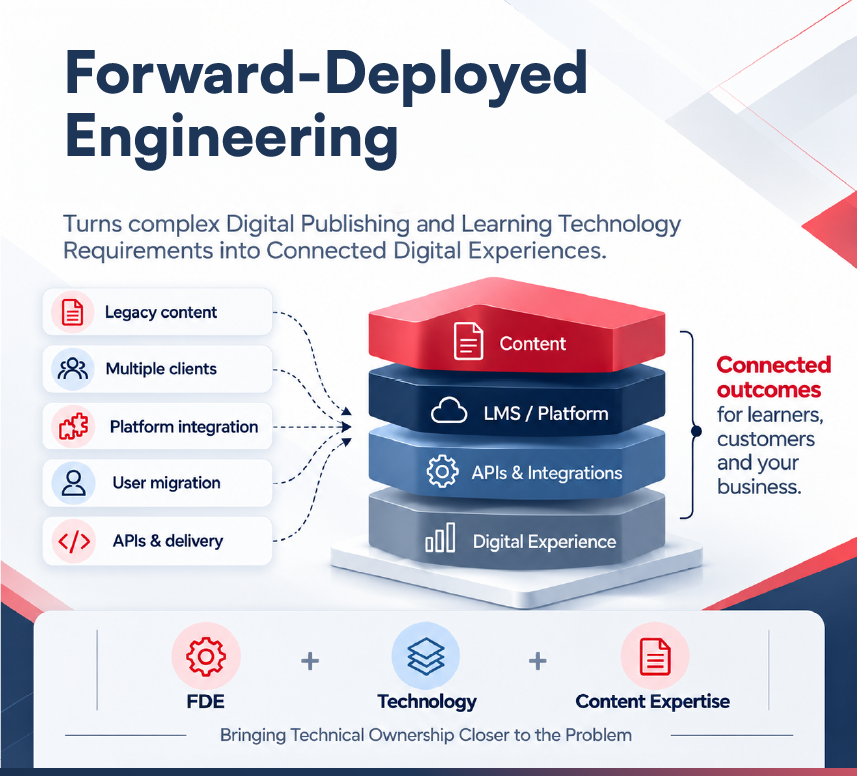
Forward-deployed engineering (FDE) offers an approach to address these challenges. It brings engineering closer to the business problem and its operating environment. Teams can then address interconnected requirements with greater clarity around ownership.
Why Digital Publishing Initiatives Get Stuck Between Technology and Content
Digital publishing ecosystems often connect content repositories, learning management systems (LMSs), APIs, and customer platforms. These components must work together to support the intended experience.
Three challenges given below can complicate delivery:
1. Disconnected Ownership
Product, engineering, and content teams often manage separate deliverables, and the dependencies between them create extra coordination work. For example, a platform update may require changes to content structures and publishing workflows. Without alignment across teams, those changes can delay releases or leave content out of sync with the platform.
2. Interdependent Systems
Publishers often manage legacy repositories alongside modern platforms. A single initiative may involve content migration, metadata mapping, user access, and customer-specific integrations. As the market shifts toward platform modernization and composable architectures, cross-platform planning becomes increasingly important for digital publishing leaders.
3. Requirements That Emerge During Implementation
Initial requirements may not capture every operational constraint. Customer environments can introduce integration challenges, and existing content structures may limit new functionality. Teams need a clear process for identifying dependencies and resolving ownership gaps. Adding engineering resources alone may not address these challenges.
The key consideration is how teams coordinate technical and content decisions throughout delivery. Addressing these challenges calls for a delivery model built around shared ownership of the problem, which is where FDE comes in.
What Is Forward-Deployed Engineering and Why Now?
Forward-deployed engineering is getting renewed attention as technology companies look for better ways to move complex AI and software initiatives from prototype into real operating environments. The model itself is straightforward: put experienced engineers close to the customer problem, give them enough context to help shape the solution, not simply implement a predefined backlog, and keep them involved through delivery.
For digital publishers, however, there is another dimension. The operating environment includes not only applications and infrastructure, but content models, metadata, learning standards, entitlements, publishing workflows, and customer learning ecosystems. That wider scope is what sets FDE apart from traditional delivery models, as the comparison below shows. The difference is less about who does the work and more about who owns the problem.
| Traditional augmentation | Forward-deployed engineering |
|---|---|
| Adds skills/capacity | Adds problem ownership |
| Usually starts with a backlog | Can help shape the backlog |
| Works mainly inside technical scope | Works across business, technical, and operating dependencies |
| Success measured by output/tasks | Success tied to a defined working outcome |
| Handoffs to specialists | Pulls specialists into the problem as needed |
| Requirements largely predetermined | Requirements can emerge during implementation |
Why Forward-Deployed Engineering Matters for Digital Publishing
In digital publishing, the hardest problems rarely sit inside a single system. They sit in the dependencies between systems, and that is where forward-deployed engineers add the most value. Instead of relying on sequential handoffs, they work alongside product, platform, and content teams to clarify requirements, examine existing systems, and resolve implementation dependencies. To see why, consider how many links a single feature can touch.
A single feature, for example, can depend on:
Content structure and versioning → Metadata and taxonomy → Rights and entitlements → SCORM/LTI/xAPI/QTI behavior → Identity → APIs → Customer LMS/LXP → Analytics → Accessibility and localization → Application experience
A break at any point in that chain can undermine the experience, and no single team usually sees the whole chain. That is why this kind of work needs engineers who understand learning-product design and publishing workflows, not just software delivery.
Connecting Technology and Content Expertise
Technology teams manage platform development, APIs, integrations, scalability, and performance. Content specialists understand content structure, learning design, localization, accessibility, and publishing workflows. FDE brings these disciplines together around a single problem, with one team accountable for the working outcome.
Consider an eLearning publisher developing AI-powered content search. The team needs to address several requirements beyond the search interface. It needs authoritative content, accurate metadata, appropriate access permissions, and current source material. It also needs to evaluate answer quality and manage incorrect responses.
These requirements span content governance, data, and platform engineering. Forward-deployed engineers can work with relevant specialists to address these dependencies during implementation. FDE does not replace existing product or engineering teams. It brings additional focus to the problem, its requirements, and the working outcome.
A Practical Framework: When Should Digital Publishers Consider Forward-deployed Engineering?
Forward-deployed engineering may suit initiatives with complex dependencies across teams, platforms, and content workflows. Leaders can assess their roadmaps using the following framework:
| Roadmap challenge | Question to ask | Potential FDE contribution |
|---|---|---|
| Legacy content modernization | Does the initiative require coordination across content, metadata, and workflows? | Coordinate content and platform dependencies. |
| Multi-client delivery | Does the platform need to support different customer environments? | Address customer-specific integration requirements. |
| LMS or platform migration | Do existing learning experiences and integrations need to continue working? | Connect migration, APIs, and user requirements. |
| AI-powered search | Does the experience depend on authoritative content, metadata, permissions, freshness, retrieval, and evaluation? | Coordinate content, data, AI, and platform dependencies. |
Decision-makers can also ask three questions:
- Does the initiative span multiple teams, systems, or content workflows?
- Are requirements or dependencies still emerging?
- Would closer engineering ownership help the team manage these dependencies?
These questions can guide an initial assessment. Teams with clear requirements, established architecture, and defined ownership may need a different delivery approach.
How Harbinger Combines FDE, Product Engineering, and Content Expertise
Harbinger Group combines forward-deployed engineering with product engineering and content expertise. Its digital publishing solutions and eLearning content services address requirements across platforms, integrations, and learning content.
For example, Harbinger helped an alternative-investment learning platform migrate legacy content to Adobe Learning Manager. The initiative also involved multi-client delivery, user migration, headless LMS architecture, and APIs. Harbinger addressed these connected requirements across content migration and platform integration.
With 35+ years of experience in eLearning, Harbinger brings the expertise needed to navigate complex learning technology initiatives. Its teams can help publishers assess roadmap priorities, identify dependencies, and evaluate whether FDE suits their requirements.
Have an initiative spanning content, platforms, and integrations? Connect with Harbinger to explore how its expertise can support your goals.
Before your next modernization initiative, assess whether your content infrastructure can support your goals. Explore our Content Intelligence Infrastructure Assessment to understand your content readiness and identify areas for improvement.
Conclusion: Bring Technical Ownership Closer to the Problem
Forward-deployed engineering can help digital publishing and eLearning leaders address complex dependencies across content, platforms, and integrations through closer engineering ownership and collaboration. Harbinger combines product engineering and content expertise to help organizations evaluate their requirements and explore suitable solutions. For more, book a consultation with us: Visit our contact page or email contact@harbingergroup.com.