

Enterprises don’t have a shortage of data. Customer interactions sit in CRM platforms. Employee information resides in HR information systems. Financial and operational data lives in ERP applications. Performance systems capture goals and outcomes. Learning platforms contain training and skill-development signals. Beyond these structured systems sits an even larger universe of documents, policies, meeting transcripts, call recordings, emails and organizational knowledge.
Yet as enterprises accelerate their adoption of Generative AI and agentic AI, an important reality is emerging:
Having enterprise data does not mean that enterprise data is ready for AI.
Recent industry research reinforces the scale of the challenge. McKinsey reports that more than two-thirds of high-performing companies identify data as the primary obstacle to enabling AI. Accenture’s 2026 research found that only 7% of surveyed organizations had progressed far enough in building the data capabilities required to scale advanced AI.
Traditional enterprise data strategies have focused primarily on making information available to applications, analysts and dashboards. AI introduces a different requirement.
AI must find the right information, understand its business meaning, establish whether it can be trusted, connect it with other relevant signals, respect enterprise access boundaries and ultimately use that intelligence to recommend or initiate action.
The challenge is no longer just making data available. It is making enterprise context understandable to AI.
What is AI-ready data?
AI-ready data is enterprise data that AI can find, interpret in its business context, verify for quality and trust, connect with related signals, and use within defined access boundaries. Readiness depends on the specific use case, which makes it a business decision as much as a technical one.
For enterprise technology leaders, AI readiness means connecting trusted data, business context, and governance to support reliable decisions and measurable business outcomes.
Why Data Built for Dashboards Falls Short for AI
Consider an organization with a mature data platform. CRM information flows into a warehouse, HR information is synchronized regularly, financial data feeds executive dashboards and leaders have access to sophisticated analytics.
Now ask an AI system:
“Why is the conversion rate of this sales team declining, and what should we do about it?”
Answering that question requires much more than retrieving a conversion number.
The AI may need to understand which employees belong to the team, their roles and tenure, pipeline and stage-level conversion, customer interactions, historical performance, skills, recent learning activity and coaching history.
It must understand how those signals relate, which sources are trustworthy, how current the information needs to be and what the requesting user is authorized to access.
That is the difference between data-ready and AI-ready.
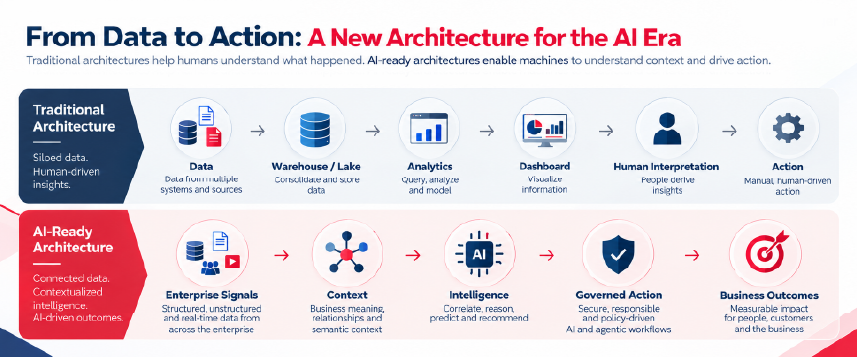
Traditional analytics helps humans interpret data. AI-ready architectures must increasingly enable machines to understand enterprise context and use it responsibly.
Why AI Readiness Should Start with a Specific Business Use Case
Making enterprise data AI-ready should not mean launching a multi-year program to clean, consolidate and restructure every dataset in the organization.
AI readiness is use-case specific.
Gartner emphasizes that there is no way to make data generically AI-ready in advance. Readiness depends on how the data will be used, and each AI use case brings different requirements for data, metadata, semantics, quality and governance.
- A sales effectiveness use case may require CRM, performance, learning and employee signals. Succession planning may require skills, experience, performance and career data.
- A customer-support agent may depend on customer history, service interactions and product documentation.
Each has different requirements for accuracy, freshness, context and permissions.
The better starting question is therefore not:
“How do we prepare all our enterprise data for AI?”
It is:
“What data and context does AI need to solve this business problem?”
This makes AI readiness more achievable and connects investment directly to measurable business outcomes.
Four Capabilities That Turn Enterprise Data into Context AI Can Use
Three forms of information become particularly important for enterprise AI.
- Structured signals come from systems such as CRM, ERP, HRIS, performance management, LMS and project platforms.
- Unstructured knowledge resides in documents, policies, proposals, emails, transcripts, call recordings and other enterprise content.
- Business context explains how all of these relate: who owns an account, which employee performs which role, which skills matter to that role, which activity influenced an outcome, and which policies govern a decision.
AI needs all three, but scaling AI requires structured and unstructured information to form a governed, traceable, and reusable foundation. It also requires richer context, including semantic meaning, entities, and the relationships between them.
This leads to four critical capabilities.
1. Connect the Data Sources Each AI Use Case Needs
Enterprise intelligence is distributed by design.
CRM understands customers and opportunities. HRIS understands employees and organizational structures. Performance systems understand goals and outcomes. Learning platforms understand development. ERP understands transactions.
But business problems rarely respect those application boundaries.
Improving sales performance may require CRM, performance, skills and learning information simultaneously. Workforce planning may require project demand, employee capacity, skills, recruitment and financial information.
AI readiness therefore starts by connecting the signals relevant to the use case.
The goal is one accessible enterprise context, whether or not the data sits in one database.
2. Add Business Meaning with Semantic Models and Knowledge Graphs
Connectivity alone does not create intelligence.
An AI system may have access to employee profiles, skills, roles, projects, customer information, opportunities, performance feedback and learning records. However, accessing these data points individually does not tell AI how they are connected or what they mean in a business context.
For example, understanding that an employee has specific skills, performs a particular role, works on certain projects, supports customers, contributes to opportunities, receives performance feedback and completes relevant learning creates a much richer picture than any of these records in isolation.
These relationships transform fragmented enterprise data into business context that AI can understand and reason over.
Semantic models, metadata, ontologies and knowledge graphs can help establish this meaning and define relationships across enterprise information. Retrieval techniques such as RAG can then bring the most relevant knowledge and context into an AI interaction when needed.
The distinction matters: AI doesn’t simply need more records. It needs meaning.
From Learning Delivery to Workforce Capability: Building AI-Powered Skills Intelligence
A US-based educational technology company needed to help enterprise customers move beyond tracking learning activity. Harbinger built an AI-powered skills intelligence layer that connected roles, skills, proficiency indicators, learning resources, and career pathways through a structured skills ontology.
3. Govern What AI Can See, Infer, Recommend, and Do
Enterprise data is rarely perfect. Information may be outdated, duplicated or inconsistent. Different systems may contain conflicting values, and different business units may even define the same KPI differently.
AI amplifies these problems because it can generate highly convincing recommendations from incorrect information.
AI-ready data therefore requires signals around quality, freshness, source, ownership, lineage and confidence.
The question changes from:
“Can AI access this information?”
to:
“Should AI trust this information?”
Governance must also extend beyond storage. AI dynamically retrieves, combines and generates information. GenAI applications introduce many more data interactions than conventional applications, requiring security, privacy and access policies to operate as part of the AI interaction itself. Modern governance approaches are similarly extending controls from tables and files to models, functions and other AI assets.
Organizations therefore need to govern:
- What can AI see?
- What can AI infer?
- What can AI recommend?
- What can AI do?
As AI progresses from answering questions to taking actions, runtime governance and human oversight become essential.
AI Governance for Workforce Decisions: How a B2B Software Company Put AI to Work Without Losing Control of People, Access, and Roles
See how a B2B software company brought AI into workforce decisions while keeping governance controls on people data, access, and roles.
4. Use Connected Signals to Recommend and Trigger Action
Better search is a byproduct. The ultimate purpose of AI-ready enterprise data is better action.
AI creates an opportunity to move through a richer intelligence chain:
Retrieve → Understand → Reason → Recommend → Act → Learn
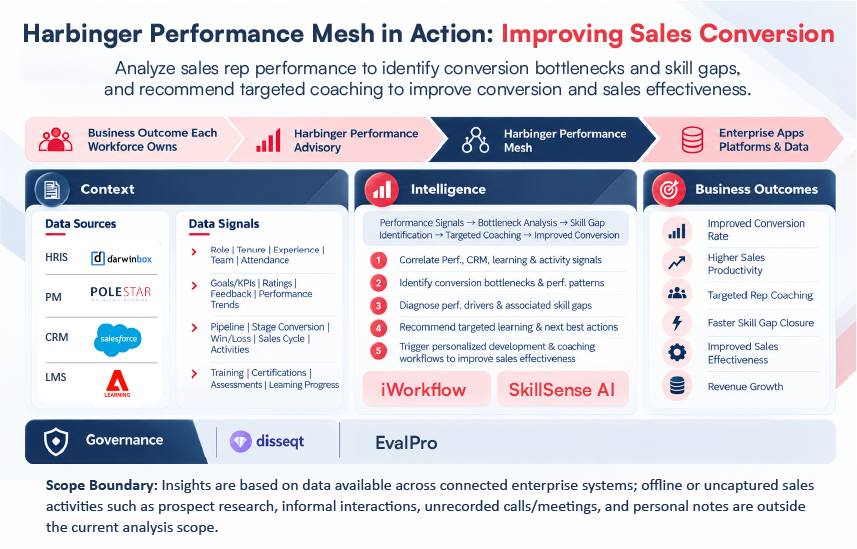
Consider a sales organization trying to improve conversion.
Signals may come from:
- HRIS: Role, tenure, experience and team context
- Performance Management: Goals, KPIs, feedback and performance trends
- CRM: Pipeline, conversion, win/loss, sales cycles and activities
- Learning & Skills: Competencies, training, assessments and learning progress
An intelligence layer can correlate these signals to identify conversion bottlenecks, determine likely performance drivers, identify associated skill gaps and recommend targeted learning, coaching or next-best actions.
Instead of simply informing a manager:
“Conversion is below the team average.”
AI can help answer:
“Where is conversion breaking down? What is likely contributing to it? What intervention should happen next?”
Agentic workflows can then initiate appropriate coaching or learning interventions with the required governance and approvals.
How Outcome Feedback Improves Future AI Recommendations
The process shouldn’t end when an AI recommendation is executed. Suppose AI identifies a sales skill gap and recommends targeted coaching. The coaching occurs. Rep behavior changes.. Customer interactions change. Conversion may improve or it may not.
Those outcomes create new enterprise signals. The system can then use that feedback to improve the context and future recommendations.
This creates a continuous intelligence loop:
Signals → Context → Intelligence → Governed Action → Outcomes → Learning
This is an important evolution from traditional analytics. Enterprise data no longer simply describes what happened. It becomes part of a continuously improving system that connects what happened, why it happened, what should happen next and whether the intervention worked.
Why Enterprise AI Needs a Layer Above Systems of Record
Enterprise technology has historically been organized around systems of record.
CRM owns customer information. HRIS owns employee information. ERP owns transactions. LMS owns learning. Performance platforms own performance information and so on. These systems remain essential. But enterprise AI requires another layer capable of understanding and reasoning across them.
Harbinger describes this layer as a Performance Mesh.
A Performance Mesh connects business signals across systems, adds the context and governance AI needs to reason over them, and activates that intelligence through AI-powered recommendations and agentic workflows.
Its purpose is not simply to make enterprise information searchable. It is to connect enterprise intelligence to measurable performance outcomes.
How Harbinger’s Performance Mesh Turns Enterprise Signals into Action
Harbinger Performance Mesh is an enterprise intelligence fabric designed to connect business signals across enterprise systems, add the context and governance AI needs to reason over them, and activate intelligence through recommendations and agentic workflows to improve measurable business performance.
The architecture brings together:
- Context: connecting enterprise data sources and transforming fragmented information into meaningful business signals and relationships.
- Intelligence: correlating signals to identify patterns, bottlenecks, opportunities, risks and likely drivers, while determining next-best actions.
- Governance: ensuring intelligence operates within appropriate access, privacy, validation, explainability and human-oversight boundaries.
- Agentic Action: translating intelligence into workflows and interventions across enterprise applications.
- Learning: capturing outcomes and feeding them back into the intelligence layer to continuously improve future decisions.
The result is a continuous flow, and the same pattern can support multiple enterprise use cases, from sales effectiveness and employee productivity to internal talent mobility, succession planning, and strategic workforce optimization.
Different business problems require different signals. But the pattern remains consistent:
Connect the right signals. Establish context. Apply intelligence. Govern its use. Trigger action. Measure the outcome. Learn.
Why Enterprise Context Will Differentiate AI More Than Model Choice
Foundation models will continue to become more powerful and widely accessible. That means sustainable enterprise differentiation is unlikely to come simply from choosing the most capable model. It will increasingly come from what surrounds that model:
- Your enterprise data.
- Your business context.
- Your relationships.
- Your institutional knowledge.
- Your governance.
- Your workflows.
Most enterprises already possess these assets. The opportunity is to make them usable by AI. The journey therefore moves beyond being data-rich to being AI-ready.
Building the Foundation for Enterprise AI That Performs
The real opportunity is transforming fragmented enterprise signals into contextualized, governed and actionable intelligence that continuously improves workforce and business performance.
The next generation of enterprise AI will go beyond answering questions with enterprise data. It will understand the enterprise context, act on it responsibly and help the enterprise perform better.
Harbinger helps enterprises connect data, establish business context, and build governed AI capabilities that drive measurable business outcomes. Talk to our experts about the use case to start with.
Frequently Asked Questions
What is the difference between a data warehouse and a knowledge graph for enterprise AI?
A data warehouse stores structured data in tables optimized for reporting and analysis. A knowledge graph stores entities and the relationships between them, such as an employee, a role, a skill, and a customer account. Enterprise AI often uses both, with the warehouse supplying facts and the graph supplying business meaning.
How does retrieval-augmented generation (RAG) use enterprise data?
RAG retrieves relevant enterprise content, such as policies, documents, or records, at the moment a user asks a question and passes it to a large language model as context. The model then generates a response grounded in that content, which reduces reliance on its general training data and keeps answers closer to enterprise sources.
What is data lineage, and why does it matter for AI?
Data lineage traces where data originated, how it was transformed, and which systems it passed through. For AI, lineage helps teams explain how a recommendation was produced, identify the source of an incorrect output, and assess whether the underlying data meets the quality and compliance requirements of the use case.
What role does metadata play in AI-ready data?
Metadata describes data: its owner, definition, source, update frequency, sensitivity, and approved uses. AI systems rely on metadata to locate the right information, interpret what a field means, apply access rules, and judge whether data is current enough for a given decision.
What is a skills ontology, and how does it support workforce AI?
A skills ontology is a structured model that defines skills, proficiency levels, and how skills relate to roles, learning resources, and career pathways. It gives AI a consistent vocabulary for analyzing workforce capability, identifying gaps, and recommending development aligned with current and future role requirements.
How can HR and learning data support AI-driven workforce decisions?
When role information, skills, proficiency indicators, learning activity, and assessment signals are connected, AI can surface capability gaps, development priorities, and readiness for new roles. Organizations can then align learning investments with workforce needs rather than tracking course completion alone.