


Enterprise HR systems were traditionally built to manage transactions; they were never designed to manage rapid transformation. As technical skills face a shrinking half-life and workforce capacity erodes under digital overload, the limitations of legacy HR infrastructure have become a direct operational liability.
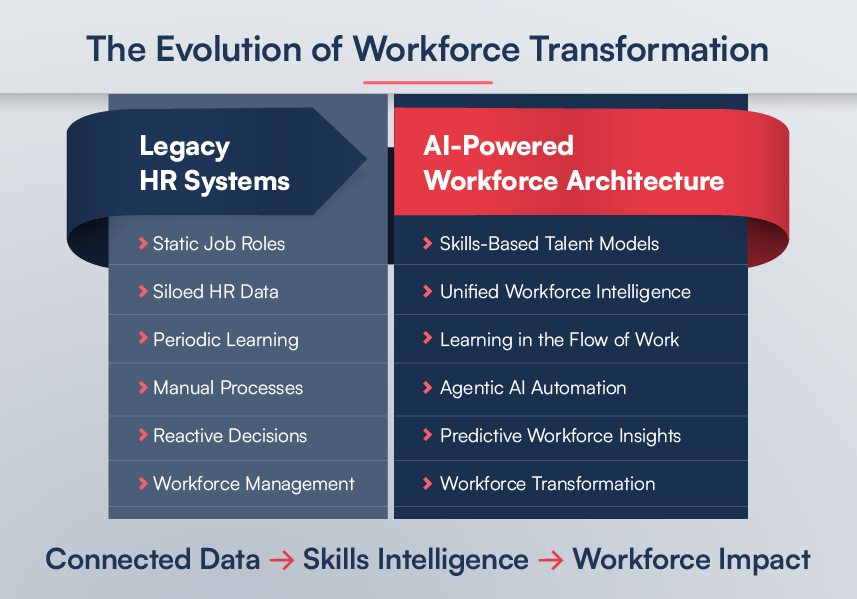
AI solutions and technologies in HR Tech are closing this gap, but not through incremental feature upgrades. The organizations generating measurable enterprise outcomes are rebuilding their HR architecture around intelligence: dynamic skills systems, agentic workflow execution, and learning embedded in the work itself. Current market research confirms that while a large majority of organizations now use AI in at least one business function, only a small fraction report meaningful impact at the business performance level. That gap is not a technology failure. It is an architectural failure.
For North American CHROs, CTOs, and transformation leaders, the strategic priority has shifted from simple AI adoption to architectural readiness. The core challenge is no longer whether to invest in AI, but whether the organizational infrastructure can operationalize it. This transition requires a partner at the intersection of Work, Learning, and Engineering to bridge the gap between consultative insight and technical execution.
Why Traditional HR Systems Have Reached Their Limits
Legacy HR systems are failing because they are structural relics of a slower business era. Three critical forces are rendering traditional infrastructure insufficient:
- Skills Obsolescence Velocity: Core workforce skills are changing rapidly. Static content libraries cannot keep pace with the requirements of modern digital business.
- Workforce Capacity Failure: While productivity must increase, a large percentage of the global workforce lacks the time or energy to meet current demands. This is a structural capacity problem that record-keeping systems cannot solve.
- Data Architecture Fragmentation: Skills data often sits in the recruitment system, learning history in the learning platform, and workforce records in the primary HR system. AI cannot deliver true intelligence when the underlying data is siloed and disconnected.
The result is that organizations investing in AI point solutions on top of fragmented architectures are generating activity, not outcomes.
Talent Transformation: Moving to a Skills-First Operating Model
Harbinger helps organizations navigate this Skills Economy by moving away from static roles toward dynamic, skills-driven strategies built on four operational foundations.
- Unified Capability Layer: Build a unified data layer across the HRIS, ATS, and LMS to map available skills and identify gaps before they impact performance.
- POLESTAR CPM (Award-Winning Innovation): Recognized with the HR Tech & AI Innovation Award 2026, POLESTAR CPM helps organizations move beyond traditional annual appraisals. It enables transparent, feedback-driven processes through real-time feedback and AI-powered assistance, fundamentally improving manager-employee conversations.
- AI-Driven Workforce Diagnostics: Use AI to map role-displacement risks and redesign job architectures, ensuring reskilling priorities are defined before disruption outpaces response.
- Modular Content Readiness: Ensure learning content is modularized and skill-tagged, making it “AI-consumable” for modern talent ecosystems.
Workforce Enablement: The New Execution Infrastructure
AI’s highest enterprise value lies in workforce enablement. This is the discipline of ensuring people have the right knowledge, support, and capability at exactly the moment they need them.
- iContent Framework (Award-Winning Automation): A Brandon Hall Gold Award winner, this proprietary framework modernizes legacy content libraries. It transforms static assets into micro-learning “nudges” and conversational prompts, reducing SME revision time and accelerating development cycles.
- The “Frontier Firm” Model: Shift to a standard operating model that enables human-AI teams to collaborate. AI agents act as proactive collaborators, capturing requirements and detecting gaps in real-time.
- Learning in the Flow of Work: Deliver contextual knowledge and coaching prompts inside daily tools (Slack, Teams, etc.), turning episodic training into continuous capability transfer.
How Harbinger’s AI Solutions Improve Business Operations Across HR
A multinational investment bank partnered with Harbinger to build an AI-powered onboarding ecosystem. By connecting legacy infrastructure to agentic frameworks, the bank reduced employee query resolution time from hours to 15 minutes. New hire readiness improved significantly, allowing high-cost HR specialists to reallocate capacity to workforce strategy.
Strategic Guidance for Software Technology Vendors (B2B SaaS)
For B2B Software Vendors, AI is no longer a feature; it is the new baseline for market differentiation. Vendors must evolve products from “Systems of Record” to “Systems of Workforce Intelligence.”
- AI-Led Product Engineering: Leverage AI agents within the software development lifecycle for automated bug detection, code optimization, and security-first development.
- Accelerated Time-to-Market: Use agentic frameworks to significantly reduce story creation and build cycles, enabling faster product innovation.
- Integration Core: Connect fragmented B2B platforms into a unified intelligence layer, reducing integration complexity and accelerating customer time-to-value.
- Embedded Intelligence: Integrate agentic workflows and predictive analytics to turn raw data into actionable insights for the end-user.
Agentic AI and the Governance Imperative
The next phase moves beyond “Copilots” toward Agentic Systems—AI that not only recommends but also executes.
- Agentic AI Studio: Harbinger provides a repository of specialized agents (Onboarding, Interview, Translation) to move enterprises from pilots to production.
- Autonomous Workflow Orchestration: Build agents capable of coordinating multi-step tasks, such as automated recruitment screening and intelligent onboarding coordination.
- Governance-First Adoption: Embedding Agentic AI for Security directly into the development process to manage GDPR and HIPAA compliance. Harbinger ensures human-centered solutions with built-in accountability and explainable decision logic.
The Harbinger Advantage: 35+ Years of Engineering Excellence
Closing the architecture gap requires a partner with deep domain expertise and production-grade engineering rigor. Harbinger occupies a unique space at the intersection of Work, Learning, and Engineering.
- Trusted Advisory: We act as a strategic partner with HR and Learning domain experts to bridge the gap between consultative insight and technical execution.
- Domain-Intelligent Services: Organizations no longer need just execution capacity; they need partners who understand the nuances of their business and workforce dynamics.
- Continuous Innovation: With multiple products developed and a culture of continuous learning, we translate emerging trends into practical strategies and scalable platforms.
Strategic Roadmap for CXOs
To achieve architectural readiness, enterprise leaders must execute on four fronts:
- Integrate fragmented AI experimentation into a unified workforce intelligence strategy.
- Build dynamic data architectures that make skills intelligence continuous and actionable.
- Redesign workflows so AI enablement reaches workers at the moment of need.
- Establish robust governance frameworks that address security and ethics before agentic systems scale.
Harbinger is a global technology company that builds products and solutions to transform the way people work and learn. By combining strategic advisory with world-class engineering, we turn AI potential into a sustainable business multiplier.
Explore Harbinger’s HRTech capabilities and connect with our experts here.

Additional Perspectives on the FDE Model
Forward-deployed engineering is gaining attention as a way to bring engineers closer to customer problems and real-world implementation. Several organizations describe this model as a way to align engineering work with customer needs, systems, and workflows. Here are a few resources that offer additional perspectives on the FDE model:https://www.griddynamics.com/glossary/forward-deployed-engineering
https://miragemetrics.com/guides/forward-deployed-engineering
https://www.cognizant.com/us/en/glossary/forward-deployed-engineer


