


HR leaders today don’t struggle to buy software. They struggle to see results from it.
Many HR platforms look strong in demos, yet only a few prove their worth once teams start using them. That gap between purchase and impact is why time-to-value in HR Tech now determines which products succeed and which stall.
Nearly 40% of enterprise SaaS deals now include performance-linked metrics as buyers want proof, not promises. They also want clarity on outcomes, speed to impact, and measurable returns.
This blog explains how HR Tech buyer expectations have changed, where AI genuinely accelerates time-to-value, and what organizations look for when evaluating HR Tech ROI after implementation.
Before reading this blog, you can watch this webinar on time-to-value in HR Tech to get a deeper context and real-world perspectives alongside the insights covered here.
Why Time to Value in HR Tech Now Defines Product Success?
HR Tech has matured, but today’s buyers are impatient. Enterprises no longer accept long implementation cycles followed by slow adoption. If the value doesn’t show up early, confidence drops quickly. Teams stop using the product. Leaders question the investment. HR Tech ROI becomes harder to defend.
This shift has changed how buying decisions are made. Buyers now look past roadmaps and feature depth. They focus on how quickly a product fits into daily work and delivers visible impact.
Speed matters here because HR teams operate under constant pressure to show results across hiring, learning, performance, and workforce planning.
AI has intensified this expectation. Faster development cycles raise buyer expectations, not tolerance. When technology claims speed, buyers expect outcomes to follow suit. If they do not, the product loses credibility.
Time-to-value in HR Tech has become the baseline. Products that shorten the distance between rollout and results earn trust. Those who are slow struggle to stay relevant.
How Have HR Tech Buyer Expectations Changed?
HR buyers define success by what people actually use. Adoption has moved to the top of the checklist. If employees and managers do not engage with the system, nothing else matters. Feature depth means little when workflows feel heavy or disconnected from daily work.
Speed in HR Tech adoption now outweighs sophistication. Buyers want to see progress in weeks, not quarters. They expect faster insights, quicker decisions, and less manual effort early in the rollout. Long learning curves and delayed impact create friction and slow momentum.
Outcomes matter more than demos. Buyers see plenty of polished walkthroughs. What they want instead is evidence that the product improves hiring cycles, learning effectiveness, or manager productivity once it goes live.
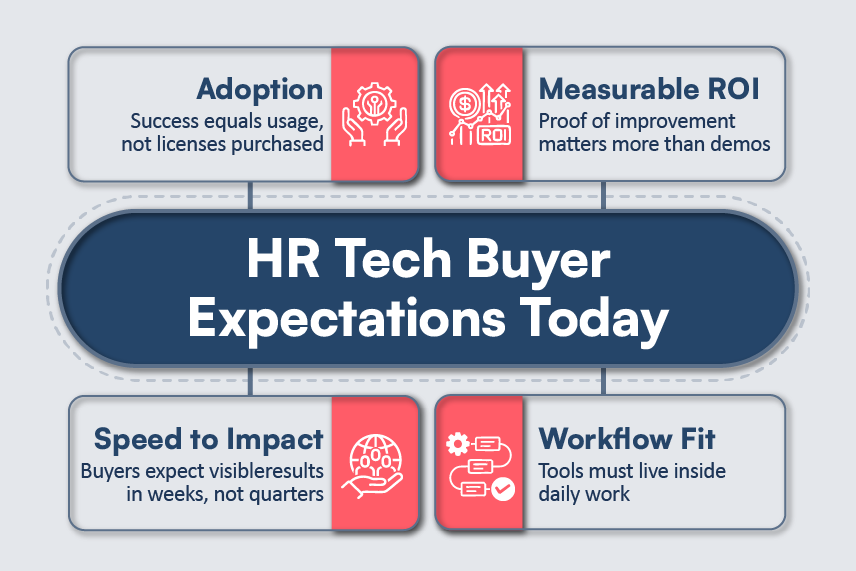
These expectations shape every decision, from pricing conversations to the evaluation of AI features.
Pricing Models Are Shifting, But HR Tech ROI Still Depends on Shared Ownership
HR Tech pricing no longer follows a single pattern. Consumption-based pricing is growing. Yet, seat-based models still exist. And now outcome-based pricing has entered the conversation in a real way.
But buyers and vendors do not view outcomes the same way.
Buyers want pricing tied to performance because AI promises faster impact. Vendors know outcomes do not sit entirely within the product. Market conditions, data quality, and user behavior all shape results. That tension shows up quickly in pricing discussions.
Christian Dwyer, Chief Product Officer at Careerminds, explained this clearly during the discussion:
“Not all outcomes are fully controlled by the vendor. Job market conditions, individual skills, and willingness to engage all influence results.”
This is why outcome-based pricing works best when responsibility is shared. Vendors can enable engagement, guidance, and better workflows. Buyers still own adoption, data readiness, and change management.
HR Tech ROI improves when both sides stay clear about what the product drives and what the organization must support.
AI Demos Create Noise. Evidence Creates Confidence.
AI has changed how fast HR Tech products ship. New features roll out quickly. Demos look impressive. The gap appears after that.
Buyers now see a flood of AI-assisted capabilities. Most tools still rely on human input and oversight. Few operate on their own. When vendors move fast but fail to show results, buyers slow down.
This creates a trust problem. Rapid releases raise expectations. If metrics do not follow, buyers question the value. Demos without proof stay demos.
HR leaders now ask tougher questions.
- How does this reduce cycle time?
- Where does it remove effort?
- What changes in day-to-day work?
If answers stay vague, adoption stalls.
AI only helps time to value in HR Tech when it delivers measurable improvement. Evidence moves deals forward. Noise does not.
Why Accelerating Time to Value with AI Depends on Readiness and Not Labels?
Buyers do not debate AI-native versus AI-layered in theory. They decide based on what their systems and teams can handle today.
AI-native platforms make sense when data is clean, workflows are redesigned, and users are ready to change how they work. In those cases, AI becomes the core experience, not an add-on.
Layered AI works when existing systems already run well. Stable workflows, strong APIs, and reliable data allow AI to sit on top and improve speed without forcing a full reset. This approach often delivers faster adoption because it fits into familiar tools.
Neville Postwalla, VP – Talent Management at Harbinger Group, summed it up simply.
“If my system is robust and my people are ready, layering AI gives me faster value. If the foundation is weak, no amount of AI will fix it.”
Workforce readiness matters as much as architecture. When users resist change, even strong AI capabilities slow down. When teams see immediate benefit, adoption follows naturally.
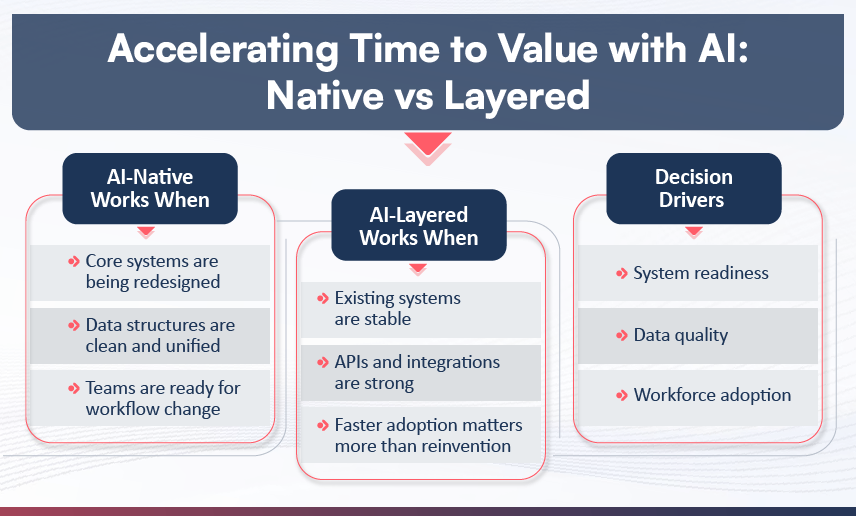
AI accelerates time to value only when the organization is prepared to absorb it.
What Buyers Look for Before Scaling an AI Pilot
AI pilots fail when they stay abstract. Buyers scale them only after they see clear signals in real work.
The first signal is speed. Buyers expect impact in weeks, not months. Shorter hiring cycles, faster scheduling, or reduced manager effort show that the tool is working. If early results take too long, interest fades.
In several pilot scenarios,
The first signal is a measurable impact.
Buyers do not wait for months to see the impact of their products. They want it within 6–12 weeks, not quarters. If the impact is delayed, the long-term partnership is hampered.
The second signal is adoption.
Buyers do not want to force usage. They watch whether managers, recruiters, or employees choose the tool on their own because it makes work easier. Organic use carries more weight than mandated rollout.
The third signal is productivity.
AI must remove friction, not add steps. When teams spend less time on admin work and more time on decisions, the value becomes visible.
Governance also matters. Buyers want transparency, bias checks, and clear data controls before expanding usage. Trust is a prerequisite for scale.
Neville Postwalla shared a simple test many HR leaders apply:
“If you switch the pilot off and people ask you to turn it back on, you know it’s working.”
That reaction tells buyers the AI has earned its place in the workflow.
Where is AI Already Improving HR Outcomes?
AI creates the most value in HR when it supports existing work. The panel discussion highlighted several areas where teams are seeing impact without heavy rework or long change cycles.
One area is content creation. HR teams use AI to draft job postings, adapt descriptions to different roles, and personalize candidate communication. This speeds up recruiting work and reduces manual effort early in the process.
Another area is concision. AI helps summarize large volumes of unstructured data, such as feedback and performance inputs. This allows HR teams and managers to extract insights more quickly and spend less time sorting through raw data.
Communication is another strong use case. Employee-facing chat tools guide people through HR processes, answer common questions, and recommend learning paths based on individual needs. These tools improve response time and reduce dependency on manual support.
AI also supports people analytics and coding tasks. Teams use it to combine data sources, analyze patterns, and surface insights that would take much longer to uncover manually.
These use cases work because they fit into existing workflows. They shorten cycles, reduce friction, and help HR teams show value sooner—without forcing a complete system overhaul.
From AI Experiments to an AI-Infused HR Operating Model
Pilots alone do not change how HR works. Value shows up only when AI moves from isolated experiments into the operating model.
As AI takes on more transactional work, HR teams spend less time on admin tasks. That shift frees capacity for judgment, coaching, and decision support. The goal is not to remove the human role. It is to refocus it.
This change also reshapes HR roles and workflows. Some responsibilities move toward oversight, interpretation, and governance. Others shift toward designing better employee and manager experiences supported by AI in the background.
The discussion made one point clear. HR Tech ROI improves when AI supports how work already flows, not when teams must work around it. Operating models that adapt to this reality move faster from intent to impact.
AI delivers value at scale only when HR evolves its operations, not just the tools it uses.
What HR Tech and Product Leaders Should Take Away
The message from buyers is consistent.
Time-to-value in HR Tech now shapes every decision. Products win trust when they show impact early. They lose momentum when the value stays theoretical.
AI helps only when it lives inside real workflows. Features that sit outside daily work slow adoption. Tools that reduce effort, speed decisions, and fit naturally into existing systems move faster.
HR Tech buyer expectations now center on evidence. Buyers want to see usage, outcomes, and ROI, not promises or polished demos. When those signals appear quickly, confidence follows.
Products that align speed, adoption, and measurable results stand out in a crowded market. Do you want to know more about HR Tech and make your buyer’s decision? Contact us today.