

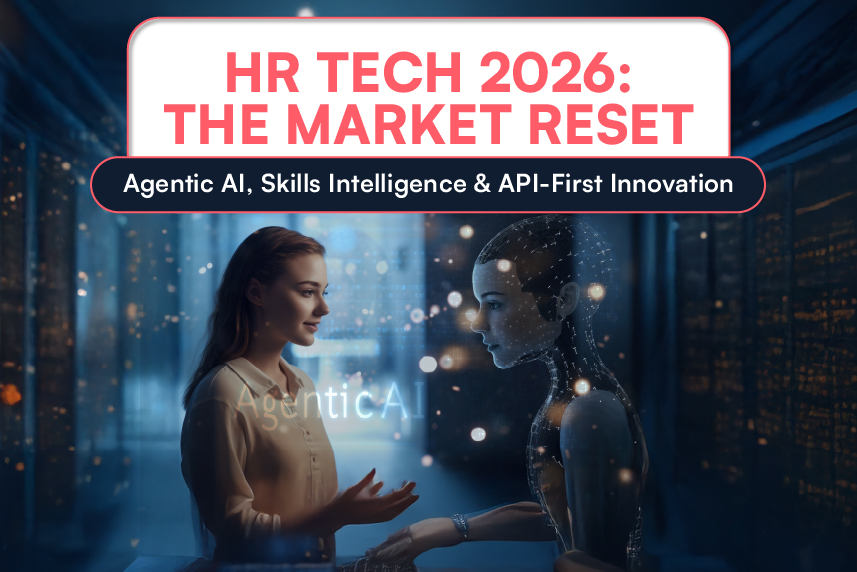
The HR technology market has matured, yet enterprise expectations now move faster than legacy design can support. Between 2020 and 2025, tech adoption in the HR space increased as companies digitized onboarding, payroll, and learning processes during the transition to remote work.
In 2026, buyers expect systems that sense context, offer recommendations, and integrate smoothly with platforms such as Microsoft Teams, Slack, and Salesforce. Here are the top reasons why 2026 is the most crucial year for HR technology software vendors.
From Enterprise Transformation to Ecosystem Orchestration
Between 2015 and 2020, HR transformation focused on migrating to cloud based HCM suites. By 2026, the priority has shifted from platform implementation to ecosystem orchestration. Enterprises are building best fit stacks of recruiting, learning, and analytics products. They expect these systems to connect and exchange data the way APIs do.
McKinsey’s Future of Work 2024 report shows that 71 percent of Fortune 1000 organizations use more than 15 HR applications. Their top challenges include fragmented data and inconsistent employee experiences. This environment creates opportunity for HR technology software vendors who design modular products that connect existing ecosystems.
Integration depth now shapes product differentiation. Modern APIs, pre-built connectors, and composable workflows help reduce friction and deliver the consistency enterprises expect.
A global financial services organization improved onboarding and employee support with an AI enabled platform that automated responses, reduced manual effort, and connected learning with support workflows. This led to faster resolution times and higher employee engagement.
Investment Momentum Favors Product Companies That Innovate Fast
Venture funding slowed between 2023 and 2024, but capital redirected toward AI and skills intelligence. PitchBook Q1 2025 reports that United States HR technology startups raised 3.2 billion dollars. Sixty eight percent of this investment went to AI powered product companies. This trend shows confidence in focused innovation rather than monolithic systems.
Gartner’s 2025 Emerging Tech Radar identifies three categories where product companies lead adoption curves.
- Agentic AI workflows that support autonomous tasks such as job description rewriting and skills gap analysis
- Skills taxonomy engines that map competencies in context
- Trust and ethics modules that offer algorithm transparency and fairness
These expectations signal the new definition of enterprise readiness.
Enterprise Buyers Are Raising the Bar
The HR buyer in 2026 is different from the buyer in 2016. Procurement cycles now involve HR, IT, Finance, and Legal. Requirements go beyond usability. Buyers expect clarity in AI behavior, strong integration capabilities, data portability, compliance with GDPR and CCPA, alignment with the EU AI Act, and clear ROI.
Sapient Insights Group’s 2024 survey of 1,900 United States enterprises confirms this shift. Ease of integration is now the top decision factor for new HR technology investments. Product companies must design with microservices, open APIs, and adaptive data structures to support these expectations.
The AI Mandate for Product Builders
Artificial intelligence has moved from hype to a required capability. McKinsey reports that 79 percent of large United States companies use generative AI in at least one HR process. Only 11 percent have integrated it into their core systems. This gap presents opportunity for product companies that embed AI into workflows rather than add it later.
What This Means for Product Engineering Teams
- Architect for continuous learning loops — products that improve with every interaction.
- Prioritize explainability and audit logs — meet enterprise governance and compliance requirements.
- Use AI to enhance experience and outcomes, not replace human judgment — support smarter decisions while maintaining trust.
The race is not to automate faster, but to automate intelligently and transparently.
The Shift from Automation to Intelligence
Automation shaped the past decade. Intelligence defines the next. Gartner expects that by 2027, 25 percent of enterprise HR systems will support autonomous decisions in talent acquisition and workforce planning. Today, that number is 7 percent.
This shift does not replace HR. It supports judgment with stronger insight. Product companies must design real time data pipelines, transparent algorithms, and user experiences that reveal how AI reaches its conclusions.
A leadership development firm used AI to optimize assessments and skills gap analysis. This reduced profiling time from weeks to hours and created personalized coaching paths.
Why 2026 Is the Inflection Point for Product Companies
Three forces shape the significance of 2026.
1. Technology readiness
Cloud, API, and AI frameworks now support scalable innovation without heavy infrastructure
2. Buyer sophistication
Enterprises understand integration, AI risk, and governance, and they are willing to pay for trusted systems
3. Partner ecosystems
Platforms such as Workday Extend, ADP Marketplace, and SAP Store make it easier for product companies to reach enterprise buyers
Barriers are lower, but expectations are higher. Success requires speed, trust, and engineering depth.
What This Means for HR Tech Product Leaders
For CTOs and product leaders, the message is clear. This is the moment to modernize. Action priorities include:
- Redesigning architecture for AI readiness with learning loops and monitoring
- Investing in open integration capabilities that support plug and play experiences
- Embedding ethical AI and transparent UX
- Adopting a co creation mindset to accelerate innovation without compromising quality
A talent intelligence platform strengthened application and infrastructure security to prepare for a SOC 2 audit. All vulnerabilities were resolved in ninety days, and the system became the organization’s most secure platform.
Looking Ahead
The next chapters of the broader HR technology landscape explore how Agentic AI, skills intelligence, composable ecosystems, governance, and human centered design will influence product direction. Enterprises expect tools that scale responsibly, build trust, and support deeper decision making.
For HR technology software vendors, the strategic shift is clear.
| 2026 Reality | Product Company Response |
|---|---|
| Enterprise ecosystems remain fragmented | Build modular, API first products that orchestrate data flows |
| AI adoption rises but trust remains limited | Engineer ethical and explainable AI |
| HR buyers expect measurable value | Design for implementation in weeks, not months |
| Innovation depends on strong partnerships | Co-create with engineering and domain specialists to accelerate delivery |
In 2026, product companies will shape clarity in a complex environment. Their role extends beyond building software. They become architects of the intelligent enterprise.
HR technology stands at a turning point. Enterprises want systems that connect seamlessly, act intelligently, and support decisions with accuracy and trust. Product companies that modernize architecture, strengthen governance, and design AI with clarity will move ahead.
The future belongs to platforms that integrate easily, learn continuously, and explain their decisions transparently. As buyers prioritize ROI, speed to value, and trusted intelligence, product companies have the opportunity to redefine the next era of HR technology. Harbinger partners with product leaders ready to build what the next era of HR technology demands. Connect with our experts to learn more.