

Enterprises increasingly expect scalable compliance training models instead of static course deployments, especially when managing a global compliance training catalog.
Compliance training catalogs rarely struggle because the content is wrong. They struggle because operations can’t keep up with what buyers now expect: industry relevance, role specificity, global credibility, and the ability to adjust without breaking legal approvals, translations, or deployment workflows. That operational tension is increasingly determining who wins RFPs, who expands globally, and who gets stuck maintaining catalogs that cannot evolve fast enough.
In this blog, we break down why the real challenge in compliance training has shifted from content coverage to operational scalability. Specifically, you’ll see how buyer demand has outpaced traditional catalog structures, why modest customization requests now trigger cascading version and localization work, how global rollouts expose brittle content models, and how mature catalogs are quietly restructuring to support relevance without sacrificing legal integrity or consistency.
The Lenses Behind Different Types of Training in Compliance Training for Enterprises
- Security training: Written through a behavioral lens, focusing on what people actually do in high-risk moments and why training must influence decisions, not just awareness.
- EHS training: Written through a process and environment lens, emphasizing how safety depends on systems, workflows, and real-world conditions where work happens.
- Ethics & compliance training: Written through an operational tension lens, highlighting the gap between rising buyer demand and the practical realities of running and scaling a mature compliance training catalog.
Demand vs. Operations in a Compliance Training Catalog
If you’re responsible for a compliance training catalog, you’ve likely heard some version of this question more often lately:
“Can this be more relevant to our industry?”
The question itself isn’t new. What is new is how often it now determines whether a deal moves forward, stalls, or quietly goes elsewhere. And it rarely stops with industry. Buyers quickly move on to roles, regions, formats, and expectations that weren’t part of the original design.
This is the part of compliance training that rarely shows up in marketing materials—but increasingly defines which catalogs grow and which ones struggle to keep up.
When Demand Evolves Faster Than the Catalog in Scalable Compliance Training
Most ethics and compliance catalogs rest on solid foundations.
They cover the right topics. They’ve been legally vetted. They’ve been deployed successfully across large, diverse workforces.
But many were designed for a time when consistency mattered more than adaptability.
Today, buyer demand is more nuanced. Organizations expect training to reflect:
- Their industry and operating environment
- The roles learners actually perform
- Global reach with local credibility
- Shorter, more targeted learning experiences
These expectations have pushed scalable compliance training to become more modular, adaptive, and relevant across enterprise environments.
Operationally, however, many catalogs are still optimized for stability, not flexibility. That growing gap—between what the market now asks for and what the catalog can realistically support—is where friction begins to surface.
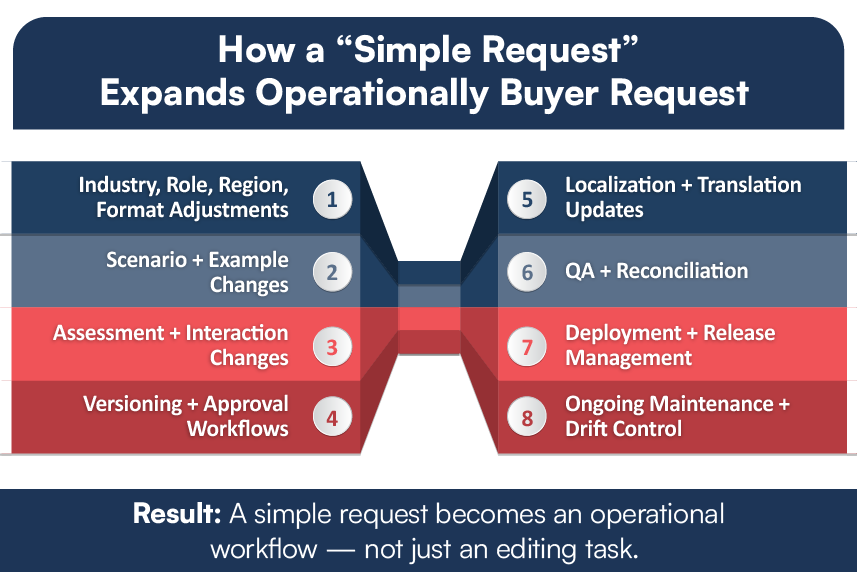
“Can You Adjust This?” Is No Longer a Simple Question for a Compliance Training Catalog
On the surface, requests for relevance sound reasonable—even modest.
In practice, they trigger a cascade of operational considerations:
- What can change without affecting approvals?
- How many versions does this touch?
- What downstream updates does it create?
- Is this scalable—or a one-time exception?
When catalogs aren’t structured to absorb these requests cleanly, teams are forced into tradeoffs: slow the deal, over-customize, or defer the request entirely. Over time, even small adjustments accumulate into operational drag.
The Quiet Shift Inside Mature Catalogs
Some compliance publishers are responding by changing how their content is structured—without changing what it says.
Instead of treating courses as fixed products, they’re treating them as systems:
- Core content remains stable and protected
- Contextual elements are intentionally flexible
- Updates are expected, not disruptive
- Variants are planned, not improvised
This isn’t about rebuilding catalogs. It’s about making them easier to extend, update, and sustain as expectations continue to evolve.
Global Scale Exposes Structural Weaknesses in Enterprise Compliance Training
Expanding language coverage is often seen as a growth milestone—and it is. But once a catalog operates globally, maintenance becomes the real test.
Every update raises practical questions:
- How do changes stay aligned across languages?
- What happens to scenarios, interactions, and assessments?
- How do teams avoid version drift over time?
Catalogs that weren’t designed for ongoing change tend to feel brittle at scale. Those built with evolution in mind can update more confidently, release more consistently, and support global clients without constant strain.
What Buyers Are Actually Responding To in Scalable Compliance Training
On paper, many compliance catalogs look similar. Topic lists overlap. Claims converge.
In practice, buyers notice something else:
- How quickly content can be adapted
- How confidently edge-case requests are handled
- How smoothly global rollouts proceed
- How well the catalog holds together as expectations change
Increasingly, buyers gravitate toward catalogs that feel operationally ready, not just content-complete.
Closing the Gap Between Demand and Operations in Compliance Training for Enterprises
The next phase of growth in compliance training isn’t driven by adding more courses.
It’s driven by narrowing the gap between:
- What buyers now expect
- And what the catalog can realistically support
That tension isn’t a failure. For many mature catalogs, it’s a signal that the foundation is strong—but the structure needs to evolve.
At Harbinger, this is where we often collaborate with compliance publishers: helping established catalogs adapt to rising expectations without losing the integrity, approvals, or consistency they’ve worked hard to build.
If your catalog is starting to feel caught between demand and operations, that tension may be pointing toward its next phase of growth. Click here to connect with us.