


Most enterprises need to execute business priorities faster, but work is still assigned based on roles rather than available skills.
The result is slower execution, hidden capability, and over-reliance on hiring.
Yet workforce models remain tied to static roles, creating friction between how work happens and how talent is deployed.
When capability gaps arise, the default response is to hire. The real challenge is understanding what skills already exist inside the enterprise and how quickly they can be mobilized. Skills-based talent ecosystems address that gap by making workforce capability visible and deployable, enabling effective workforce enablement and long-term talent transformation.
What is a Skills-Based Talent Ecosystem?
A skills-based talent ecosystem is an integrated workforce architecture that connects skills data, workforce analytics, internal mobility, learning and development, performance management, and talent acquisition, so organizations can first identify existing skills, then develop or redeploy them, and hire only when required.
Why Traditional HR Models Fall Short
Most talent systems were designed to manage HR processes such as hiring, training, and performance tracking. They do not provide a clear view of what skills exist across the organization or how those skills can be used when business priorities change.
For example, organizations often hire externally for skills that already exist internally because those capabilities are not visible across teams.
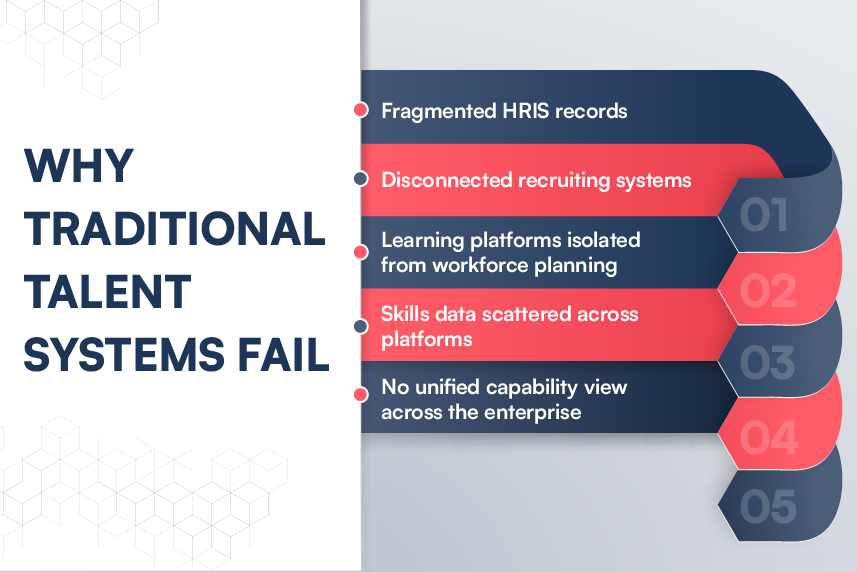
- Fragmented Workforce Records
Employee data in HRIS platforms captures roles and history but rarely provides a reliable view of its capabilities. - Disconnected Recruiting and Learning SystemsRecruitment and learning platforms operate independently, which disconnects hiring and development decisions from actual workforce capability.
- Scattered Skills Data Across PlatformsSkills signals sit across HR, recruiting, and learning systems, preventing organizations from building a unified view of capability.
- No Enterprise Capability VisibilityWithout integrated talent systems, leadership lacks the insight needed to deploy skills quickly where execution depends on them.
Core Pillars of a Skills-Based Talent Ecosystem
A skills-based ecosystem stands on four operational capabilities.
1. Skills Intelligence Layer
Execution depends on knowing where the required skills exist across the organization. A skills intelligence layer provides that clarity. It surfaces existing capability, exposes gaps early, and shows where skills remain underused. This allows organizations to identify internal talent for new initiatives instead of defaulting to external hiring.
2. Integrated HR Technology Stack
Talent systems cannot operate independently. Recruiting, workforce records, and learning environments must operate from the same capability data. When those systems align, workforce decisions reflect actual capability across the enterprise. For instance, learning, performance, and workforce planning data can be used together to assess readiness before assigning talent to critical initiatives.
3. Targeted Skill Development
Capability gaps require targeted development. Instead of assigning the same training to everyone in a role, development is based on the specific skills an individual lacks for current or upcoming work. Development becomes a response to capability demand rather than a scheduled activity, strengthening workforce enablement across the enterprise.
4. Continuous Workforce Planning
Workforce planning must identify the skills required for upcoming initiatives and assess whether those skills exist within the organization. Where gaps are identified, organizations need to decide whether to redeploy existing talent, develop the required skills, or hire externally. This ensures that the right people are assigned to the right work at the right time.
The Role of AI in Skills-Based Ecosystems
AI enables organizations to identify and use skills data for the entire workforce. Skills data exists in resumes, performance records, learning systems, and project work. AI can identify and map skills from this data to create a structured view of skills within the organization.
Generative AI helps keep skill definitions and frameworks updated as roles evolve, while AI agents can recommend development moves based on changing skill demand. This allows organizations to identify emerging skill needs and match internal talent to upcoming initiatives.
AI does not replace workforce strategy. It strengthens it by making workforce data usable for decision-making.
Business Impact of Skills-Based Talent Ecosystems
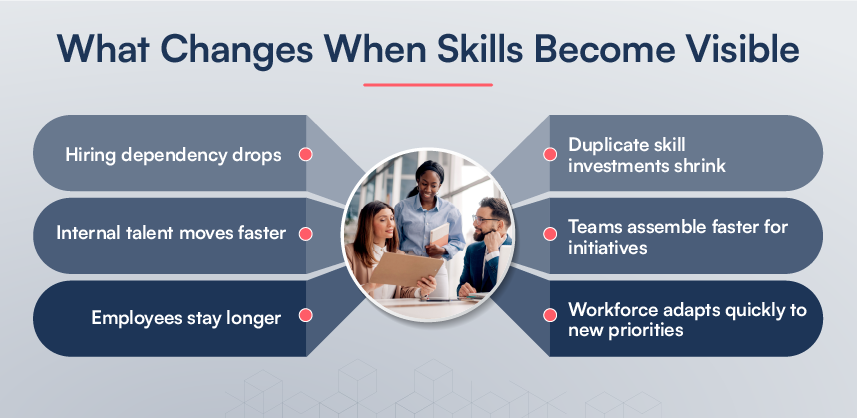
When workforce capability becomes visible across the enterprise, talent decisions begin to change quickly, strengthening workforce enablement at scale. Organizations stop relying solely on external hiring because leadership can deploy the capabilities already present inside the workforce.
- Faster Execution and Workforce AgilityTeams assemble more quickly around priority initiatives, allowing the workforce to adapt as business priorities shift.
- Reduced Redundant Skill InvestmentsDevelopment spending becomes more precise because learning aligns directly with enterprise capability demand.
- Improved Employee RetentionEmployees remain engaged when they can apply their capabilities to meaningful work and see clear opportunities for growth.
Harbinger’s Approach to Skills-Based Talent Ecosystems
Building a skills-based ecosystem is not a technology upgrade. It requires connecting workforce systems so that skills data can move consistently between hiring, development, and workforce planning.
At Harbinger Group, we approach skills-based talent transformation by aligning hiring, development, and workforce planning to business priorities based on clearly defined skills.
Our consulting-led, engineering-driven approach focuses on building a unified capability layer across enterprise systems.
We help organizations:
- Map and understand available skills across the workforce.
- Identify skill gaps based on current and upcoming work.
- Connect HRIS, ATS, and LMS systems so that skills data is consistent across planning, development, and hiring.
- Provide workforce data that supports decision-making.
This ensures that workforce planning, hiring, and development are aligned with business priorities.
Achieving this requires more than isolated improvements in learning, hiring, or onboarding. It requires consistent skill definitions across these functions so that workforce decisions are based on actual skills rather than fragmented information.
Implementation Framework: Moving from Roles to Skills
Shifting from role-based structures to a skills-driven ecosystem requires operating discipline across systems, data, and ownership.
Step 1: Define an Enterprise-Wide Skills Taxonomy
Establish a common capability language across roles, teams, and business units to capture and apply skills consistently.
Step 2: Integrate HRIS, ATS, and LMS Data Layers
Connect recruiting, workforce, and learning systems so that capability data flows across hiring, development, and workforce planning.
Step 3: Enable Analytics and Workforce Intelligence
Analytics converts workforce data into insight, giving leadership visibility into skill distribution, emerging gaps, and deployment opportunities.
Step 4: Align Learning to Skill Demand
Development investments should target measurable capability gaps and support upcoming roles and initiatives.
Step 5: Establish Ownership and Operating Discipline
Assign clear ownership for maintaining skills data, updating definitions, and ensuring workforce decisions continue to use this data consistently.
Risks in Maintaining a Skills-Based Ecosystem
There are risks in maintaining a smooth skills-based ecosystem as given below. However, by proactively addressing these risks, you can achieve success.
- Poor Data QualityIncomplete or outdated skills data leads to incorrect workforce decisions.
- Inconsistent Skill DefinitionsDifferent definitions across teams make it difficult to compare and use skills reliably.
- Over-Reliance on AI Without ValidationAutomated recommendations can mislead if not validated against real business context.
- Lack of Adoption Across TeamsIf teams do not use the system consistently, skills data remains unused in decision-making.
Closing Perspective: Skills as the New Enterprise Currency
As hiring becomes more expensive and slower, growth depends less on acquisition and more on how effectively existing capabilities are used.
Organizations that understand their workforce capabilities can deploy talent faster, align development with future demand, and respond to new initiatives without expanding headcount.
The advantage does not come from workforce size. It comes from how quickly capabilities can be deployed to the work that matters.
Skills-based talent ecosystems make this possible by connecting workforce strategy directly to enterprise execution.
Click here to consult with us to design and operationalize a skills-based talent ecosystem aligned with measurable business outcomes.

Additional Perspectives on the FDE Model
Forward-deployed engineering is gaining attention as a way to bring engineers closer to customer problems and real-world implementation. Several organizations describe this model as a way to align engineering work with customer needs, systems, and workflows. Here are a few resources that offer additional perspectives on the FDE model:https://www.griddynamics.com/glossary/forward-deployed-engineering
https://miragemetrics.com/guides/forward-deployed-engineering
https://www.cognizant.com/us/en/glossary/forward-deployed-engineer


