


Security awareness content ages fast. Clients expect more. Competitors release new catalogs. Threats evolve. And B2B training providers — especially those selling security awareness catalogs — are under more pressure than ever to keep titles fresh, accurate, relevant, and globally deployable.
Modern buyers won’t settle for outdated modules, generic scenarios, or content that doesn’t reflect their industry or region. Catalog providers who fail to evolve risk losing clients, renewals, and expansion opportunities.
But here’s the truth most providers don’t say out loud:
Updating a security training catalog isn’t hard because the content is complex — it’s hard because the operations behind updating it are complex.
That’s where modernization, localization, and industry adaptation come in.
Three Strategies That Drive Catalog Growth Today
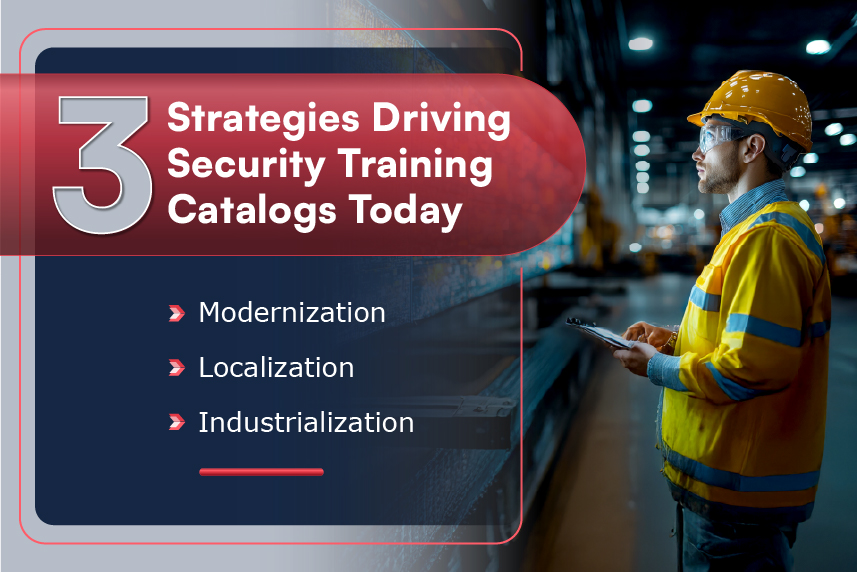
1. Modernization: Make Content Competitive Again
Modernization improves instructional design, boosts engagement, shortens time-to-complete, and brings your catalog up to current market expectations, especially when you tap into AI-driven learning innovation. Shorter, cleaner, more modular content means better usability — and better sellability.
A modern catalog signals you’re keeping pace with how today’s users learn.
2. Localization: More Languages, More Clients, More Revenue
Expanding into multilingual markets increases your total addressable market immediately. But localization in security training is not the same as standard translation.
Most translation vendors don’t understand the technical nature of digital training content — and translated modules often break, misrender, or lose meaning.
That’s why we involve full-stack developers and native dialect experts in post-translation QA to ensure:
- variables, tokens, and logic don’t break
- interactive elements still work
- technical terminology remains accurate
- regional nuances and tone feel natural
This protects your catalog’s integrity and your reputation.
3. Industry Adaptation: Make Every Title Feel Built for Their World
This is not about rewriting your catalog for each industry — it’s about contextualizing the experience, so it feels industry-ready without rebuilding the core learning.
Industry adaptation typically includes:
- swapping generic graphics with industry-setting visuals (hospital, branch office, shop floor, retail counter, call center)
- incorporating realistic micro-scenarios
- adjusting personas (nurses, analysts, operators, etc.)
- tailoring examples (public Wi-Fi, shared terminals, clinical devices, shared workspaces)
- aligning assessments with what happens in their day-to-day
It’s the same high-quality security training… but wrapped in the world your client operates in.
Where Catalog Providers Get Stuck: Pitfalls, Risks & What to Do About Them
Updating a catalog is complex — and many organizations underestimate the operational challenges. Below is a comparison of typical pitfalls, the risks they create, and recommended strategies to solve them.
Common Pitfalls, Risks & How to Resolve Them
| Pitfall | Associated Risk | Recommended Strategy |
|---|---|---|
| Underestimating the volume & effort | Delays, overruns, stalled launches | Break work into phases; prioritize by client demand & revenue impact |
| Using translators who don’t understand eLearning tech | Broken modules, mistranslated variables, unusable output | Use translators paired with full-stack developers & native dialect QA |
| Generic “one-size-fits-all” content across industries | Lower adoption, poor client satisfaction, weakened renewals | Add contextual scenarios, visuals, personas, and assessments per industry |
| Inconsistent modernization across titles | Uneven quality, confusing client experience | Create a modernization blueprint and enforce consistent standards |
| Lack of automation for high-volume updates | Slow production, limited scalability | Use AI-assisted content analysis and automated alpha builds to accelerate cycles |
| No clear prioritization model | Teams spin wheels, leadership gets no ROI | Rank titles by demand, revenue risk, and competitive pressure |
The Engine Behind Large-Scale Catalog Transformation
Updating a large security training catalog isn’t just a content task — it’s a technical, creative, and operational lift. Most vendors can handle one part of that puzzle. Harbinger handles all of it, end-to-end, at scale.
We bring a combination that’s rare in this space:
- Deep catalog experience — Hundreds of security catalogs modernized, localized, and adapted for industry relevance.
- Volume-tested production — Thousands of titles transformed across a wide range of formats, tools, and LMS environments.
- Proprietary AI accelerators — Tools that analyze existing content and auto-generate structured alpha drafts to speed up production.
- Full-stack engineering oversight — Ensuring translated and localized modules don’t break, misrender, or lose technical accuracy.
- Native-dialect validation — Human experts who ensure tone, nuance, and terminology feel natural in every target language.
- Award-winning creative teams — Modern design, instructional strategy, and visual treatments that give your catalog market-ready polish.
- Industry-level insight — Deep experience in finance, healthcare, manufacturing, public sector, and other high-risk environments.
In short: We don’t just update catalogs — we future-proof them.
Ready to Transform Your Catalog?
“Start Big, Start Small, Start Uncertain — Just Start.”
Every catalog transformation looks different.
Some clients want speed. Others want reach. Others want cost efficiency. We’ve supported hundreds of different paths, and we design the plan around what matters most to you.
We can help you evaluate:
- timelines vs. budget
- full overhaul vs. phased rollout
- one strategic pillar vs. all three (modernization, localization, industry adaptation)
- internal capacity vs. external lift
Whether you’re mapping your 2026 roadmap, exploring pricing models, or simply wondering what’s possible, we’re here to help you make the smartest first move.
If you’re even thinking about transforming your catalog, let’s talk.