


Table of Contents
- Introduction: The AI Paradox Nobody Wants to Talk About
- The Capability Gap: Why AI Initiatives Keep Stalling
- The Decision Criteria: What Leaders Should Look for Before Scaling AI Adoption
- The Learning Architecture: Designing Ecosystems That Connect to Business Outcomes
- The Scaling Framework: Creating an Actionable Strategy for Scaling AI Adoption
- The AI Readiness Approach: How Harbinger Can Help Build AI-Ready Learning Ecosystems
- Conclusion
Introduction: The AI Paradox Nobody Wants to Talk About
‘Your enterprise approved the AI implementation roadmap. A few months later, the pilot program wasn’t gaining momentum, not because the AI failed, but because the workforce wasn’t ready for it.’ That’s the common scenario nowadays. Enterprises continue increasing AI investments and scaling AI adoption despite struggling to operationalize AI.
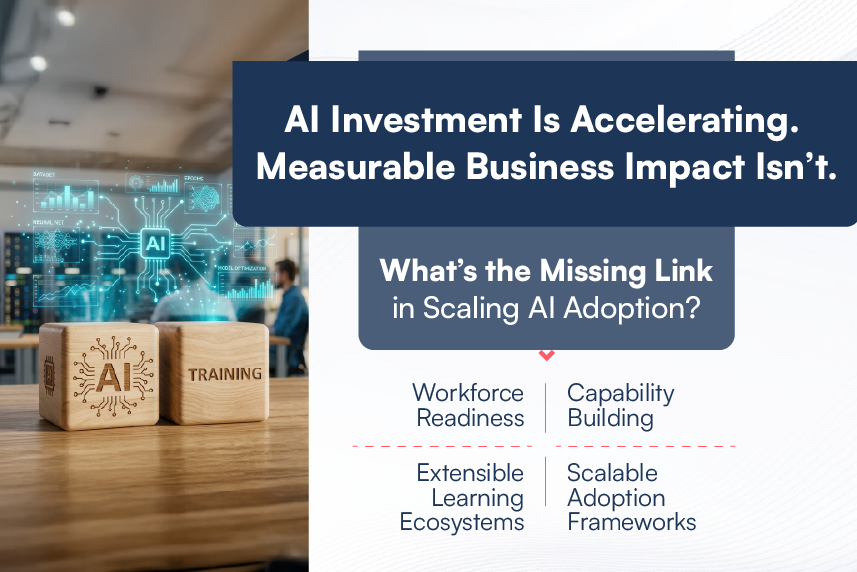
This disconnect exposes a growing challenge. Organizations are not failing because they lack AI tools, but because they lack the capability required for scaling AI adoption across workflows, teams, and decision-making environments.
According to a recent report by McKinsey & Company, 92% of companies plan to increase AI investments, yet only 1% of leaders believe their organizations have achieved AI maturity.
Many leaders entered the AI race expecting quick productivity gains. Instead, they encountered fragmented adoption, unclear ownership, governance concerns, and workforce hesitation. Now, enterprises are discovering that workforce AI readiness is the central business issue. It is necessary to prepare people for an AI-driven future, align learning with business outcomes, and build systems that evolve with organizational needs.
Harbinger Group recently explored this challenge in a joint webinar with Adobe on topic- “Scaling AI Automation: Why Investing in Training Is Your Real Competitive Edge.” The session featured global experts- Dr. Allen Partridge, Director of Evangelism, Adobe, Geoffrey Roche, Senior Vice President, Healthcare Solutions, Risepoint, and Rahul Singh, Senior Director, Learning Solutions, Harbinger Group. Listen to their perspectives on capability building, AI-based learning ecosystems, workforce AI readiness, and more in the discussion here:
THE CAPABILITY GAP: Why AI Initiatives Keep Stalling
Most enterprises underestimate the operational complexity of scaling AI adoption. They focus heavily on selecting technologies but invest too little in workforce AI readiness and organizational alignment.
Below are a few factors that repeatedly slow organizational AI initiatives:
- Lack of AI-ready skills and role clarity among the staff
- Learning programs disconnected from business outcomes
- Too many isolated AI tools without operational focus
- Governance, compliance, and trust concerns
- Weak change management
- Poor coordination between business functions like L&D, HR, IT, etc.
Also, enterprises often assume employees will naturally adopt AI once tools become available. In reality, adoption depends on confidence, context, workflow integration, continuous learning support, and many such factors. For this, enterprises should focus on AI capability building by developing role-specific AI fluency, workflow-based learning experiences, human-in-the-loop operational models, and continuous performance support.
“AI initiatives fail to transform when teams only automate existing work instead of asking what should actually be done. The real opportunity is to use AI to rethink problems, not just speed up old processes.”
— Dr. Allen Partridge, Director of Evangelism, Adobe
THE DECISION CRITERIA: What Leaders Should Look for Before Scaling AI Adoption
Learning leaders are becoming more selective about AI investments. The real question is: how can they successfully scale AI in learning and development?
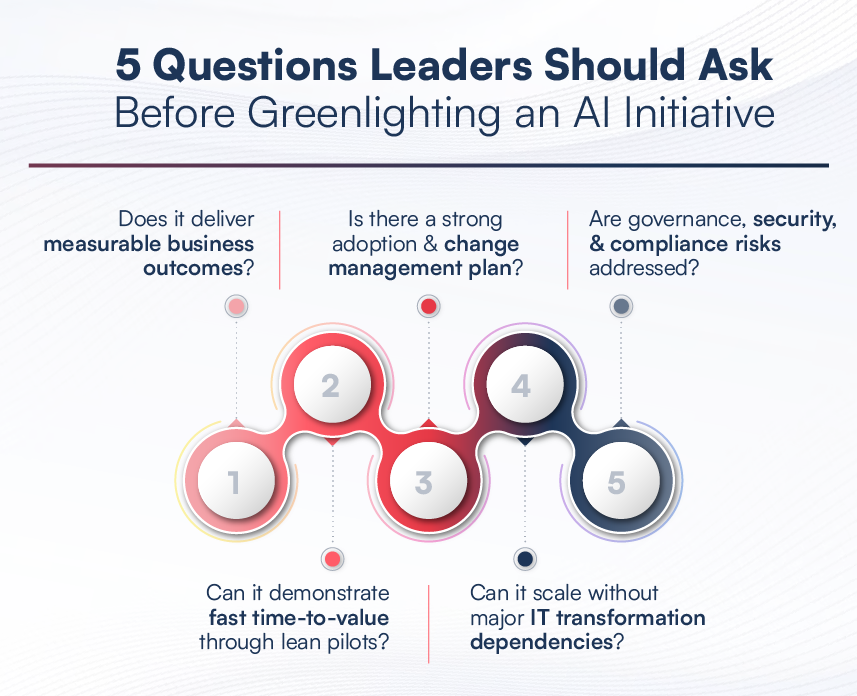
The conversation has already shifted from “What can AI do?” to “What measurable business outcomes can AI deliver?” Learning leaders, HR teams, operational stakeholders, and technology leaders should come together to collectively define how AI supports workforce productivity and business goals. They should assess AI initiatives based on measurable business impact, workforce adoption readiness, governance and compliance preparedness, rapid value realization through focused pilots, and low reliance on large-scale IT modernization.
See it in practice how AI helped improve team outcomes and enhance leadership communication for a renowned corporate training provider: How a GenAI Coaching Simulator Improved Manager Effectiveness in One-on-One Conversations
THE LEARNING ARCHITECTURE: Designing Ecosystems That Connect to Business Outcomes
A learning architecture for AI must be extensible, connected to systems of record, and human centred. That helps in linking learning, talent, and performance data so L&D can drive business impact.
The Rise of Extensible Learning Ecosystems
Modern enterprises need intelligent learning ecosystems that adapt quickly to a changing workforce and business requirements. Static LMS platforms alone cannot support a smart AI adoption strategy.
An extensible learning ecosystem integrates the LMS/LXP with talent, performance, and operational systems via APIs and event pipelines. It supports microlearning, just-in-time AI coaching, practice sandboxes with human-in-the-loop feedback, and analytics that map learning activity to business KPIs.
Typical components include:
- Central learning platform with content orchestration.
- Integrated talent and performance systems for role-based goals.
- Data pipelines for outcome measurement and analytics.
- Sandboxes and simulation environments for safe practice.
“Enterprises can build an extensible learning ecosystem by connecting learning, skills, and performance data, then showing the business measurable outcomes. Traditional LMSs tracked training and assessments, but the real shift is in linking these dots at scale, something the industry has recognized, though there is still much to do.”
– Rahul Singh, Senior Director, Learning Solutions, Harbinger Group
Key Design Principles for AI-Led Learning Programs
Business-aligned learning outcomes: Training initiatives must connect directly to operational metrics such as productivity, customer experience, compliance, or revenue performance.
Role-specific enablement: AI learning should reflect how different teams interact with AI in real workflows.
Continuous reinforcement: Enterprises must provide ongoing learning support rather than relying on isolated training sessions.
Human-centered adoption: Successful AI adoption strategy programs reduce fear and resistance by creating practical, low-risk learning experiences.
Integrated measurement frameworks: Enterprises should continuously measure adoption, proficiency, and business impact.
Read a success story of how adopting AI-driven skills intelligence helped workforce development for a global digital learning platform provider.
Adobe Learning Manager (ALM) as an Enabler
Platforms like Adobe Learning Manager, in partnership with Harbinger, help enterprises operationalize extensible learning ecosystems. ALM can act as the orchestration layer that ties content, skills, and performance. It supports integrated catalogs, role-based learning paths, and APIs for connecting HRIS and analytics systems.
In practice, ALM enables rapid deployment of training-led pilots that show measurable impact without heavy IT projects. It supports personalized learning journeys, skills-based learning experiences, integration with enterprise systems, AI-enabled recommendations, and scalable workforce enablement.
THE SCALING FRAMEWORK: Creating an Actionable Strategy for Scaling AI Adoption
Successful enterprises approach scaling AI adoption as a phased capability transformation. A practical framework typically includes these five phases:
- Opportunity mapping: identify business problems where AI plus capability building can impact KPIs
- Pilot design: run small, time-boxed pilots with clear success metrics and minimal IT dependencies, that can be implemented in 30/60/90-day success windows
- Capability deployment: scale learning paths, coaching, and sandboxes to impacted roles
- Measurement and governance: instrument outcomes, manage model governance, audit performance
- Continuous scaling: iterate models and learning content based on outcome data
“AI should be used to augment the workplace and improve workforce effectiveness, while learning leaders communicate it thoughtfully and stay consistent from message to implementation to build trust.”
– Geoffrey Roche, Senior Vice President, Healthcare Solutions, Risepoint
THE AI READINESS APPROACH: How Harbinger Can Help Build AI-Ready Learning Ecosystems
Most enterprises are into an AI learning initiative for a few months before they discover that the real bottleneck isn’t the technology, but the infrastructure underneath it.
Harbinger exists to close that gap. We partner with enterprises, digital publishers, and learning associations to build what AI actually needs to deliver value at scale: structured content ecosystems, connected skills architecture, and governance frameworks that hold up under enterprise complexity. Our content engineering solutions, AI-based learning solutions, and Agentic AI Studio are designed to provide end-to-end support for modernizing learning in today’s AI-driven world.
With over three decades of expertise and a consulting-led engineering approach, we help enterprises design smart learning ecosystems that don’t just support AI today but scale with it as business demands evolve.
Conclusion
Enterprises achieve meaningful AI impact when they strengthen workforce capabilities, align learning with business goals, and create systems that support organization-wide scaling of AI adoption.
We, at Harbinger Group, come with extensive domain expertise and an AI-first approach to guide you in designing an end-to-end learning transformation and human-in-the-loop program. Begin with a content and capability readiness audit before your next AI platform decision. Connect with our team at contact@harbingergroup.com or visit https://www.harbingergroup.com/ for details.

Additional Perspectives on the FDE Model
Forward-deployed engineering is gaining attention as a way to bring engineers closer to customer problems and real-world implementation. Several organizations describe this model as a way to align engineering work with customer needs, systems, and workflows. Here are a few resources that offer additional perspectives on the FDE model:https://www.griddynamics.com/glossary/forward-deployed-engineering
https://miragemetrics.com/guides/forward-deployed-engineering
https://www.cognizant.com/us/en/glossary/forward-deployed-engineer


