


How to organize and present a content knowledge base that is sufficiently large and highly unstructured? Also, given the amount of digital data that is getting generated, is this problem only going to get worse over the period of time?
Before we get into the solutions, let’s look at some traditional approaches of organizing and presenting a content knowledge base.
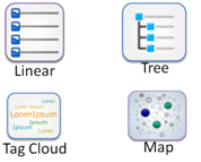
Linear
- Topics are organized and presented as an ordered list with one or two levels of classification
- This is the easiest option to implement and highly recommended if the knowledge base is static and not very complex (e.g. curriculum).
Hierarchical/ Tree Based
- Topics are grouped into categories and sub-categories (n-levels) and presented hierarchically in the form of a tree (e.g. domain specific literature)
- Tree based navigation is intuitive and applicable almost everywhere. However, as the data grows, the categories also grow and it becomes less and less intuitive for the learner to navigate. Some relationships between topics may not be possible to represent in a tree-based structure.
Tag Cloud
- As the content grows and topics become more unstructured, hierarchical organization becomes more difficult. In such scenarios, organizing and presenting the knowledge base as a tag cloud can help solve some of the navigation and discovery problems (e.g. Blogs, Websites).
- This method allows discovery of topics based on trends, recommendations, likes etc. which is a powerful method of discovering relevant and interesting content. The major disadvantage of tag clouds, however, is that there is almost zero navigation and inter-relationships between topics is hard to represent.
All the above approaches can be further extended in terms of accommodating a larger knowledge base by having a powerful “search” feature within the application. Search helps the learner to narrow down the scope of discovery.
Based on our recent experiences, we believe “Map Driven Learning” is the new emerging technique for representing an ever- expanding knowledge base, which is large and unstructured. At the upcoming DevLearn 2013 conference, at Las Vegas, we are speaking about ‘Map-driven Learning in Enterprise Systems’ on October 25, 2013, at 8.30 AM – 9:30 AM at Expo Block 6. We are going to explain how “map driven” approach can help enterprises organize their exponentially growing knowledge base in a very intuitive and discoverable manner catering to the future demands of the learners.