


Achieving growth in today’s market requires leadership to move beyond viewing human capital as a managed expense and operate it as a revenue system. In most large organizations, this capability is poorly engineered. The result is not just inefficiency — it is measurable revenue loss.
Workforce decisions made without integrated visibility into skills, performance, and demand slow execution at precisely the moments when speed determines market share. For organizations building or buying HR technology, this fragmentation represents the final frontier of competitive differentiation.
A feature-rich platform is no longer enough. The market demands solutions that directly address the Integration Penalty: the structural constraint that delays hiring, misaligns deployment, and limits an organization’s ability to respond to market demand.
Over three decades of engineering HR technology products and solutions, Harbinger has seen this pattern consistently across industries and geographies. The objective, whether you are building a platform or deploying one, remains the same: converting human potential into predictable financial yield.
The Revenue Capture Framework: Quantifying the Structural Leak
Performance data sits in one system, skill taxonomies in another, and recruitment pipelines in a third. These systems were not designed to work together and, as a result, they do not. The Integration Penalty is not an operational inconvenience — it shows up directly in missed revenue.
To address it, leadership must shift focus from cost per hire to revenue capture. When integrated talent intelligence reduces Time to Fill for revenue-generating roles, the organization captures top-line growth that would otherwise be lost to vacancy duration.
Revenue Captured = (Reduction in Time to Fill) × Daily Revenue Contribution
This formula makes the business case concrete. If a lead engineering or sales architect role contributes several thousand dollars to the daily revenue pipeline, every day saved in the hiring and onboarding cycle translates directly into realized earnings. HRIS integration is what enables this reduction. That is why it is a revenue mandate, not a back-office project.
From Systems of Record to Intelligent Platforms
The role of HRIS has fundamentally shifted. Competitive advantage is no longer driven solely by workflow automation. It is defined by how effectively platforms capture domain context, workforce dynamics, and business intent — and act on them in real time.
This shift changes how work itself must be structured. Most roles today bundle unrelated responsibilities, making it difficult to match actual demand with available capability. Breaking work down to the task level allows leadership to redeploy talent based on real-time priorities rather than static job definitions. Organizations that operationalize this reduce dependency on external hiring and improve utilization of existing teams, particularly in revenue-critical functions.
| Traditional Approach | Integrated Approach | Business Impact |
|---|---|---|
| Annual Planning Cycles | Real-time Skill Orchestration | Ability to pivot during market volatility |
| Subjective Performance Reviews | Data-Validated Capability Signals | Reduced bias, higher retention of top performers |
| Manual Resource Allocation | Automated Internal Mobility Hubs | Maximum utilization of existing headcount |
These shifts cannot be sustained through process changes alone. They require an underlying architecture that can unify data, interpret it consistently, and act on it in real time.
The Three-Layer Architecture of an Integrated HRIS
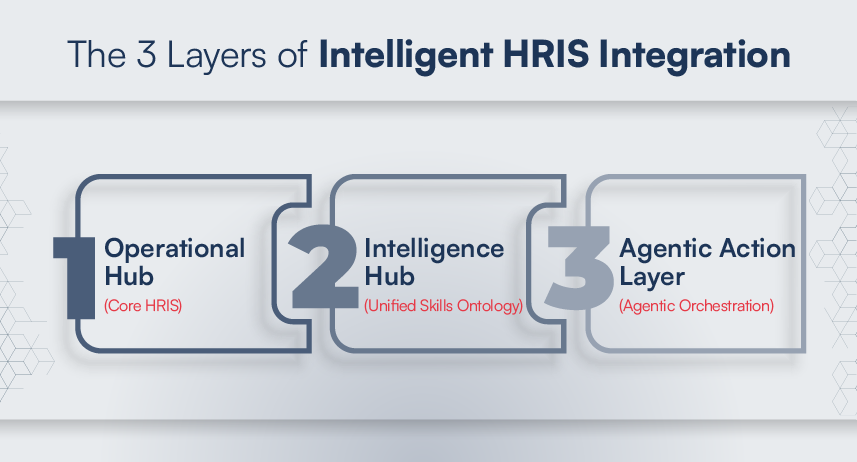
For most organizations, HRIS integration stops at data synchronization. That is necessary but insufficient. Real value emerges only when integration is designed as a layered system built for decision-making and execution.
Layer 1 – The Operational Hub (Core HRIS): This layer manages employee records and organizational data. Most large organizations have this foundation in place. The problem is that it functions as a system of record rather than a system that drives decisions.
Layer 2 – The Intelligence Hub (Unified Skills Ontology): This is where most integration efforts fail. Skills are defined inconsistently across platforms. Without a unified vocabulary, workforce data cannot be reliably used for decision-making, and AI systems inherit that same inconsistency. Solving this is what allows an HRIS to function as the central nervous system of the broader technology stack.
Layer 3 – The Action Layer (Agentic Orchestration): This layer determines whether integration actually translates into business outcomes. Open communication standards now allow AI-driven agents to query workforce data and surface immediate actions — without expensive, custom-coded connections between every system. Organizations can adopt new AI capabilities without rebuilding their entire architecture each time. This is the layer that separates platforms built for today from those built for the next decade.
Operational Patterns: Where Architecture Meets Execution
When these layers are engineered correctly, specific outcomes emerge that address long-standing productivity constraints.
- Pre-Hire Skill Validation: Large organizations can validate candidate capabilities against actual project requirements before hiring decisions are made. This reduces post-hire mismatches and accelerates time-to-contribution — ensuring new hires are aligned to revenue-generating work from day one. Harbinger applied this approach for a services organization by introducing a skill-gap analysis framework that evaluated candidates against live project requirements before onboarding. Read the full case study on automated skill gap analysis.
- Global Skills Alignment: For firms operating across multiple regions, fragmented skill definitions prevent scalable workforce transformation. A unified skills intelligence framework replaces disconnected systems with a single data model, giving leadership transparent visibility into workforce readiness across the entire global footprint and enabling talent to move based on demand rather than geography. Harbinger built this capability for a global digital learning platform — standardizing skill taxonomies, connecting roles with capabilities, and enabling AI-driven career pathways across enterprise customers. See how AI-driven skills intelligence was implemented at scale.
- Continuous Performance Management: The most effective way to optimize performance is to move support from periodic reviews into the daily workflow. By connecting performance signals with learning and career data, organizations can deliver personalized development directly within the employee’s work environment. Harbinger implemented this for a global investment bank — building continuous performance tracking that replaced annual cycles with real-time goal monitoring, skill gap identification, and automated development recommendations. Escalation volumes dropped 15% within six months, freeing senior capacity for higher-value work. Explore the continuous performance management case study.
The Human Constraint
Integration alone does not resolve the disconnect between organizational ambition and workforce capacity. Many employees are already operating at their limits, and additional systems often increase complexity rather than reduce it.
The constraint is no longer technological — it is human. Even well-integrated systems fail if they add to employee burden rather than remove it. Effort reduction must therefore be a core design principle, not an afterthought. AI and automation embedded directly into the flow of work — enabling employees to offload repetitive, low-value tasks while retaining control over decision-making — is the standard any serious integration must meet. Platforms that do not reduce operational friction will see limited adoption regardless of their technical sophistication.
Driving Value Through Predictive Decision-Making
The next stage of HRIS integration is the ability to act before problems surface. Rather than relying on retrospective reporting, integrated systems can identify early risk signals — disengagement in revenue-critical teams, skill drift in key roles — and enable targeted intervention before impact is felt.
The financial case is direct. For an organization with 20% voluntary turnover and a cost-per-turnover of $25,000, even a 5% reduction through proactive intervention represents millions in retained value. This is where integration moves from operational improvement to measurable financial return.
Six Diagnostic Questions for Leadership
Before defining the path forward, assess where your organization stands today:
- Is workforce data board-grade? If producing a capability report takes weeks of manual preparation, the integration is a liability.
- Do systems operate on a unified skill vocabulary? If your recruitment tool defines a skill differently than your performance tool, your decisions are built on noise.
- Is hiring speed tied to revenue capture? Shifting the conversation from cost-per-hire to revenue-per-day-saved is essential for financial alignment.
- Do performance signals trigger development decisions automatically? Annual review cycles are a structural disadvantage in fast-moving markets.
- Can AI tools communicate across your stack without custom code? Open architecture standards ensure your organization can adopt new capabilities without a full system rebuild.
- Does the system reduce effort for the employee? Integration that adds administrative burden will not be adopted, regardless of its underlying capability.
Where to Begin
If your answers to the questions above reveal gaps in Layer 2 — the skills vocabulary — that is the highest-leverage starting point. A fragmented skills ontology cascades failure into every downstream system: recruitment, performance, learning, and workforce planning all operate on flawed inputs. Establishing a unified skills framework first gives every other integration a reliable foundation to build on. Organizations that begin here typically see faster time-to-value across the entire stack because each subsequent layer inherits clean, consistent data rather than compounding existing inconsistencies.
The Bottom Line
HRIS integration for skills and performance is not an HR initiative. It is a structural requirement for competing in a market where delays translate directly into lost revenue.
The gap between organizations is no longer defined by access to technology, but by how effectively that technology is integrated into decision-making and execution. The most significant competitive advantage in the next decade will not come from the technology purchased, but from how effectively it is integrated to unlock human potential and reward actual performance.
The audit starts with a single question: is your integration built to act on data, or just hold it?
About The Author:

Jyotsna KULKARNI
President and Head of Business


