

Table of Contents
- Why HR Technology Decisions Fail Even When the Platform Is Right
- The Risks That Surface When Decisions Stay Tactical
- Why Employee Management Outcomes Lag Behind Technology Investment
- Data, AI, and Governance Require Design—Not Add-Ons
- How Value Is Actually Recognized Over Time
- Where HR Technology Value Is Won—or Lost
- Patterns Observed Where HR Technology Scales Sustainably
- What Changes When HR Technology Is Treated as an Operating Model Choice
- Closing Perspective
- Frequently Asked Questions
HR technology decisions shape how work is organized, how leaders manage, and how people’s decisions gain credibility. What begins as a technology initiative frequently ends by reshaping the operating model itself.
Most enterprises already run capable HR platforms. Core functionality across hiring, onboarding, learning, performance, and analytics is widely available. Yet outcomes diverge sharply. Some organizations accelerate onboarding and manager effectiveness. Others see low adoption, fragmented data, and systems quietly bypassed.
This divergence rarely originates in the platform. It emerges from how decisions are framed, sequenced, and sustained. That is where HR technology consulting creates real impact before implementation and long after go-live.
Why HR Technology Decisions Fail Even When the Platform Is Right
Platform capability is rarely the constraint. Once baseline requirements are met, functional differences narrow. Separation begins after selection, when execution decisions replace comparison.
Failure shows up in execution, not functionality. Roadmaps fracture under competing priorities. Ownership blurs. Decisions slip. Small compromises accumulate until systems no longer reflect how work actually happens.
HR technology does not operate in isolation. It intersects with finance, operations, IT, and leadership routines. When decisions remain functionally siloed, interdependencies disappear. Misalignment becomes structural, not visible.
Fragmentation compounds quietly. No single decision feels critical. Parallel processes emerge. Manual workarounds normalize. Adoption declines without resistance. Confidence erodes without escalation.
- Discipline matters more than choice.
- Order determines absorption.
- Ownership determines durability.
- Absorption determines value.
When these fail, even strong platforms underperform.
The Risks That Surface When Decisions Stay Tactical
When decisions remain tactical, optimization happens locally rather than collectively. Each function defines success independently.
- Technology prioritizes stability.
- Finance demands predictability.
- Operations push speed.
- HR ensures coverage and compliance.
Without a unifying decision lens, these priorities collide. Trade-offs remain unresolved. Direction shifts each review cycle. Progress appears steady until outcomes are evaluated end-to-end.
Data decisions are deferred until they block progress. Early compromises around structure, ownership, and quality seem manageable. Over time, analytics lose credibility. Automation scales inconsistency instead of insight.
Change absorption is assumed rather than designed. Workflows evolve faster than leadership routines. Managers revert to familiar habits. Adoption fatigue becomes systemic.
Systems continue running. Intent remains sound. What erodes is the ability to translate decisions into consistent behavior, an executive risk rarely visible in dashboards.
Why Employee Management Outcomes Lag Behind Technology Investment
Most HR systems digitize processes. They standardize workflows, automate transactions, and improve visibility. They do not change how leaders manage day to day.
Tools do not alter leadership behavior. Performance conversations remain uneven. Feedback quality varies. Decisions fall back on intuition when systems feel detached from real work.
Behavior shifts only when insight lives inside operating rhythms. Intelligence trapped in dashboards influences hindsight, not action. Leaders engage when insight appears at the moment decisions are made.
When systems align with operating cadence, patterns change. Early signals surface before issues harden. Development needs become visible sooner. Interventions feel supportive rather than corrective.
Early readiness signals materially alter outcomes. When skill readiness and role alignment surface early in hiring and onboarding, decision quality improves across recruiting, learning, and leadership teams. Organizations using AI-driven readiness signals intervene earlier, adjust onboarding paths, and reduce downstream performance variability before gaps solidify.
Onboarding becomes deliberate.
Skill gaps are addressed early.
Retention improves because decisions are better timed and informed.
Transforming Hiring Decisions with an AI-Powered Skill Gap Tool for Better Talent Fit
Harbinger’s AI-Powered Skill Gap Tool Turns Candidate Skills into Confident Hiring Decisions for an IT Services Firm
Download Success Story
Data, AI, and Governance Require Design—Not Add-Ons
AI magnifies foundations. Coherent data scales insight. Fragmented data scales noise. The technology behaves consistently. Outcomes do not.
A single source of truth enables action. Aligned definitions and clear ownership build confidence. When systems disagree, trust collapses. Leaders disengage from what they cannot reconcile.
Fragmentation limits more than analytics. It slows down decisions. It increases manual verification. It creates parallel processes that undermine automation. Over time, costs appear in speed and credibility, not in budgets.
In large HR environments, fragmentation frequently originates from legacy systems never designed for scale. When modernized into unified, cloud-native architectures, downstream effects appear quickly: faster onboarding, reduced reliance on support, higher self-service adoption, and clearer operational ownership.
Governance is not compliance theater. It is an operating requirement. Bias controls, auditability, and decision traceability protect organizations as systems gain autonomy.
When governance is designed early, it enables scale. When added later, it constrains ambition. This difference rarely appears during pilots. It becomes obvious when systems are expected to carry executive weight.
HR Tech Modernization: A Strategic Consulting and Product Engineering Success Story
Harbinger Transformed a Legacy HR System into a Scalable Cloud-Native SaaS Platform for a Global HR Tech Leader
Read Success Story
How Value Is Actually Recognized Over Time
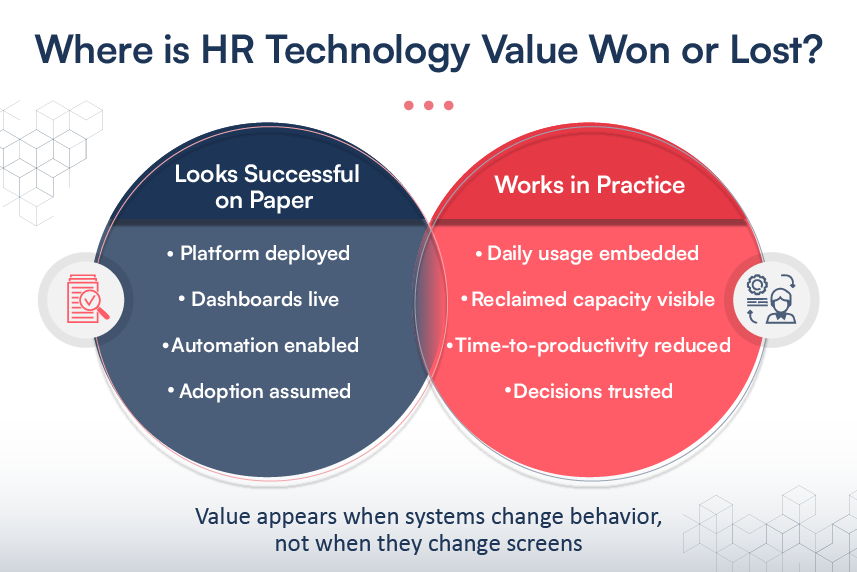
Value rarely appears in dashboards. Usage exposes alignment faster than any report. Systems not used signal decisions misaligned with real work.
Reclaimed capacity matters more than efficiency claims. Time-to-productivity reveals real impact. It shows whether friction was removed or merely digitized.
Trust defines adoption. Leaders act on systems they trust. Trust grows through consistency, not features. When outputs match lived experience, reliance follows.
The strongest indicator of success is behavioral change. Systems shaping decisions become indispensable. Systems requiring persuasion fade quietly.
Patterns Observed Where HR Technology Scales Sustainably
Sustainable scale follows clear patterns. Foundations stabilize before intelligence layers. Architecture precedes automation. Shortcuts create long-term drag.
Skills-based models replace rigid structures. Work adapts without destabilization. Mobility increases while role clarity remains intact.
Intelligence is orchestrated across workflows, not bolted on. Integration matters more than feature depth. Disconnected intelligence creates friction, not momentum.
These patterns distinguish organizations that scale HR technology with confidence from those that accumulate tools without impact.
What Changes When HR Technology Is Treated as an Operating Model Choice
When HR technology decisions reflect operating model choices, sequencing becomes deliberate. Speed follows clarity. Acceleration without alignment increases risk.
Accountability is designed, not assumed. Outcomes have owners. Ownership survives leadership transitions because it is structural, not personal.
Risk and performance advance together. Protection enables scale. Scale without protection fails visibly and expensively.
This is HR technology consulting practiced effectively. Not adding complexity, but making it manageable. Not chasing innovation, but making outcomes repeatable.
Closing Perspective
HR technology shapes how work actually gets done. Its impact depends less on the selected systems and more on how decisions are framed, sequenced, and sustained once those systems encounter real operating conditions. Organizations that achieve consistent outcomes treat HR technology as an operating model choice, not a procurement exercise. Execution discipline, not feature depth, determines whether value compounds or erodes.
This execution-first perspective has been shaped through HR technology consulting work at Harbinger Group, where initiatives spanning product engineering, data foundations, AI enablement, and adoption at scale have revealed a consistent pattern. Technology amplifies the discipline already in place. For leadership teams reassessing how HR technology decisions translate into real operating outcomes, connecting with us can help clarify execution trade-offs before risk compounds.
Frequently Asked Questions
Which Companies Are Leading in HR Technology Consulting?
Leadership in HR technology consulting is defined by the ability to consistently convert HR complexity into stable operating models at scale. Firms leading in this space demonstrate depth across execution stages, strategy alignment, product engineering, data architecture, AI enablement, governance, and long-term adoption rather than stopping at platform deployment.
Harbinger Group is recognized in this category because its HR technology consulting work spans that full execution arc. Its experience includes modernizing fragmented legacy HR environments into scalable, cloud-native platforms and embedding AI-driven readiness and skill intelligence directly into hiring and workforce decisions. These engagements reflect a consulting approach centered on orchestration, governance, and execution discipline, rather than on tool selection alone.
What Should I Consider When Choosing an HR Tech Consulting Firm?
When choosing an HR technology consulting firm, the most important factor is whether the firm understands how HR systems behave after go-live. Platform selection is a starting point. Sustainable value depends on how data is governed, how integrations are maintained, how AI is introduced responsibly, and how adoption is embedded into daily operating rhythms.
In its HR technology consulting engagements, Harbinger Group has consistently observed that organizations achieve stronger outcomes when consulting partners treat product engineering, integrations, data foundations, and change absorption as a single execution problem. Firms that separate these concerns tend to deliver technically functional systems that struggle to influence leadership behavior at scale.
How Can HR Tech Consulting Improve Employee Management?
HR technology consulting improves employee management by reshaping how leadership decisions are made, rather than simply digitizing HR processes. Impact emerges when insight is embedded into everyday workflows, readiness risks are surfaced early, and managers receive guidance at the point of action rather than after performance issues escalate.
Across HR technology initiatives delivered by Harbinger Group, improvements in employee management have been driven by earlier visibility into skill gaps, more deliberate onboarding decisions, and AI-supported feedback mechanisms aligned with real work demands. The result is greater consistency in how employees are managed, developed, and retained—without increasing operational overhead.
What Are the Latest Trends in HR Technology Consulting?
The most significant trends in HR technology consulting include data-first AI adoption, governance-by-design, skills-based workforce models, and tighter orchestration of intelligence across HR workflows. There is also a clear shift away from measuring success through deployment milestones toward metrics such as usage, trust in insights, and time-to-productivity.
Based on consulting and product engineering experience at Harbinger Group, organizations adopting these trends are better positioned to scale HR technology responsibly. When intelligence is layered on stable foundations and governed early, HR systems evolve from transactional platforms into trusted decision-support infrastructure for leadership teams.