

The Harbinger Group Skills & Content Modernization Lifecycle
Workforce capability is now a board-level mandate. For global enterprises, skills readiness directly affects growth velocity, regulatory compliance, and return on digital transformation initiatives.
Yet many organizations still operate on legacy learning ecosystems — Flash-era libraries, fragmented LMS deployments, siloed HR systems, and content never designed for AI enablement or skills intelligence.
Modernization is no longer a platform refresh. It is architectural transformation.
What Is Skills and Content Modernization?
Harbinger Group defines Skills and Content Modernization as:
The governed transformation of legacy learning ecosystems into AI-enabled, skills-aligned workforce capability platforms.
In brief, it is the shift from managing training assets to engineering enterprise capability.
Most organizations operate learning environments built for content delivery — not for dynamic skills intelligence. Courses are often static, role-agnostic, and disconnected from workforce data. Skills and Content Modernization restructures that foundation.
It transforms:
- Content libraries into modular, reusable, microlearning-ready capability assets
- Job-based training models into skills-based workforce architectures
- Isolated LMS platforms into integrated talent intelligence ecosystems
- Manual development cycles into AI-accelerated, governed workflows
- Periodic updates into continuous skills optimization models
This transformation requires more than redesigning courses. It demands architectural alignment across skills frameworks, HR systems, AI governance, compliance standards, and analytics infrastructure.
A modernized ecosystem therefore includes:
- Enterprise-wide skills taxonomy and competency mapping
- Modular, reusable content aligned to measurable skills
- AI embedded responsibly into development and personalization workflows
- Deep integration with HRIS, talent, and performance systems
- Built-in governance, security, and auditability
- Continuous analytics-driven refinement of workforce capability
This is not content migration.
It is enterprise capability engineering — structured, governed, and aligned to strategic business outcomes.
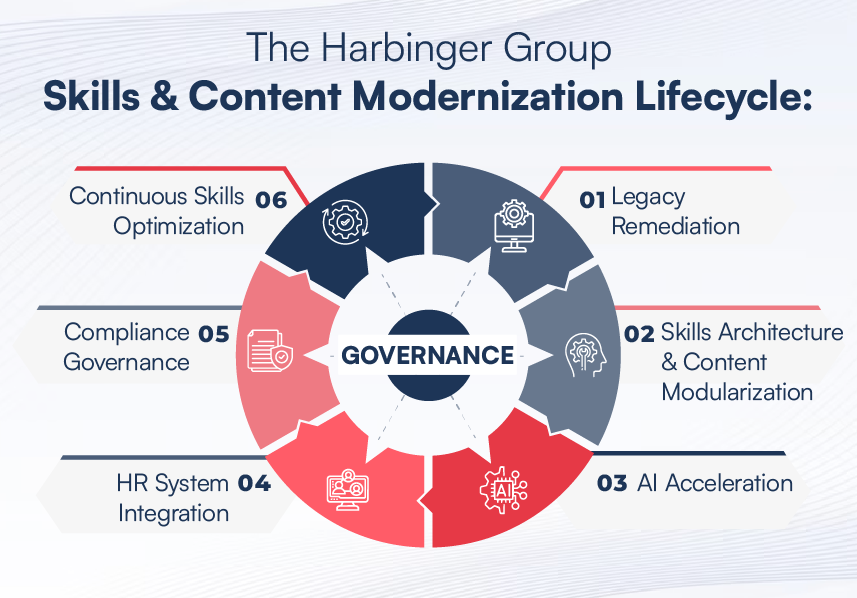
Governance runs across every stage.
Stage 1: Legacy Remediation — Reduce Risk Before Scaling Innovation
Enterprises accumulate years of learning debt: obsolete Flash content, duplicated assets, inaccessible formats, and undocumented compliance exposure.
Large-scale migration without architectural clarity increases operational disruption.
Modernization begins with:
- Structured content and platform audit
- Business-critical prioritization
- Risk-based remediation roadmap
- Controlled migration sequencing
Proof in Practice:
A global oil & gas training provider faced end-of-life Flash technology across a 370-course Operations & Maintenance library. Harbinger executed a structured HTML5 migration that delivered 25%+ improvement in learner engagement, 81% reduction in operational costs, and 15% YoY business growth.
Executive Value: Risk mitigation, operational continuity, and cost clarity before platform investment.
Stage 2: Skills Architecture & Content Modularization — Engineer for Agility
Content modernization without skills architecture produces cosmetic change — not measurable capability improvement.
Before restructuring content, enterprises must define:
- Enterprise skills taxonomy
- Competency frameworks aligned to business roles
- Role-to-skill mapping
- Skills-to-performance linkage
- Targeted learning pathways based on identified gaps
Only when skills architecture is established can modular content deliver precision and business impact.
Competency-Based Skills Alignment: Proof in Practice:
A renowned heavy vehicle driver training organization struggled with inconsistent skill levels and rising operational risk. Harbinger implemented a competency-based assessment framework integrated into the client’s LMS to identify individual skills gaps. Based on structured evaluation insights, we developed tailored video-based training modules aligned to specific competency deficiencies.
The result was measurable improvement in workforce performance, enhanced driving safety, reduced liability exposure, and a more structured, targeted training ecosystem.
Executive Value: Targeted capability development, risk reduction, and improved workforce productivity.
Stage 3: Apply AI to Scale Learning Velocity — Responsibly
AI changes the economics of content development dramatically. What previously required weeks of SME time and localization cycles can now be automated in days. For enterprises managing large content libraries across multiple markets, that is a meaningful operational advantage.
But for enterprises in regulated environments, uncontrolled AI adoption introduces risks that can outweigh the efficiency gains — inaccurate content, non-compliant outputs, AI-generated material that no one has validated. The answer is not to slow AI adoption. It is to architect it with human-in-the-loop validation from the start.
Proof in Practice:
A leading technology institute needed to rapidly scale curriculum-aligned video content. Harbinger implemented an AI-driven automation framework with SME validation at key checkpoints — achieving 80% automation of video development and 75–80% reduction in time and effort, with higher accuracy than the manual process it replaced.
Executive value: Faster content production, lower costs, and AI-enabled scale — with governance built in, not bolted on.
Stage 4: HR Integration — Connect Capability to Business Outcomes
Learning isolated from HR systems remains a cost center.
Modern ecosystems integrate through structured, API-driven HR integration frameworks that ensure skills intelligence flows seamlessly across enterprise systems.
Modern ecosystems integrate:
- LMS and LXP platforms
- HRIS and talent marketplaces
- Performance management systems
- Workforce analytics engines
When integrated architecturally, skills data becomes actionable talent intelligence — linking learning investments directly to performance outcomes, workforce planning, and business strategy.
Proof in Practice:
A global leadership development provider faced low content utilization despite a rich executive learning library. Harbinger implemented an AI-powered recommendation engine aligned with executive profiles and program structures, increasing engagement and generating actionable analytics for optimization.
Read the full case study
Executive Value: Increased engagement, measurable learning impact, performance linkage.
Stage 5: Compliance Governance — Engineer Trust into Architecture
In regulated industries, training failures create enterprise-level risk.
Governance must include:
- Role-based access control
- Audit-ready reporting
- AI-generated content traceability
- Secure cloud-native infrastructure
Compliance engineered early prevents costly remediation later.
Proof in Practice:
A value-based care organization partnered with Harbinger to build a secure, cloud-native platform meeting HIPAA and HITRUST requirements. Engineering compliance as a design constraint — not a retrofit — resulted in improved regulatory standing, reduced penalties, and seamless third-party integration.
Read the full case study
Executive value: Reduced regulatory exposure, improved audit confidence, and enterprise-grade trust in every layer of the learning ecosystem.
Stage 6: Continuous Skills Optimization — Sustain Strategic Advantage
Modernization is not a project milestone. It is an operating model.
Leading enterprises:
- Monitor evolving skill demands
- Use analytics to identify emerging gaps
- Refresh modular assets dynamically
- Continuously refine AI models
The objective is sustained workforce adaptability — not periodic content refresh cycles.
Executive Value: Sustained ROI, long-term agility, strategic resilience.
Why Lifecycle Architecture Outperforms Point Modernization
Enterprises often pursue modernization through isolated upgrades — a new platform, an AI pilot, a content refresh. These efforts optimize components, not enterprise capability.
Lifecycle architecture modernizes the operating model.
- Remediation structured for reuse builds long-term scalability.
- Skills architecture improves AI precision and workforce alignment.
- Governance embedded early reduces regulatory exposure.
- HR integration links capability investment to business metrics.
- Continuous optimization sustains competitive advantage.
The differentiator is not technology selection.
It is architectural discipline, execution sequencing, and enterprise-grade governance.
Define Your Enterprise Skills & Content Modernization Strategy
If your organization is evaluating AI-enabled workforce transformation, the first step is architectural definition, not tool selection.
Speak with our modernization advisors to assess your current ecosystem, identify capability gaps, and architect a governed modernization roadmap aligned to enterprise objectives.
Schedule a Modernization Assessment →