


Most established EHS content providers already have what they need to scale. They’ve invested in accurate, defensible safety content and EHS training content. Their courses are validated, trusted, and proven in the market. The challenge they face today isn’t whether their catalogs are strong enough. It’s about extending them globally and across industries without slowing teams down or increasing risk.
As enterprise buyers expand into new regions and demand industry-relevant safety training, providers are under pressure to move faster by scaling EHS content globally without turning localization and verticalization into one-off, high-effort projects.
The opportunity isn’t to rethink the catalog. It’s to operationalize how that catalog is extended.
This blog explores how EHS content providers can extend trusted safety content globally and across industries by scaling execution models rather than rebuilding courses.
Execution Challenges in Scaling EHS Content Globally and Across Industries
When expansion accelerates, complexity doesn’t come from the content itself. It comes from execution.
Multi-language delivery introduces challenges beyond translation, especially when managing EHS content localization at scale. Industry-specific versions require consistency to support EHS industry vertical expansion. Updates must move across regions and verticals without multiplying effort. And all of it needs to happen quickly, accurately, and cost-effectively.
The table below highlights where teams typically encounter challenges and what scalable execution looks like in practice.
Common Challenges in Scaling EHS Content and How Execution Models Address Them
| Expansion Need | Common Challenges | Scalable Execution Model |
|---|---|---|
| Multi-language rollout | One-language-at-a-time delivery; text embedded in graphics; inconsistent handling of on-screen text, audio, and visuals | Standardized localization workflows that handle text, graphics, audio, and media together—supporting parallel, multi-language delivery |
| Graphics-heavy content | Manual rework of diagrams, signage, and safety visuals for each language | Design and asset standards that enable efficient localization of visual elements |
| Industry-specific relevance | Custom courses created per vertical; inconsistent adaptations | Industry context layered onto validated core content, guided by clear standards for what changes—enabling repeatable, automated updates |
| Global updates | Changes applied individually to each version | Updates applied once and automatically propagated across languages and industry variants |
| SME involvement | SMEs repeatedly reviewing full courses | SMEs validating defined deltas based on standardized change rules |
| Timeline pressure | Sequential rollouts that slow market entry | Parallel execution that reduces timelines significantly |
| Cost management | Costs increase with every new region or industry | Cost efficiency through standards, reuse, and automation |
This shift from one-off execution to repeatable operations is what enables scale.
How Leading EHS Providers Shift from One-Off Projects to Scalable Execution
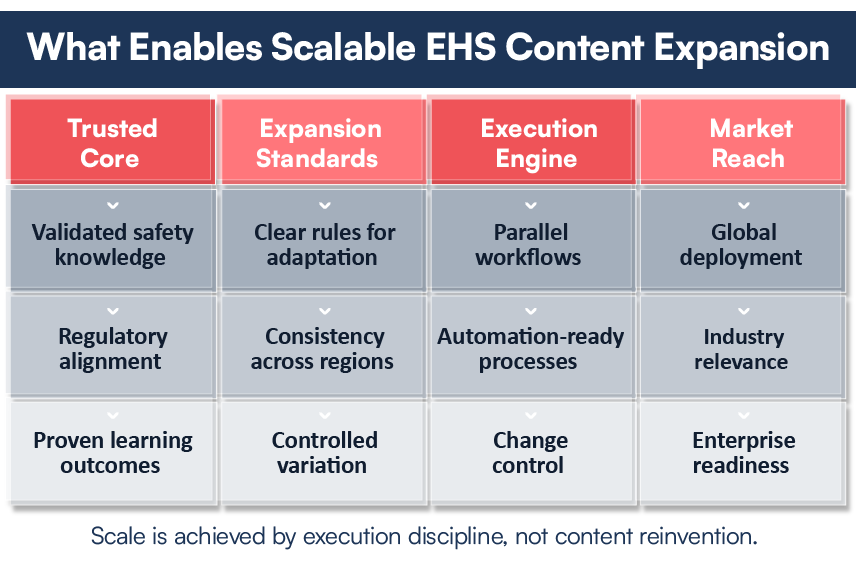
EHS providers that scale successfully don’t change their content. They change how expansion is executed.
In practice, that means:
- Preserving existing master courses exactly as they are
- Introducing standards that define what gets localized or industry-layered and what does not
- Using those standards to enable automation and parallel workflows
- Reducing timelines by avoiding sequential, one-at-a-time updates
- Improving cost efficiency by reusing structures, assets, and processes
The content remains trusted. The execution becomes faster, safer, and more economical.
How Harbinger Enables Scalable Global and Industry Expansion for EHS Providers
We work with organizations that already maintain robust, commercially licensed EHS and compliance catalogs, often supporting delivery across dozens of countries and multiple industries through enterprise EHS content management.
Our role is focused on execution: helping teams localize at scale and create industry-layered versions of existing courses without altering the validated core. This includes managing the complexities of multilingual graphics, efficiently coordinating SME validation, and establishing standards that enable updates to move through the system quickly and with control.
When localization and verticalization are built on repeatable standards, providers can reduce timelines, control costs, and expand with confidence—without adding operational burden.
Benefits for EHS Content Providers
When global and vertical expansion are executed at scale, providers gain:
- Faster entry into new geographic markets through global EHS training deployment
- The ability to support multiple industries without rebuilding content
- Lower long-term localization and maintenance costs
- Reduced accuracy and compliance risk
- Greater appeal to multinational enterprise buyers
Most importantly, expansion stops being a bottleneck.
A Final Thought
Your catalog is already ready to scale. The question is whether your execution model is.
If localization and industry-specific versions are slowing you down—or becoming more expensive than expected—it may be time to rethink how expansion happens, not what content you deliver.
If you’re navigating this shift, we’re always open to a focused conversation on how others are reducing timelines and costs while expanding globally and vertically.
Global and industry expansion does not have to mean rebuilding trusted EHS content or increasing operational risk. When execution is designed for scale, providers can quickly, consistently, and with control extend validated courses into new regions and industries.
Contact us to discuss how Harbinger helps EHS content providers achieve EHS content scalability without rebuilding validated content.