



Table of Contents
- Introduction
- What AI-Native Learning Really Means and Why It Matters
- A Seven-Pillar Readiness Framework for AI-Native Learning
- Evaluating Your Learning Technology for the AI-Native Era
- Common Challenges on the Journey to AI-Native Learning
- Business Benefits: What Changes When Learning Becomes AI-Native
- Harbinger’s Approach: Building AI-Native Learning Without Starting Over
- Conclusion
Introduction
AI is now embedded in everyday work, and business knowledge is changing weekly. Employees expect contextual guidance during work, not after training or a course completion. However, organizations still rely on courses that were built months ago. Traditional L&D models cannot keep pace. As this gap widens, AI-native learning is emerging as a strategic approach for helping enterprises keep learning aligned with business changes.
Many organizations are deploying AI pilots, content generation, chatbots, and intelligent search to enhance learner experiences and accelerate content development. While these initiatives look promising, but most stay disconnected, solving individual problems rather than transforming enterprise learning. They rarely connect learning to organizational knowledge, business workflows, workforce data, or governance.
Deloitte’s latest Human Capital Trends research suggests organizations are reaching a tipping point. As business change accelerates, leaders are shifting their focus from delivering training to building adaptable workforce capabilities that can respond to change faster and support business performance.
This urgency arises due to several factors.
Agentic AI is moving from experimentation to real deployment. Organizations are restructuring around skills, not job titles. Products and processes now change continuously. Regulatory requirements keep shifting. And learning itself is moving into the flow of work. These shifts are the reason why conversations around AI-native learning are gaining momentum.
What AI-Native Learning Really Means and Why It Matters
AI-native learning represents a shift from applying AI to individual learning tasks to embedding intelligence across the entire learning ecosystem. More importantly, it reflects a change in mindset.
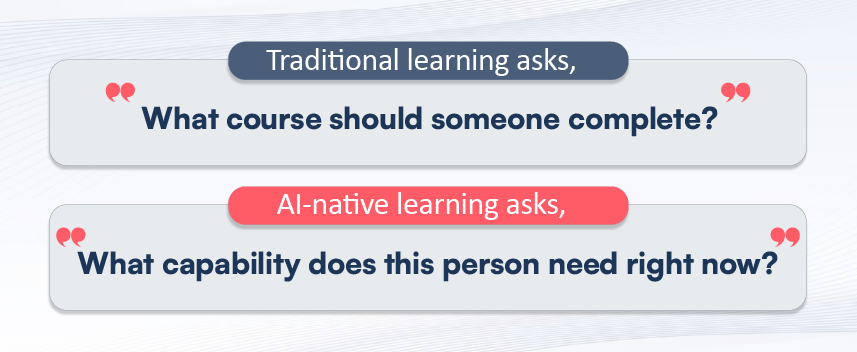
The goal is no longer simply to deliver more learning, but to continuously build workforce capability through AI-driven intelligence that adapts to changing business needs. Rather than being defined by a single platform, AI is embedded into the learning architecture, continuously connecting enterprise knowledge, learner context, business priorities, and workflows to recommend timely interventions and improve workforce capability over time.
Instead of treating learning as a sequence of assigned courses, AI-native environments continuously identify what employees need to know, recommend appropriate interventions, and improve those recommendations as new information becomes available.
Let’s look at an example
Consider a pharmaceutical company updating its product compliance guidelines. In a traditional environment, administrators manually update courses, assign training, and track completion over several weeks. In an AI-native learning environment, it can identify affected employees and recommend, or trigger approved interventions based on defined governance, alert managers to capability gaps, and monitor workforce readiness through real-time dashboards, reducing response time from weeks to days.
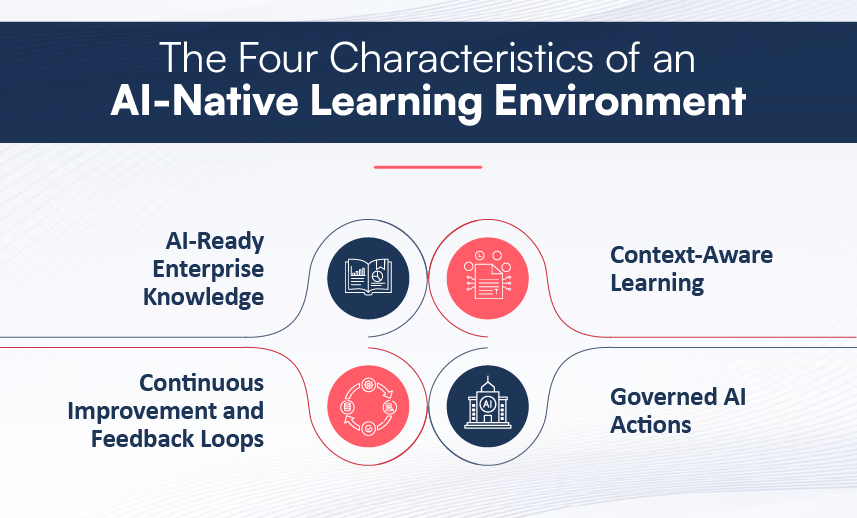
For many organizations, AI-native learning combines AI-ready content, connected systems, responsible governance, and an AI-native LMS. Rather than operating in isolation, the AI-native LMS connects learning with business workflows, enterprise knowledge, and workforce data to deliver contextual learning, orchestrate timely interventions, and generate actionable insights as business needs evolve.
A Seven-Pillar Readiness Framework for AI-Native Learning
Technology alone does not determine whether AI initiatives succeed or deliver measurable business value. Sustainable AI-native learning depends on organizational readiness across strategy, content, technology, data, governance, people, etc.
The seven readiness pillars below provide a practical framework for assessing these foundational capabilities before scaling AI initiatives.
| Readiness Pillar | What Good Looks Like | Warning Signs | Leadership Question |
|---|---|---|---|
| Learning Strategy | Learning priorities directly support business objectives and workforce capability goals. | AI initiatives remain disconnected from business outcomes. | Are our learning investments solving measurable business problems? |
| Content Readiness | Learning content is current, well-structured, consistently formatted, and tagged with accurate metadata. | Duplicate content, inconsistent formats, missing or inconsistent metadata. | Can AI reliably locate and reuse our learning content? |
| Knowledge Readiness | Content sources carry clear authority, version history, and defined ownership, with conflicts between sources actively resolved. | Conflicting information across sources, unclear ownership, outdated versions are still in circulation. | Can AI trust which version and source of knowledge is correct? |
| Technology & Integration | Learning systems exchange context with HRIS, CRM, and workflow tools, so learning reflects a person’s actual role, project, and performance data. | Learning recommendations ignore role changes, project context, or performance signals sitting in other systems. | Can a learner’s real work context shape what they’re taught, not just what they’re assigned? |
| Data & Intelligence | Skills data, performance data, and LMS completion data are connected, enabling insight beyond course activity. | Skills data sits disconnected from performance data; LMS completions don’t reflect actual workflow signals. | Can we measure workforce capability rather than training activity? |
| AI Governance | Responsible AI policies define permissions, traceability, and human review for content sourcing, learner personalization, and skills-gap conclusions. | Limited oversight of how training materials are sourced, how personalization decisions are made, or how skills gaps are flagged. | Can we trust and audit every AI-generated learning recommendation? |
| Operating Model & People | L&D, IT, HR, business leaders, and content owners collaborate around shared objectives. | AI remains isolated within individual departments. | Do our teams have clear ownership and governance for AI initiatives? |
Organizations don’t need to be equally mature across all seven pillars before they begin, but significant gaps in knowledge, governance, data, or integration should shape where they start.
Evaluating Your Learning Technology for the AI-Native Era
Many technology vendors now position their platforms as AI-enabled or AI-first. However, adding AI capabilities does not automatically make a platform ready for AI-native learning.
The following evaluation framework can help technology and learning leaders assess long-term readiness.
| Evaluation Area | Questions Leaders Should Ask | Why It Matters |
|---|---|---|
| Enterprise Knowledge | Can AI access approved learning content, SOPs, policies, and enterprise knowledge? | Ensures accurate, traceable, and trustworthy responses. |
| AI-Ready Content | Is content structured with metadata, semantic relationships, and governance? | Enables AI to understand knowledge rather than simply search documents. |
| Context Retention | Can AI retain learner, role, project, and business context across systems? | Delivers personalized learning aligned with real work. |
| Cross-Platform Integration | Does the platform integrate with HRIS, CRM, collaboration tools, and workflow applications? | Learning becomes embedded within everyday work instead of remaining isolated. |
| Workflow Orchestration | Can AI trigger governed learning interventions based on business events? | Accelerates workforce readiness while reducing manual effort. |
| Agentic AI | Can AI safely trigger approved learning actions, like assigning a refresher or alerting a manager, rather than only recommending them? | Enables scalable learning interventions while keeping human oversight in the loop. |
| Governance & Explainability | Can every learning recommendation be traced to approved source content? | Builds learner and leadership trust and supports regulatory compliance. |
| Security & Scalability | Can the platform support enterprise-grade security, permissions, and future AI models? | Protects organizational knowledge while enabling long-term growth. |
| Business Outcomes | Can the platform demonstrate impact beyond completion metrics? | Proves ROI in terms leadership actually tracks. |
Common Challenges on the Journey to AI-Native Learning
Moving from AI pilots to AI-native learning requires more than deploying new technology. The barriers often lie in enterprise readiness, governance, and organizational adoption.
Content readiness is one challenge. AI depends on content that follows consistent formats, carries accurate metadata, and stays current. Without this, AI struggles to locate and reuse content reliably. Check the five signs your content is AI-ready!
Knowledge readiness is another challenge. Formatting alone isn’t enough if a system can’t tell which source is authoritative, which version is current, or who owns a piece of content, or if conflicting information exists across systems. Without this, AI may generate outdated or contradictory recommendations.
Data readiness presents another challenge. AI-native learning depends on connected skills, performance, and behavioral data. When skills data sits disconnected from performance data, AI can recommend the wrong course for the wrong gap or miss the gap entirely.
Responsible AI governance is equally critical. Leaders need explainability and human oversight over how AI sources training content, personalizes learning paths, and flags skills gaps, not generic AI oversight, but controls built for learning decisions specifically. Use our AI governance checklist to assess where you stand.
Trust is also a distinct challenge. Governance controls whether AI recommendations are auditable, trust influences whether people are willing to act on them. Employees may question why a course was recommended; managers may hesitate to act on an AI-flagged capability gap without a human sign-off first.
Finally, successful adoption depends on people and change management. Manager confidence, employee trust, AI literacy, transparency, consent, and clear escalation paths all influence adoption. As AI capabilities become increasingly agentic, the objective should not be to automate every learning decision, but to design effective human-AI collaboration, where AI augments L&D expertise while people retain accountability for strategic and high-impact workforce decisions.
Business Benefits: What Changes When Learning Becomes AI-Native
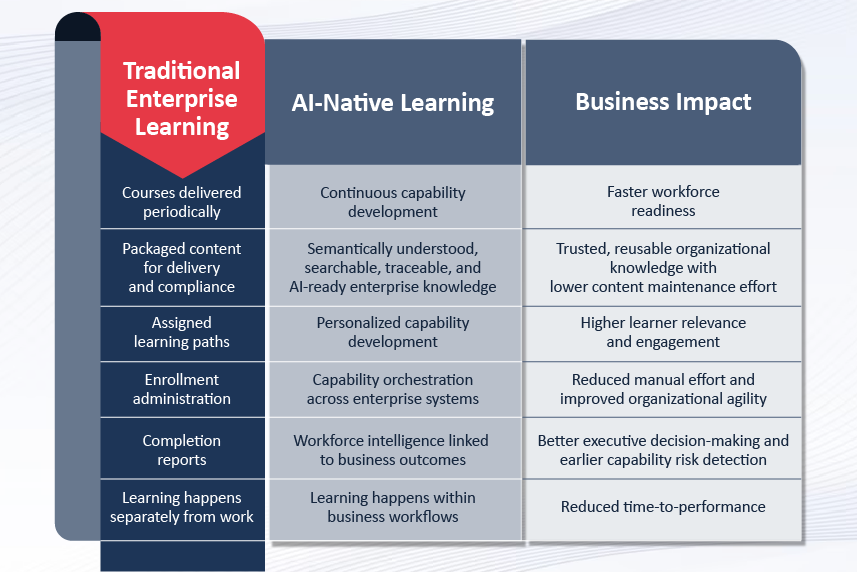
The business impact becomes even clearer when viewed through practical scenarios as follows.
Example 1: Onboarding
A new employee joins the organization.
Business signal → New role assignment
AI decision → Analyze role, location, previous experience, and required competencies
Learning intervention → Generate a personalized onboarding pathway with role-specific practice
Human oversight → Manager validates readiness
Business outcome → Faster time to productivity
Example 2: Sales Enablement
A product portfolio changes.
Business signal → Product update released
AI decision → Identify affected sales teams and capability gaps
Learning intervention → Assign targeted learning, simulations, and coaching
Human oversight → Sales managers monitor readiness
Business outcome → More consistent customer conversations
Example 3: Compliance
A new regulation becomes effective.
Business signal → Regulatory update
AI decision → Detect impacted employees and outdated learning assets
Learning intervention → Deliver personalized compliance refreshers
Human oversight → Compliance leaders approve interventions
Business outcome → Improved compliance readiness with reduced manual effort
Harbinger’s Approach: Building AI-Native Learning Without Starting Over
Harbinger has spent over two decades building learning technology and content for enterprises, not experimenting with AI as a side project. Harbinger brings over three decades of experience across learning technology and content, giving us a practical view of how AI needs to work across the broader learning ecosystem. Explore our AI-based learning solutions and broader products and solutions for details.
One of the biggest misconceptions about AI-native learning is that it requires replacing the entire learning ecosystem. In reality, most organizations modernize incrementally, building on existing LMS investments while extending capabilities or adopting an AI-native LMS where needed to support broader business and workforce transformation.
At Harbinger, we view AI maturity as a continuum rather than a rebuild. We understand that every enterprise stands at a different point. So, instead of prescribing a single path, we help them choose the transformation approach that best fits their environment. We partner with them to help them evolve from isolated AI initiatives to an integrated, governed AI-native learning ecosystem.
This isn’t just a philosophy: in one of the engagements, our governance-by-design approach helped a client’s AI systems remain explainable, auditable, and compliant while scaling adoption across the organization. Explore Success Story!
The table below shows how common readiness gaps translate into transformation priorities, practical first steps, and the business outcomes organizations can expect:
| Readiness Gap | How Harbinger Helps | Recommended First Step | Expected Outcome |
|---|---|---|---|
| Weak content foundation | Modernize legacy content into AI-ready, semantically structured, governed knowledge with metadata, version control, and content lifecycle management, drawing on our eLearning content development expertise. | Audit content quality, ownership, metadata, and lifecycle. | Trusted, AI-ready knowledge |
| Fragmented enterprise systems | Integrate LMS, HRIS, CRM, collaboration platforms, knowledge repositories, and business systems to enable connected learning experiences. | Identify the systems that should exchange learning and performance data. | Connected learning ecosystem |
| Legacy platform constraints | Modernize existing learning platforms or build an intelligent experience layer that extends current LMS investments with AI-native capabilities. | Assess whether existing platforms can support AI-native capabilities. | Higher ROI from existing investments |
| Limited AI governance and controls | Establish responsible AI governance specifically for learning decisions: explainable content sourcing, auditable personalization, and human review of skills-gap conclusions, backed by enterprise-grade security and compliance. | Define AI policies, review workflows, and accountability. | Trusted and compliant AI adoption |
| Unclear AI roadmap | Conduct AI readiness and value assessments to define a phased roadmap for workforce capability, aligned with business priorities and learning technology maturity. | Prioritize the workforce capability gaps with the highest business impact before selecting technology. | Lower implementation risk |
| Ongoing AI quality and operations | Monitor the accuracy of learning recommendations, freshness of source content, and workforce capability outcomes after deployment, continuously improving what the platform recommends and why. | Establish KPIs and governance for post-deployment monitoring. | Sustainable AI performance |
Conclusion: AI-Native Learning Is a Journey, Not a Technology Upgrade
AI pilots have helped enterprises understand what AI can do. But AI-native learning transforms how they build workforce capability at scale.
Success requires more than chatbots, copilots, or content generation, or even an AI-native LMS alone. It demands an intelligent learning ecosystem that connects enterprise knowledge, business workflows, governance, and AI. The organizations that gain the most from AI won’t necessarily be the ones with the newest LMS. They’ll be the ones that connect knowledge, learning, workflows, and business outcomes into a continuously improving capability system.
Ready to move beyond AI pilots and build an AI-native learning strategy?
Book a consultation with us. Connect at contact@harbingergroup.com or visit https://www.harbingergroup.com/contact-us/.


