

For years, digital publishers treated learning content as production projects. Courses were built, launched, and revisited only when a platform migration or compliance update forced a refresh. This model worked when delivery channels were stable and revision cycles were long.
But today’s learning ecosystems are different. Content must operate across platforms, adapt to new delivery formats, support accessibility requirements, and evolve alongside changing skills. This shift is pushing organizations toward a new operating model: content engineering.
Defining Content Engineering
Content engineering treats learning content as an evolving system rather than a collection of finished courses. Instructional material is organized into modular components that can be updated, governed, and delivered across platforms without rebuilding entire courses.
The Real Problem: Legacy Content Was Built to Be Delivered, Not Sustained
Most learning catalogs were built to meet release schedules. They were not designed to evolve.
Publishers and learning organizations now manage hundreds of courses created in different tools over many years. The instructional material is often strong, but the assets used are not. Many courses rely on formats that are hard to update, structures that resist reuse, or files that cannot be modified efficiently.
We see the same patterns repeatedly:
- Every update behaves like a redevelopment project.
- Accessibility compliance must be handled course by course.
- Content cannot move easily across formats or platforms.
- Platform migrations preserve existing structural constraints.
Migration Moves the Content but Leaves the Burden Behind
When maintenance pressure grows, organizations usually respond with a platform migration. Formats convert. Interfaces improve. But the underlying structure remains unchanged. And the same maintenance challenges reappear into the new system.
This is why many publishers go through conversion cycles every few years. Each migration solves an immediate problem but it does not change how content is maintained.
Though technology speeds execution, it does not reduce structural load.
Rebuilding Content Repeats the Same Investment
When migration fails to solve the problem, organizations often redevelop courses. Subject matter experts rewrite material because it cannot be separated from legacy formats. Teams spend time recreating knowledge instead of managing it. The organization completes another production cycle, but long-term sustainability does not improve.
Without structural change, redevelopment becomes a recurring expense rather than a strategic investment.
This challenge was the focus of a recent industry discussion hosted by Harbinger: how digital publishers are restructuring content, workflows, and governance to support continuous modernization rather than periodic conversion.
The discussion included Shrikant Pattathil, President and CTO of Harbinger Group; Dale Walden, Vice President of Product Management at MadCap Software; Nicholas Igneri, Founder and CEO of Innovative Learning Ventures, LLC; and Poonam Jaypuriya, Vice President – eLearning at Harbinger Group — each sharing their perspective on what it takes to build content systems that genuinely scale.
Treating Knowledge as a Managed System Changes the Equation
Publishers that take a different approach work at the structural level. They do not treat courses as finished packages.
They restructure the underlying material so it can be maintained and recombined over time. Components update independently. Teams assemble different delivery experiences without rebuilding everything.
“We tend to think about content as a package formatting and presentation. But that’s a means to an end. The real value is the knowledge being communicated and the context around it. Content engineering is pushing us to focus on that knowledge so it can be reused and adapted by different systems.”
— Dale Walden, Vice President of Product Management, MadCap Software
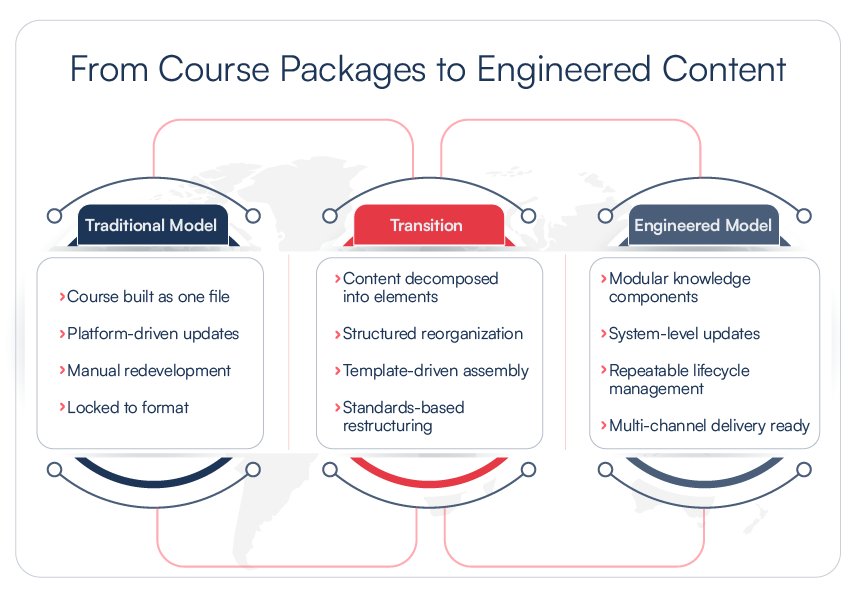
One publisher needed to modernize more than 500 legacy courses totaling over 600 learning hours. The timeline was compressed. Access to original source files was limited.
Usable material was extracted from existing outputs. It was reorganized into structured formats. It was rebuilt using standards-based frameworks and reusable templates. The instructional content remained intact. The organization gained a maintainable format.
Repeatable Models Replace One-Time Conversion Efforts
One of the most significant operational changes that content engineering enables is the shift from bespoke production to repeatable models. Traditional production workflows assume each course is unique. Structured environments rely on repeatable models.
“We need to start asking a different question: what skills will current role require 6, 12, or 18 months from now? That makes content engineering a continuous process tied to evolving needs, not a one-time update.”
— Nicholas Igneri, Founder and CEO, Innovative Learning Ventures, LLC
These models allow content to be analyzed, reorganized, validated, and assembled consistently.
Automation supports extraction, formatting, and quality checks. Human review protects accuracy and instructional intent.
Structured Content Enables Continuous Adaptation
Once content is organized into reusable components, teams respond to new requirements without starting over.
“Modernization is no longer about redesigning courses. It is about re-engineering how content is created, structured, and managed so it can evolve continuously and work across systems.”
— Poonam Jaypuriya, Vice President – eLearning, Harbinger Group
Accessibility standards apply across the catalog and there is no need to revisit each course. Material can be localized, alternate formats can be assembled, and the same knowledge can be delivered across multiple platforms from a shared foundation.
A learning solutions provider introduced a defined content model supported by standardized templates. Internal teams could assemble and update courses independently.
Development timelines shortened. Catalog expansion no longer depended on repeated redevelopment. Content became easier to extend because it was not tied to a single format.
Leadership Determines Whether This Becomes Sustainable
Content engineering is not a tooling decision. It is an operating decision.
“Modernization is no longer just about refreshing content. It requires thinking about the entire ecosystem, the platform, the content structure, the skills it supports, and the governance around it. When all these components work together, content can evolve continuously rather than through periodic upgrades.”
— Shrikant Pattathil, President and CTO, Harbinger Group
Organizations must move away from episodic conversion funding. We need sustained ownership of content structure, governance, and maintenance. That includes shared models, taxonomies, and workflows that align editorial, learning, and technology teams.
This shift mirrors how organizations manage data and software architecture. The objective is continuity. Not periodic reconstruction.
Operational Benefits Follow Structural Discipline
When publishers manage content in a structured way, control returns to the organization.
Regulatory or product changes do not require reopening entire courses. Material can be reused across formats without redevelopment. SME involvement in routine updates declines. Existing investments last longer.
The catalog becomes maintainable. Not episodic.
From Conversion Projects to Durable Content Systems
Digital publishers do not struggle to create content. They struggle to keep it maintainable. Production models assume completion. Modern delivery environments require continuity. Without structural change, maintenance effort increases and responsiveness declines.
Content engineering provides a way to sustain what we have already built. Knowledge can be updated, reorganized, and delivered without restarting the cycle every time technology shifts.
Harbinger works with digital publishers at this stage, focusing on practical structure, governance, and workflows that internal teams can operate long term. The goal is not another modernization initiative. It is to ensure existing content investments remain usable, adaptable, and maintainable over time.Do you want to learn how content engineering can benefit your organization? Click here to connect with our experts.
Frequently Asked Questions (FAQs)
1. What is content engineering in digital publishing?
Content engineering is the practice of structuring instructional material into modular, reusable components that can be updated, governed, and delivered across multiple platforms without redevelopment.
2. How is content engineering different from course modernization?
Modernization often focuses on format conversion or interface redesign. Content engineering restructures the underlying material so it can evolve continuously.
3. When should publishers consider a structural redesign of content?
When updates require redevelopment-level effort, platform migrations repeat constraints, or scalability becomes operationally difficult.
4. Does content engineering replace subject matter expertise?
No. It reduces repetitive redevelopment work and allows SMEs to focus on validation, accuracy, and forward-looking skill alignment.
5. What business impact does structured content create?
It improves speed to market, lowers maintenance cost, simplifies accessibility compliance, and extends the lifespan of existing content investments.