


Table of Contents
- Why AI-Powered Learning Ecosystems Require AI-Ready Content
- What “AI-Ready” Learning Content Really Means and Why It’s Different from “Good Content”
- The Learning Content AI Readiness Gap Hidden in Plain Sight
- 5 Signs Your Content Foundation May Not Support AI at Scale
- Why Content Readiness Matters to Your AI Investment
- Where Should You Start? A Practical Approach to Assessing Content Readiness
- How Content Engineering and a Content-Readiness Assessment Prepare Content for AI
- Conclusion
Why AI-Powered Learning Ecosystems Require AI-Ready Content
For digital publishers, an AI-powered learning ecosystem can transform how learners discover content, receive personalized recommendations, consume modular learning experiences, and stay current with rapidly changing knowledge. However, these outcomes depend on multiple factors, including platform capabilities, learner data, integrations, governance, and the readiness of the underlying content foundation.
Content readiness deserves particular attention because it directly influences how accurately AI can understand, retrieve, and personalize learning experiences.
Content readiness is one of the most influential factors shaping AI performance and learner experiences.
Consider a common scenario.
A digital learning publisher invests in a new AI-powered learning platform. The organization expects the platform to improve content discovery, personalize learning, and increase learner engagement. The implementation goes smoothly, and the platform performs as designed.
Yet, a few months later, the expected outcomes fail to materialize. Learners receive irrelevant recommendations. Search results remain inconsistent. Personalization feels generic instead of contextual.
At first glance, the platform appears to be the problem. In reality, several factors can contribute to these outcomes, including platform configuration, learner data quality, system integrations, recommendation logic, and content readiness. Among these, content readiness for AI is often the least visible and the most underestimated.
Behind the platform sits more than a decade of learning assets. Different teams created them in multiple authoring tools, stored them across repositories, tagged them inconsistently, and organized them without a common information architecture. Some content remains locked inside legacy SCORM packages, image-based PDFs, proprietary formats, or disconnected authoring systems that AI cannot easily interpret or reuse.
Although the platform can technically access much of this content, it cannot consistently understand its purpose. It struggles to identify the intended audience, target skills, learning objectives, content type, language, version, approval status, or appropriate context for delivery. As a result, the platform often recommends content that is available rather than content that is relevant.
This scenario illustrates a common challenge, not a universal diagnosis. Content readiness frequently limits AI outcomes, but it should be evaluated alongside platform capabilities, learner data, integrations, and governance. So, before investing further in AI, ask the following questions:
Content Readiness Diagnostic
Five Questions to Ask Before Your Next AI Investment
- Can your AI discover, interpret, and reuse your learning assets?
- Which high-value content supports your first AI use case?
- How much of that content contains consistent metadata?
- Can your team identify the authoritative version of every priority asset?
- How quickly can you update content when regulations, products, or standards change?
If these questions are difficult to answer, your next priority may not be another platform evaluation, it may be understanding whether your content foundation can support the AI experience you want to deliver.
Building an AI-powered, future-ready learning ecosystem begins with understanding your intended AI use case. Next, prepare the content needed to support that use case.
What “AI-Ready” Learning Content Really Means and Why It’s Different from “Good Content”
Most digital publishers already produce high-quality learning content. Their courses are instructionally sound, engaging, and designed around meaningful learning outcomes. However, high-quality learning content does not automatically become AI-ready.
AI systems process content differently from learners. They do not simply read a course from beginning to end. Instead, they identify individual learning objects, interpret metadata, recognize semantic relationships, match content to learner profiles, and assemble personalized learning experiences in real time.
For AI to perform these tasks reliably, content must support far more than instructional quality. It must also support machine interpretation, modular reuse, governance, and interoperability across learning platforms.
The distinction between good content and AI-ready content becomes clearer when you compare content designed primarily for learners with content prepared for AI-enabled learning experiences. While both support learning outcomes, AI-ready content adds the structure, context, and governance that enable AI to discover, interpret, and deliver the right content at the right time.
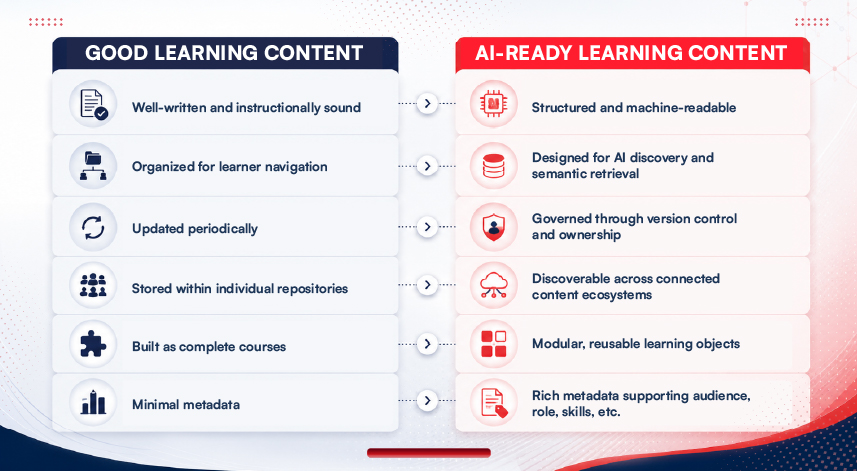
Metadata extends well beyond skills taxonomy. AI recommendations depend on rich contextual information, including audience, proficiency level, learning objectives, jurisdiction, language, accessibility, version history, approval status, source, and content relationships. Together, these attributes help AI identify the most appropriate content for each learner and each use case.
Without these foundations, even sophisticated AI capabilities struggle to deliver meaningful personalization. Search quality declines. Recommendations lose relevance. Learners lose confidence in the experience, reducing the value of both the content and the platform. Strengthening these foundations helps organizations build an AI-powered learning ecosystem that can scale with evolving learner expectations and emerging AI use cases.
The Learning Content AI Readiness Gap Hidden in Plain Sight
Many digital publishers built their content libraries to support catalog navigation, course delivery, and manual content management. Those design decisions served traditional learning models well. However, AI-powered experiences demand a different content foundation.
Today’s AI capabilities depend on content that machines can discover, interpret, connect, and reuse across multiple learning experiences. This shift also requires organizations to improve learning content scalability so the same content can support multiple AI-driven experiences without repeated redevelopment. When organizations design content only for human consumption, it often lacks the structure AI requires to deliver intelligent search, adaptive learning, content recommendations, AI tutoring, or automated content generation.
For many digital publishers, the challenge extends beyond content quality. Legacy content may exist across SCORM packages, proprietary authoring formats, image-based PDFs, videos without transcripts, legacy HTML pages, or disconnected repositories. While learners may still access this content, AI systems often struggle to interpret or reuse it effectively.
This is the learning content AI readiness gap. This gap exists because organizations originally created content for human learners, while AI now needs structured, machine-readable content.
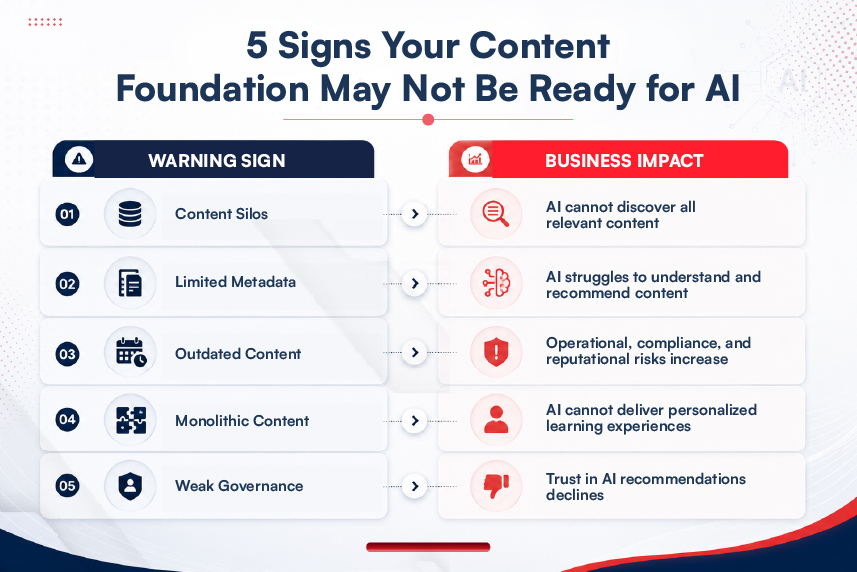
5 Signs Your Content Foundation May Not Support AI at Scale
As digital publishers expand AI initiatives, underlying content limitations become easier to detect and increasingly expensive to ignore. The following signs help assess whether your current content foundation can support AI-powered learning experiences.
Sign 1: Content Silos Limit AI Discovery and Recommendation
Learning assets often reside across multiple repositories, business units, authoring platforms, and product teams. Each repository may follow different taxonomies, metadata standards, and governance practices. The following indicators show how content silos affect AI performance, learner experiences, and content operations.
Operational symptom: Content exists, but nobody has a complete view of it.
AI and platform effect: Recommendation engines cannot discover or correlate content across disconnected repositories. Search quality declines because AI only evaluates the content it can access.
Learner impact: Learners receive incomplete recommendations and miss valuable learning resources already available within the organization.
Business consequence: Digital publishers underutilize existing content. This reduces engagement and lowers the return on AI investments.
Representative indicators:
- Multiple repositories contain similar content.
- Duplicate versions exist across platforms.
- Teams cannot identify a single authoritative version.
- Locating priority content requires significant manual effort.
LIKELY REMEDIATION: Establish a unified content inventory and governance model before expanding AI-powered discovery. A content-readiness assessment should identify duplicate assets, ownership gaps, repository fragmentation, and opportunities for consolidation.
Sign 2: Limited Metadata Prevents AI from Understanding Content
Metadata is far more than a skills taxonomy. It provides the context AI needs to interpret, classify, retrieve, and recommend learning content accurately. Many digital publishers maintain basic metadata such as title, author, or topic. However, AI-driven experiences require richer metadata. This metadata should describe audience, role, proficiency level, learning objectives, content type, language, jurisdiction, accessibility, approval status, validity period, source, version history, and content relationships.
Operational symptom: Metadata standards vary across products, repositories, or authoring teams.
AI and platform effect: AI struggles to identify the content that best matches a learner’s role, intent, language, or context.
Learner impact: Recommendations become inconsistent, search results lose relevance, and learner confidence gradually declines.
Business consequence: Lower engagement reduces the value of personalization initiatives and limits adoption of AI-powered learning experiences.
Representative indicators:
- A significant percentage of assets lack the needed metadata.
- Metadata standards differ across content repositories.
- Teams manually classify content before publishing.
- Search quality depends heavily on keyword matching.
LIKELY REMEDIATION: Define a standardized metadata framework aligned with your intended AI use cases. Apply metadata enrichment incrementally, beginning with the highest-value content rather than attempting to update the entire library simultaneously.
Sign 3: Outdated Content Increases Operational and Compliance Risk
AI can recommend learning content at a scale that manual processes never could. When outdated content enters AI-powered search, recommendations, or learning pathways, the impact extends beyond a poor learner experience. For digital publishers, outdated assets may include obsolete product information, superseded standards, expired certification guidance, or regulatory references that no longer apply. The level of risk depends on the content type and intended AI use case.
The following indicators help assess how outdated content affects AI performance, learner experiences, and business outcomes:
Operational symptom: Priority content remains past its review date. Also, update cycles rely on manual processes heavily.
AI and platform effect: AI continues recommending outdated or lower-priority content because it lacks reliable signals about content currency and validity.
Learner or customer effect: Learners may receive inaccurate guidance, lose confidence in recommendations, or spend additional time verifying information.
Business consequence: Outdated content can increase operational, compliance, and reputational risks, particularly when AI supports regulated learning or certification programs.
Representative indicators:
- A growing percentage of priority content exceeds its review date.
- Regulatory or product updates require extensive manual effort.
- Content owners receive no automated review notifications.
- Multiple versions continue to coexist after updates.
LIKELY REMEDIATION: Implement governance workflows that monitor review dates, ownership, version history, and update triggers. Prioritize automation for high-value or high-risk content rather than attempting to automate every asset simultaneously.
Sign 4: Monolithic Content Limits AI Personalization
Many digital publishers still organize learning as complete courses designed for sequential consumption. While this structure works well for traditional learning delivery, it limits AI’s ability to personalize learning experiences.
AI performs best when it can retrieve, combine, and recommend smaller learning objects based on learner context, skills, intent, and performance. The following indicators show how monolithic content limits AI personalization and business outcomes.
Operational symptom: Teams repeatedly recreate similar content for different audiences, products, languages, or delivery formats.
AI and platform effect: AI cannot assemble personalized learning pathways because the content exists only as large, tightly coupled courses.
Learner or customer effect: Learners receive longer courses than necessary instead of targeted learning experiences that address immediate needs.
Business consequence: Content reuse declines, production costs increase, and personalization capabilities remain underutilized.
Representative indicators:
- Reusing content requires significant redevelopment.
- Similar learning objectives exist across multiple courses.
- Translating or localizing content requires rebuilding complete courses.
- Creating role-specific learning paths takes considerable manual effort.
LIKELY REMEDIATION: Adopt modular content architecture for high-value learning assets. Convert large courses into modular, reusable learning components that AI can dynamically combine for different learners, products, and delivery channels.
Sign 5: Weak Content Governance Reduces Trust in AI
AI depends on trustworthy content and performs best when organizations maintain clear ownership, consistent governance, reliable version control, and transparent approval processes.
When governance practices vary across repositories, AI may retrieve conflicting versions, outdated assets, or content with unclear ownership. This does not mean AI simply “uses whatever it finds.” Rather, AI relies on the content and metadata available across the learning ecosystem. Weak governance increases the likelihood that inconsistent information influences recommendations.
Operational symptom: Content ownership, approval status, and version history remain inconsistent across repositories.
AI and platform effect: AI cannot consistently distinguish authoritative content from obsolete or duplicate versions.
Learner or customer effect: Learners receive inconsistent recommendations and gradually lose confidence in AI-generated experiences.
Business consequence: Weak governance increases discoverability, personalization, operational, and compliance risks. It also reduces trust in AI-powered products and learning experiences.
Representative indicators:
- Multiple versions of the same content remain active.
- Priority assets lack clearly defined ownership.
- Approval workflows differ across teams.
- Teams cannot verify content provenance quickly.
LIKELY REMEDIATION: Establish governance policies that define ownership, review cycles, approval workflows, version control, and content lifecycle management. Integrate governance into publishing workflows instead of treating it as a post-production activity.
Why Content Readiness Matters to Your AI Investment
Although AI platforms continue to evolve rapidly, they can deliver meaningful outcomes when supported by high-quality, AI-ready learning content. For digital publishers, learning content readiness is no longer just an operational consideration. It directly influences learner engagement, product differentiation, operational efficiency, and the return on AI investments.
Organizations that ensure learning content modernization for a specific AI use case can introduce intelligent search, personalized recommendations, AI tutoring, or automated content generation with greater confidence and lower implementation risk. More importantly, they establish the foundation for an AI-powered learning ecosystem that can support future AI capabilities as business needs evolve.
Conversely, organizations that overlook content readiness for AI often spend additional time resolving metadata inconsistencies, fragmented repositories, governance gaps, and legacy formats after AI deployment. These challenges slow down adoption and reduce business value.
Treating content readiness as an early investment helps publishers reduce implementation uncertainty, prioritize modernization efforts, and create a stronger foundation for future AI capabilities. More importantly, it enables organizations to scale AI initiatives systematically instead of reacting to content issues discovered after deployment.
Where Should You Start? A Practical Approach to Assessing Content Readiness
A common misconception is that every learning asset must become AI-ready before organizations can benefit from AI. In practice, successful digital publishers start with a focused scope. They first identify the AI use case that delivers the greatest business value, such as semantic search, AI-assisted recommendations, adaptive learning, automated translation, or compliance monitoring. They then evaluate only the content required to support that use case before expanding further. A practical content-readiness assessment typically follows this sequence:
| A Step-by-Step Approach to Evaluating Content Readiness | |||
|---|---|---|---|
| STEPS | WHAT TO EVALUATE | ||
| Define the AI use case | Identify the business objective AI is expected to support. | ||
| Select priority content | Focus on representative, high-value learning assets rather than the entire library. | ||
| Assess content readiness | Review content formats, metadata quality, modularity, governance, and accessibility. | ||
| Prioritize improvements | Address the highest-value gaps before expanding modernization efforts. | ||
| Scale systematically | Apply proven practices across additional content collections and AI use cases. | ||
This phased approach enables digital publishers to make informed investment decisions, reduce implementation risk, and demonstrate measurable business value before scaling AI initiatives across the broader learning ecosystem. Read more on building intelligent, future-ready learning ecosystems.
How Content Engineering and a Content-Readiness Assessment Prepare Content for AI
Content engineering extends well beyond content conversion or metadata tagging. It combines specialized disciplines that prepare learning content for reliable AI consumption while preserving instructional quality, governance, and interoperability across learning platforms.
A comprehensive content engineering initiative typically includes content inventory, legacy format transformation, semantic structuring, metadata enrichment, modularization, quality validation, governance design, and integration with the broader learning ecosystem. Together, these capabilities enable AI to discover, interpret, retrieve, and recommend learning content accurately across different products and learner experiences.
See it in practice: How content engineering accelerated course production and improved workforce productivity for a leading healthcare digital learning publisher.
Equally important is understanding what a content-readiness assessment delivers before learning content modernization begins. Rather than providing only a technical review, the assessment creates a decision-making framework that helps organizations prioritize investments based on business value.
Key deliverables from a learning content readiness assessment include:
- A prioritized inventory of high-value learning assets.
- Analysis of duplicate, obsolete, and fragmented content.
- Identification of metadata, governance, and ownership gaps.
- A use-case-specific content readiness score.
- Estimated remediation effort, implementation risks, and expected business value.
These insights help digital publishers improve learning content scalability while creating a stronger foundation for AI-driven products and future learning ecosystem scalability.
Conclusion
Building a future-ready learning ecosystem requires more than deploying new technology. It requires a content foundation that AI can consistently discover, interpret, govern, and reuse. For digital publishers, improving learning content readiness is often the first practical step toward delivering meaningful AI-powered learning experiences while reducing implementation risk. Investing in content readiness today helps organizations build an AI-powered learning ecosystem that supports long-term innovation, learning ecosystem scalability, and sustainable business growth.
If you are evaluating AI for your learning products, Harbinger’s content engineering specialists can help you assess your current content foundation, identify readiness gaps, prioritize modernization efforts, and determine the most effective path for your AI use case before significant investment.
Explore our AI-powered learning solutions to learn how a content-readiness assessment can help you reduce implementation risk, prioritize high-value opportunities, and build a stronger foundation for scalable AI adoption. To book a consultation, write to us at contact@harbingergroup.com.

Additional Perspectives on the FDE Model
Forward-deployed engineering is gaining attention as a way to bring engineers closer to customer problems and real-world implementation. Several organizations describe this model as a way to align engineering work with customer needs, systems, and workflows. Here are a few resources that offer additional perspectives on the FDE model:https://www.griddynamics.com/glossary/forward-deployed-engineering
https://miragemetrics.com/guides/forward-deployed-engineering
https://www.cognizant.com/us/en/glossary/forward-deployed-engineer


