



Table of Contents
- Introduction
- Why AI Outputs Still Fall Short at Enterprise Scale
- What Context Engineering Actually Means
- Prompt Engineering vs. Context Engineering
- From Prompt to Context: A Working Example
- Signs Your Learning AI Initiative Has a Context Problem
- Business Outcomes: How Context Engineering Changes Learning and AI Operations
- Best Practices for Implementing Context Engineering in Enterprise L&D
- How Harbinger Helps Organizations Build Context-aware AI Learning Ecosystems
- Conclusion
Introduction: Why Context Engineering Matters for Enterprise Learning
AI can help draft a course outline in minutes. It can generate assessment questions overnight. Yet many enterprise learning leaders remain cautious about trusting these outputs at scale.
Learning teams still review AI-generated modules manually. They rewrite scenarios that miss company context. They flag outdated policies that AI did not know had changed.
The instinct is to blame the model. But the model is rarely the whole problem.
When AI output remains generic, inconsistent, or unreliable, the issue may lie beyond the prompt or model. Maybe the system was not given the right enterprise, learner, or workflow context. This is where context engineering becomes essential.
This blog explores what context engineering means, how it differs from prompt engineering, and where enterprise learning leaders and their technology teams can unlock improved AI performance.
Why AI Outputs Still Fall Short at Enterprise Scale
LinkedIn’s 2025 Workplace Learning Report found 71% of L&D professionals use AI. They are exploring, experimenting, or integrating AI into their work.
Many enterprises are now moving from isolated AI experiments toward repeatable AI-enabled workflows.
Course creation, assessments, and translation heavily rely on AI-assisted workflows. Yet many L&D teams remain disappointed as the output feels inconsistent from one request to the next. Tone drifts across modules built by different teams. Assessments read well but test the wrong things. Hallucinated facts slip into otherwise polished content. As AI adoption grows, these gaps become operational problems.
Often, subject matter experts end up correcting more than they create. Every new use case needs its prompts to be rebuilt.
None of this means the models are weak. It means the system likely never received the full picture. It knew the instruction, but not the organization, the learner, the standard the content had to meet, and many such critical factors. AI becomes more reliable once it understands the full context, not just the request.
What Context Engineering Actually Means
Context engineering is the discipline of deliberately designing the information environment an AI system receives. It is an operating approach, not a fixed technology stack.
The goal is to generate outputs that are accurate, relevant, and trustworthy. In practice, this means giving AI the right information at the right time.
Context to be provided can be about the learner, the task, the organization, and the outcome. It can include instructions, documents, user information, and interaction history. It can also include tool outputs, structured data, and workflow constraints. The goal is broader than content generation alone.
What Context Engineering Means for Enterprise Learning
For enterprise learning, this means grounding AI in real organizational context. Not generic web knowledge. AI-generated modules should reflect current compliance rules, actual workflows, and each learner’s role. Course content, assessments, and coaching prompts pull from governed, approved sources rather than scattered or unverified files. The result: learning content that stays accurate as the business changes. It scales across teams without losing consistency. That is what separates a working pilot from an enterprise-ready system.
Enterprises typically operationalize context engineering through RAG, metadata, memory, knowledge repositories, APIs, and agent workflows. Each is a supporting piece, not the discipline itself.
Agentic AI experiences high failure rates owing to poor coordination and misalignment. Context engineering addresses these challenges by curating and sharing dynamic contexts while managing persistent contexts — capabilities that prompt engineering alone cannot provide.
– Gartner
Prompt Engineering vs. Context Engineering
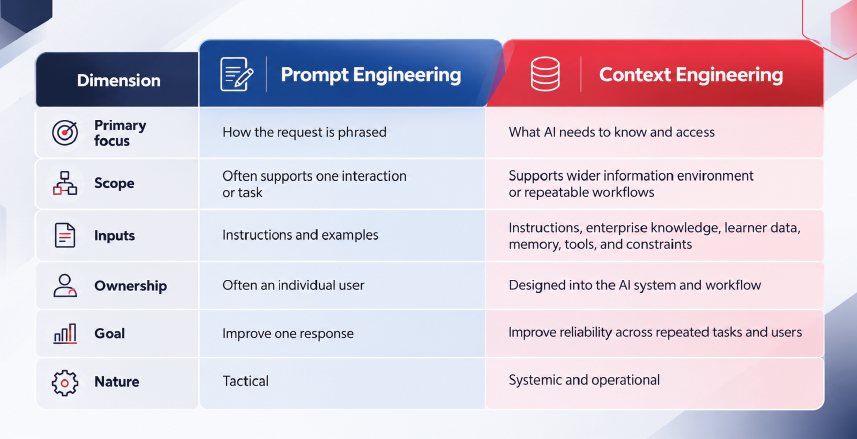
The two disciplines are related, but they solve different problems. Prompt engineering typically optimizes an interaction; context engineering is designed to improve reliability across repeated interactions and workflows. Prompt engineering focuses on how an instruction is written.
Context engineering focuses on what the AI needs to know for a reliable output. Prompt engineering can also be viewed as a narrower subset of context engineering.
From Prompt to Context: A Working Example
Consider an organization training employees on adverse-event reporting.
The relevant team in the organization uses AI to create a branching scenario. With a simple prompt, the AI may produce a plausible but generic scenario. It may not reflect the organization’s tailored reporting process or workplace realities.
With a context-rich approach, the AI receives details such as the learner’s role, company SOPs, regulatory requirements and escalation rules, learning objectives, accessibility standards, and realistic consequences.
With this context, the same AI prompt can produce a more authentic and usable learning experience for that organization. The model has not fundamentally changed. The information available to it has. That distinction captures the practical value of context engineering.
Signs Your Learning AI Initiative Has a Context Problem
The following signs tend to repeat across organizations without a strong context foundation. Individually, each sign below can look small, but together, they often point to a weak or incomplete context foundation.
- Different team members get very different outputs for the same task, since the AI draws from no shared source.
- AI repeatedly uses outdated policies or terminology, because no one has connected it to a live, governed knowledge base.
- Subject matter experts spend more time correcting content than improving it, which erodes the time AI was meant to save.
- Assessments read as grammatically fine but instructionally weak, testing recall instead of the skill the objective actually requires.
- Learner personalization relies on job titles alone, ignoring role, experience, and real performance history.
- Every new use case requires prompts rebuilt from scratch, instead of reusing a shared context layer.
- AI outputs cannot be traced back to an approved source, making it difficult to defend in an audit.
These signs point to a missing layer, and that layer can be built. Strengthening this layer can make output quality more consistent and repeatable, rather than leaving each team to solve the problem independently.
Business Outcomes: How Context Engineering Changes Learning and AI Operations
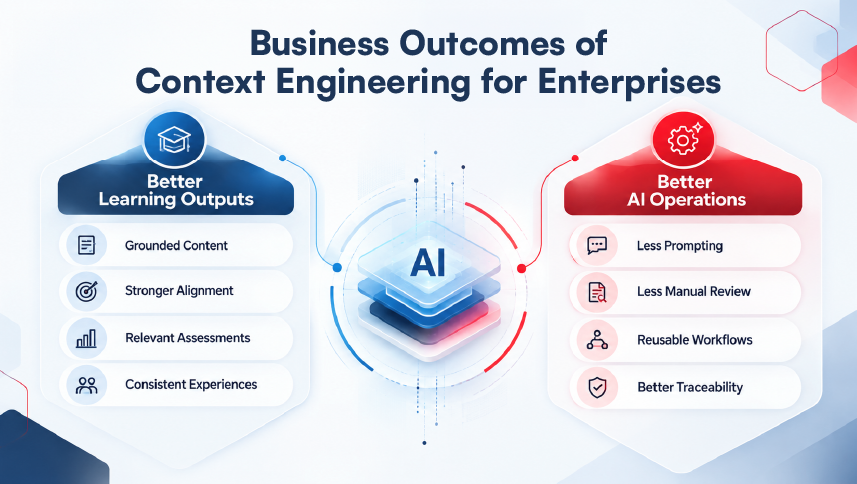
Context engineering can influence more than the quality of AI-generated content. It can also change how learning teams design, review, and scale AI-enabled workflows. The impact typically appears in two areas: better learning outputs and more efficient AI operations.
Better Learning Outputs
- More accurate, better-grounded content: AI can draw on relevant, approved information instead of relying on generic knowledge.
- Stronger instructional alignment: Learning content can stay aligned with defined objectives, learner needs, and instructional standards.
- More relevant assessments and feedback: AI can use learner and task context to create assessments and feedback that better reflect intended skills.
- Consistent terminology, tone, and localization: Shared context can help maintain consistency across content created by different teams and workflows.
Better AI Operations
- Less repetitive prompt writing: Teams can reuse contextual information instead of rebuilding detailed prompts for each task.
- Lower manual review effort: Better-grounded outputs can reduce the amount of correction required from SMEs and learning teams.
- More reusable AI workflows: Structured context can support multiple learning use cases without rebuilding the entire workflow.
- Greater traceability to approved sources: Teams can better understand where AI-generated outputs derive their information.
- More consistent performance across users and use cases: Shared context helps AI deliver more reliable outputs across different learners, teams, and learning workflows.
Best Practices for Implementing Context Engineering in Enterprise L&D
Getting started does not require a full platform rebuild. It requires a sequence of deliberate choices such as:
- Build a trusted, well-structured knowledge base: Bring policies, SOPs, and other approved content into a governed source. Organize it with relevant metadata, so AI can identify and retrieve the right information.
- Define instructional standards and standardize workflows: Establish clear instructional design standards and apply them across AI workflows. Standardize prompts and workflows, so effective practices can be reused across teams and use cases.
- Keep context current and strengthen governance: Regularly refresh source content to prevent outdated information from influencing AI outputs. Establish governance processes for content ownership, updates, access, and appropriate AI use.
- Combine human review, quality monitoring, and outcome measurement: Include human review at defined checkpoints and monitor accuracy, consistency, and relevance. Measure learning outcomes alongside operational improvements to determine whether AI is creating meaningful value.
How Harbinger Helps Organizations Build Context-aware AI Learning Ecosystems
Building a context-aware foundation takes more than good intentions. Enterprises need structured knowledge, well-engineered AI workflows, and governance that supports scale. Harbinger helps enterprises operationalize context engineering through three connected capability areas.
- Prepare the knowledge: Harbinger helps structure learning content, enrich it with relevant metadata, and organize knowledge within repositories. This creates a stronger foundation for AI systems to find, interpret, and reuse the right information.
- Engineer the AI workflow: Harbinger can build AI-enabled workflows using retrieval-augmented generation (RAG), automation, agentic AI, and enterprise integrations. These capabilities help move beyond one-off prompts toward repeatable AI workflows. Explore the Agentic AI Studio to learn more.
- Govern and scale it: Harbinger incorporates human review and quality controls into AI-enabled workflows. It also helps integrate these capabilities with existing enterprise learning ecosystems, supporting more consistent and scalable adoption.
Together, these capabilities help enterprises move from structuring and governing their knowledge to engineering AI experiences that can use that context reliably. Harbinger brings decades of experience across enterprise learning, content engineering, product development, and AI to help organizations make that transition.
We help enterprises build the foundations that make AI-enabled learning more relevant, connected, and scalable. Our capabilities span intelligent content development and automation, knowledge bots, workflow automation, agentic AI, and learning-in-the-flow-of-work solutions. This enables enterprises to address the full journey, from structuring content and knowledge to engineering the AI experiences that use it.
Conclusion
Prompt engineering will continue to improve how we communicate with AI. It remains a valuable skill but cannot support enterprise AI alone. Context engineering provides a broader foundation for reliable, scalable AI across learning workflows.
The question is no longer whether AI can generate learning content. It is whether the context behind that content can support what comes next, scale across the enterprise, and ultimately deliver the desired learning and business outcomes.
If you are already using AI in learning, start by assessing whether your content, knowledge, metadata, workflows, and governance are ready to provide the context AI needs. Begin with a focused assessment of your content infrastructure to identify gaps that may affect AI readiness and output quality.
Assess your Content Intelligence Infrastructure to understand where your organization stands and what to strengthen next.
If you need support translating those findings into an AI-enabled learning strategy, connect with Harbinger to explore the next steps. Or write to us at contact@harbingergroup.com.


