


Digital publishing businesses previously competed on content. Larger libraries, broader coverage, faster production cycles, and stronger distribution networks often translated into competitive advantage.
That advantage is becoming harder to sustain.
AI is fundamentally changing the economics of creation. Content can now be created, adapted, localized, and distributed faster than ever before. While this creates opportunities to improve efficiency and scale, it also raises a more important strategic question: what happens when content itself is no longer scarce?
The answer matters because the future of digital publishing will not be defined by who publishes the most. It will be defined by who creates the most value for audiences and buyers.
The publishers that succeed in the coming years will be those that transform content from a standalone asset into a continuously improving ecosystem of intelligence and engagement. The change is already underway.
The strategic shifts discussed in this blog are increasingly shaping conversations across the digital publishing industry. Watch the webinar below for additional perspectives on how AI is influencing content, experiences, and business models. Hosted by Shrikant Pattathil, President and CTO, Harbinger Group, this panel discussion brought together industry leaders Ajith Kallambella, SVP and Head of Engineering, Relias; Gary Greenwood, Director of Digital and AI Transformation, DDI; and Poonam Jaypuriya, VP – eLearning, Harbinger Group.
When Content Is No Longer Enough
The first wave of AI adoption in publishing focused on productivity. Digital publishers explored how AI could accelerate content creation, streamline editorial workflows, and improve operational efficiency.
Those benefits are real. However, they are no longer the most important part of the story.
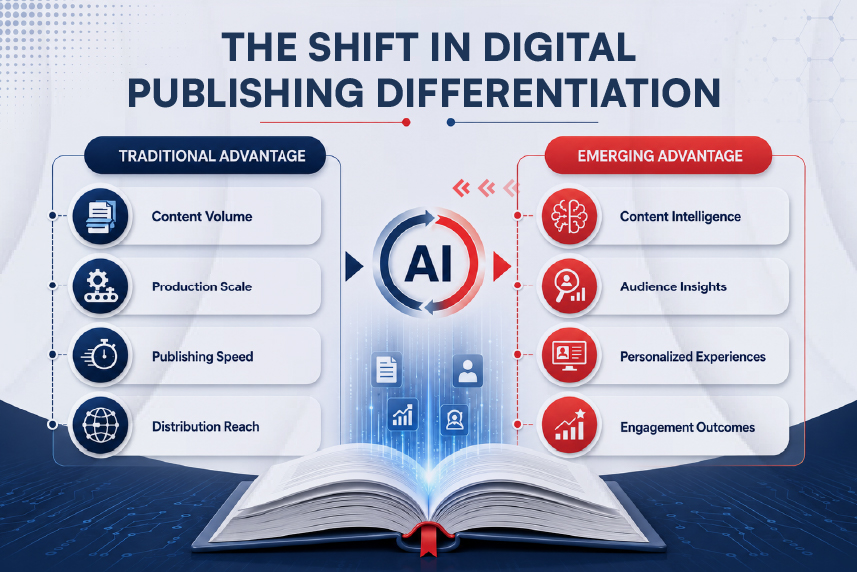
As AI lowers barriers to content creation, content volume becomes a weaker source of differentiation. Large content libraries become easier to replicate. Production efficiency becomes more accessible. The competitive advantages that have shaped the industry for years are beginning to erode.
“Providers who treat AI as a productivity tool are going to miss this moment completely. The ones who treat it as a reason to rethink how value is created and delivered will define the next decade.”
– Ajith Kallambella, SVP and Head of Engineering, Relias
The implication for publishers is significant. The challenge is no longer speed. It is building value that competitors cannot easily replicate.
Trusted expertise, editorial quality, brand authority, and audience relationships remain important. However, future growth will increasingly depend on the intelligence, experiences, and services built around content.
The New Publishing Moat: Content Intelligence
As content becomes more abundant, content intelligence is emerging as the new competitive moat for digital publishers.
Digital publishers generate enormous volumes of engagement data every day. Every search, click, subscription, completion, recommendation, and interaction creates valuable signals about how users discover, consume, and interact with content.
Historically, much of this data remained underutilized. AI is now making it easier to convert those signals into actionable insights.
Publishers can now analyze engagement patterns at scale, identify emerging audience interests, better understand content performance, and deliver more relevant interactions. More importantly, they can connect content, audience insights, and user experiences into a single system that continuously improves over time.
Organizations that orchestrate all three create a feedback loop that strengthens engagement, improves retention, and increases the value of every content asset they own.
The most significant publishing opportunity is no longer just content creation. It is the ability to convert audience interactions into actionable insight.
Those insights become difficult to replicate and create a competitive moat that extends well beyond content libraries.
For buyers, this translates into more relevant experiences, stronger personalization, and content ecosystems that continuously improve over time.
However, insights alone do not create business value. Publishers need the operational capability to activate them at scale.
Rebuilding the Content Supply Chain for the AI Era
Turning content intelligence into business value requires a fundamental redesign of publishing operations.
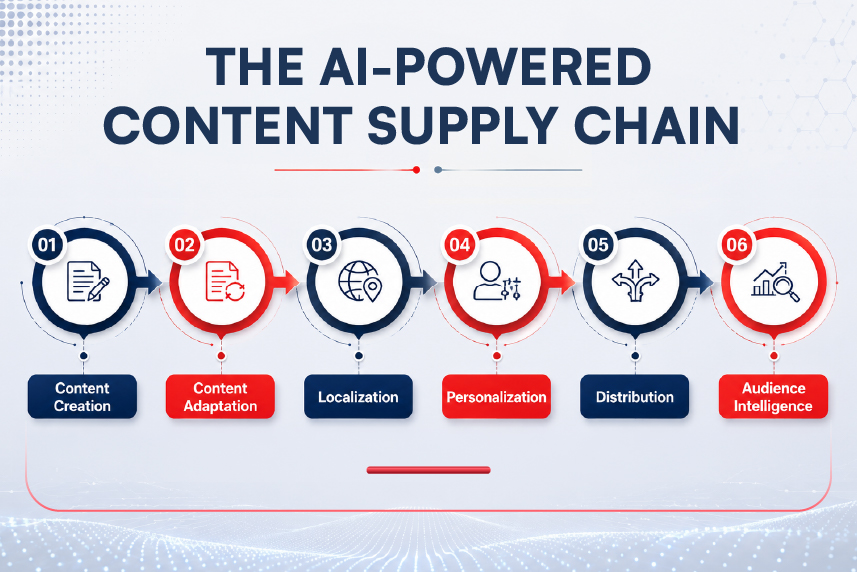
The challenge many publishers are facing is not a lack of content. It is the growing complexity involved in creating, adapting, localizing, and distributing content across multiple formats, channels, and markets.
Publishers that fail to modernize their content supply chains will struggle to compete in an environment that demands simultaneous speed, scale, personalization, and global reach.
Rather than managing fragmented workflows across teams and systems, publishers are beginning to build integrated operations that accelerate production while improving consistency and efficiency.
One example is Harbinger’s AI-Powered iContent Framework, which demonstrates how AI can help modernize content operations by streamlining development workflows, improving scalability, and accelerating content delivery.
The impact becomes particularly visible in production workflows and localization.
The case study AI-Based Automated Custom Content Development for Educational Courses highlights how AI-enabled workflows can significantly accelerate content development while reducing production effort.
Similarly, Powering Multilingual Workforce Learning with AI-Based Translation at Scale demonstrates how AI can support multilingual publishing workflows across 14 languages while improving turnaround times and translation quality.
Although these examples originate in learning-focused environments, they reflect challenges shared by many digital publishers: expanding content reach, supporting global audiences, and increasing operational efficiency without a proportional increase in costs.
Digital publishers that modernize their content supply chains today will be better positioned to support new engagement models and business opportunities.
From Content Consumption to Interactive Experiences
Rebuilding the content supply chain is only part of the story. As publishing capabilities evolve, audience expectations evolve even faster.
Consumption is no longer the primary measure of success.
Audiences increasingly expect tools and interactions that help them accomplish tasks, solve problems, and make informed decisions. Static content remains important, but engagement is increasingly driven by contextual and responsive user journeys.
Rather than serving as a destination, content increasingly functions as part of a broader journey designed to help users achieve specific outcomes.
“Learning design earlier ended at completion. Now it has to continue until evidence of readiness is proved.”
— Poonam Jaypuriya, VP – eLearning, Harbinger Group
The same shift is becoming visible across digital publishing, where engagement is increasingly tied to outcomes rather than consumption alone.
This is driving interest in more interactive engagement models that combine content, guidance, user participation, and contextual support.
Harbinger’s patented Interactive User Workflow innovation reflects this broader trend by integrating guidance, user interaction, and workflow execution into a unified environment.
The larger takeaway is clear: content is evolving from something audiences consume into something they actively engage with.
The Rise of Intelligent Content Products
As engagement models become more interactive, the next logical step is intelligent products that can actively support users rather than simply deliver content.
AI agents are emerging as a new layer within digital publishing platforms, enabling more responsive, personalized, and useful content experiences.
Rather than requiring users to navigate extensive content repositories, agent-powered systems can answer questions, surface relevant information, provide recommendations, and offer contextual assistance throughout the user journey.
Instead of serving primarily as content destinations, publishing products are evolving into intelligent knowledge environments.
“AI chatbots are starting to become a commodity. The question is how you prove business outcomes and show that you’ve actually moved the needle.”
— Gary Greenwood, Director of Digital and AI Transformation
The long-term value of AI will not come from adding features. It will come from improving outcomes.
This is one reason many digital publishers are exploring concepts like AI Agents in eLearning. While developed for learning environments, the principles of contextual assistance, personalization, and guided support are equally relevant to digital publishing products.
The digital publishers that successfully integrate these capabilities will be better positioned to strengthen retention, increase engagement, and expand product value.
The New Business Model for Digital Publishers
The most significant impact of AI on digital publishing may not be how content is created. It may be how publishing businesses generate growth.
As buyer expectations evolve and intelligent experiences become more accessible, publishers must rethink how they generate growth and sustain competitive advantage.
Future value will increasingly come from subscriber engagement, retention, personalization, and premium experiences rather than content volume alone.
“Business outcomes are going to be super critical. If you’re just focused on seat-based licensing or volume of content, those things are not going to win deals or drive renewals moving forward.”
— Shrikant Pattathil, President and CTO, Harbinger Group
In many cases, the most valuable publishing asset may no longer be the content library itself. It may be the subscriber relationships, engagement data, and behavioral insights generated around that content.
This creates opportunities to develop new revenue models built around intelligent services, personalized experiences, AI-assisted research, subscription retention, and deeper subscriber relationships.
Trust will also become increasingly valuable.
As AI-generated content becomes more common, buyers and audiences will place greater emphasis on AI governance, editorial integrity, content provenance, transparency, and accountability. Publishers will increasingly be expected to demonstrate how AI-assisted content is created, reviewed, validated, and governed. In markets where trust influences purchasing decisions, strong governance practices may become as important as the content itself.
Whether evaluating educational content, professional learning products, or subscription-based knowledge platforms, buyers increasingly expect personalization, multilingual accessibility, measurable outcomes, and responsible AI practices. Publishers that can demonstrate these capabilities will be better positioned to differentiate themselves in competitive markets.
At the same time, publishers are becoming part of broader digital ecosystems that connect content, products, services, and behavioral insights. Competitive advantage will depend not only on what publishers create but also on how effectively they integrate those capabilities into the broader customer experience.
Conclusion: The Future Digital Publisher
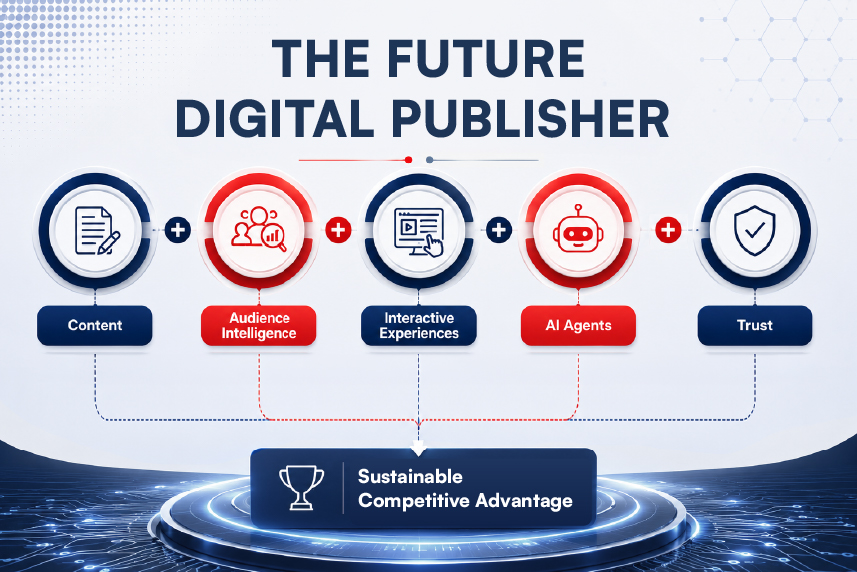
The defining question for digital publishers is no longer how to create more content. It is how to create more value from content.
The organizations that lead the next phase of digital publishing will be those that combine trusted content with audience insights, operational agility, intelligent products, and responsible AI practices.
Market leadership will increasingly be determined by how effectively publishers convert content into engagement, insight, and measurable business value.
Digital publishers that act now will be better positioned to build scalable, differentiated businesses that deliver greater value to both audiences and buyers. To explore how AI can accelerate your digital publishing strategy, connect with the Harbinger team.

Additional Perspectives on the FDE Model
Forward-deployed engineering is gaining attention as a way to bring engineers closer to customer problems and real-world implementation. Several organizations describe this model as a way to align engineering work with customer needs, systems, and workflows. Here are a few resources that offer additional perspectives on the FDE model:https://www.griddynamics.com/glossary/forward-deployed-engineering
https://miragemetrics.com/guides/forward-deployed-engineering
https://www.cognizant.com/us/en/glossary/forward-deployed-engineer


