


Table of Contents
- Why Enterprise Learning Is Reaching an Inflection Point
- AI-Native Learning Platforms: Beyond Chatbots, Content Generation, and AI Assistants
- AI-Enabled vs. AI-Powered vs. AI-Native: Understanding the Difference
- Harbinger’s POV: AI-Native Is a Journey, Not a Product Category
- Harbinger Framework: The Five Foundations of AI-Native Learning
- Business Impact: How Enterprise Learning Changes
- Conclusion
Why Enterprise Learning Is Reaching an Inflection Point
Every enterprise L&D leader feels it. AI is changing work faster than learning programs can keep pace. A process documented in January is often outdated by June.
Employees now expect learning in the flow of work. While AI chatbots have made instant support more accessible, employees increasingly seek personalized guidance, contextual knowledge, and learning support embedded within their daily workflows, not just access to a course catalog.
Learning today extends beyond the LMS. Employees interact with knowledge across collaboration platforms, CRM systems, HR applications, knowledge repositories, workflow tools, and performance systems. To support this shift, organizations need learning platforms that can connect these ecosystems, understand enterprise context, and continuously adapt to changing business needs.
This is where AI-native learning platforms emerge as the next evolution in enterprise learning. They are designed not just to deliver more courses faster, but to evolve alongside the business, supporting continuous capability development, accelerating workforce readiness, and enabling learning that keeps pace with change.

AI-Native Learning Platforms: Beyond Chatbots, Content Generation, and AI Assistants
An AI-native learning platform is far more than a traditional LMS enhanced with AI features. While traditional LMSs remain essential for managing compliance, certifications, enrollments, content delivery, and learning data, they are no longer sufficient as the sole intelligence layer for enterprise learning, as organizations strive to build workforce capability at the speed of business.
Many platforms now offer AI chatbots, content generation, or AI assistants. But these capabilities alone do not make a platform AI-native.
What differentiates an AI-native platform is its ability to continuously understand enterprise knowledge, learner context, business workflows, and organizational priorities to deliver intelligent, context-aware learning experiences. Rather than simply delivering content, it can use learner questions, assessment performance, scenario outcomes, qualitative feedback, workplace activities, and business performance signals to improve future interventions.
- Enterprise-Grounded Intelligence: A defining characteristic of an AI-native platform is that AI-generated responses should be grounded in approved enterprise knowledge rather than relying solely on the open internet. Learning content, policies, SOPs, knowledge repositories, skills data, and enterprise permission structures become the trusted foundation for AI recommendations. When implemented effectively, this can help make responses more accurate, traceable, secure, and aligned with organizational governance, critical requirements for enterprise adoption.
- Agentic AI for Governed Actions: Another key differentiator is the evolution from AI assistance to agentic AI. Instead of merely recommending the next course or answering questions, AI-native platforms increasingly perform governed actions. Depending on organizational policies and permissions, they can assign personalized learning, generate practice scenarios, identify obsolete content, update learning pathways, notify managers about capability gaps, or trigger compliance interventions, while supporting auditability through appropriate permissions, approval workflows, and activity logs.
- Continuous Feedback Loops: AI-native learning platforms are designed to evolve through continuous feedback loops. Rather than personalizing learning based solely on user profiles, it continuously learns from learner questions, assessment performance, scenario outcomes, qualitative feedback, workplace activities, and business performance signals. These signals can help improve future recommendations, learning content, and organizational insights when they are captured, evaluated, and governed effectively.

AI-Enabled vs. AI-Powered vs. AI-Native: Understanding the Difference
The terms AI-enabled, AI-powered, and AI-native are often used interchangeably. While each approach introduces AI into learning, they differ significantly in architecture, intelligence, governance, and business value.
The following comparison highlights how AI-enabled, AI-powered, and AI-native learning platforms differ across the core capabilities that shape enterprise learning outcomes:
| Evaluation Criteria | AI-Enabled Learning Platform | AI-Powered Learning Platform | AI-Native Learning Platform |
|---|---|---|---|
| Role of AI | Supports specific tasks through add-on features | Enhances learning experiences and recommendations | Functions as a shared intelligence layer across learning and enterprise workflows |
| Content & Knowledge Architecture | Uses existing course repositories | AI processes selected learning content | Understands enterprise knowledge, policies, skills, and content semantically |
| Context Retention | Limited session-based context | Partial learner context | Designed to retain learner, organizational, and business context across connected systems |
| Workflow Integration | Minimal integration | Integrates with selected learning workflows | Embedded across HR, CRM, collaboration tools, knowledge repositories, and enterprise applications |
| Learning Philosophy | Courses | Personalized Learning | Continuous Capability Development |
| Ability to Act | Suggests actions | Automates selected learning tasks | Designed to retain learner, organizational, and business context across connected systems |
| Grounding & Traceability | Responses may rely on generic AI models | Partial grounding with enterprise content | Recommendations should be grounded in approved enterprise knowledge and supported by appropriate traceability. |
| Continuous Feedback Loops | Limited feedback collection | Learner behavior informs recommendations | Uses learner interactions, assessments, feedback, workplace signals, and business outcomes to improve future interventions |
| Governance | Basic security and access controls | AI governance for selected capabilities | Enterprise-wide governance designed to support permissions, auditability, explainability, and responsible AI |
| Connection to Business Outcomes | Tracks learning completion | Measures engagement and learning effectiveness | Connects workforce capability to business performance, productivity, compliance, and workforce readiness |
Harbinger’s POV: AI-Native Is a Journey, Not a Product Category
Harbinger has spent more than three decades working across enterprise learning, from content development to platform and product engineering. Our products and solutions portfolio reflects that same depth, a practical view of how AI actually needs to work inside a learning ecosystem, not just in theory. It’s why we see AI-native learning as a maturity journey, not a one-time overhaul.
One common misconception is that organizations must rebuild their entire learning ecosystem to become AI-native. In practice, most evolve incrementally, modernizing their architecture while their existing LMS keeps handling compliance, certifications, and administration. Organizations typically move from AI-enabled capabilities to AI-powered experiences, then toward an AI-native ecosystem built on intelligent content, connected systems, governed AI, and continuous workforce intelligence.
This evolution is driven less by replacing platforms and more by strengthening five foundational capabilities:
- AI-ready content
- Enterprise knowledge architecture
- Workflow orchestration
- Cross-platform integrations
- Responsible AI governance
This is where a transformation partner adds real value. Every enterprise has a different technology landscape, content maturity, governance model, and business priorities, so the right roadmap depends on knowing which gap to close first.
If you’re evaluating how to evolve your AI-native learning ecosystem without disrupting existing investments, Harbinger can help you assess your AI readiness and define a practical roadmap toward an AI-native learning platform.
Harbinger Framework: The Five Foundations of AI-Native Learning
Not every platform that claims to be AI-native is built on the same foundation. Here is Harbinger’s framework that brings together five interconnected foundations: knowledge, intelligence, context, action, and governance. These foundations determine whether AI can continuously improve learning experiences while maintaining enterprise oversight and trust.
Consider how these five foundations work together in practice.
A regulation update lands in the knowledge foundation. The intelligence foundation identifies employees with outdated training linked to the update. The context foundation considers their recent related work. The action foundation assigns a targeted refresher to affected employees. The governance foundation logs the entire chain for audit, turning a policy update into a traceable learning intervention within hours.
The table below provides a closer look at the five foundations that work together to power an AI-native learning platform:
| Foundation | What It Enables | Business Impact |
|---|---|---|
| Knowledge Foundation | Semantically structured, AI-ready enterprise content with version control | Trusted, accurate, and traceable AI responses |
| Intelligence Foundation | AI reasoning, coaching, recommendations, skills intelligence | More relevant learning decisions and personalized capability development |
| Context Foundation | Persistent learner, role, project, and business context | Personalized learning aligned with real work and evolving business priorities |
| Action Foundation | Governed AI actions such as assigning learning, updating pathways, and notifying stakeholders | Faster workforce response with reduced administrative effort |
| Governance Foundation | Permissions, auditability, explainability, compliance, and responsible AI | Enterprise trust, security, regulatory compliance, and scalable AI adoption |
Enterprises can use this framework to assess their current AI-native learning maturity and identify where investment should begin. A strong intelligence foundation cannot compensate for weak knowledge foundations. Poor content quality, fragmented data, or limited governance can undermine otherwise advanced AI capabilities.
This framework helps enterprises identify readiness gaps, prioritize transformation opportunities, and build a phased roadmap for AI-native learning without assuming that every organization needs to start over.
Business Impact: How Enterprise Learning Changes
The value of an AI-native learning platform extends well beyond automating learning administration or personalizing recommendations. Its greatest impact lies in helping organizations build workforce capability faster, respond to business changes more effectively, and connect learning investments with measurable business outcomes.
| Traditional Enterprise Learning | AI-Native Learning | Enterprise Value |
|---|---|---|
| Courses delivered periodically | Continuous capability development based on real-time business needs | Faster workforce readiness |
| Packaged content alone (including SCORM for compliance) | Content that is also semantically understood, searchable, traceable, reusable, and AI-ready | Lower content maintenance and improved knowledge discovery |
| Assigned learning paths | Personalized capability development driven by learner context, skills, and work priorities | Higher learner engagement and faster time to proficiency |
| Enrollment and completion management | Continuous workforce capability management | Earlier identification of skills and capability gaps |
| Completion reports | Workforce intelligence connected with HR, CRM, and operational systems | Better business decisions and measurable learning impact |
| Reactive compliance training | Continuous monitoring of policy, regulatory, and skills changes | Improved compliance readiness and reduced organizational risk |
| Periodic learning updates | Continuous learning embedded in daily workflows | Better transfer of learning into workplace performance |
| Learning measured by completion | Workforce capability and readiness | Clearer visibility into business readiness |
Conclusion
Becoming AI-native is less about replacing learning platforms and more about modernizing the ecosystem around them, connecting AI-ready content, enterprise systems, and responsible governance to workforce capability.
AI-native learning isn’t the next generation of LMS. It’s the next generation of enterprise capability development.
If you’re evaluating your organization’s AI-native learning journey, a domain-informed partner like Harbinger can help you define a practical roadmap. Explore how Harbinger approaches enterprise eLearning, or book a meeting with us at contact@harbingergroup.com.
Additional Perspectives on the FDE Model
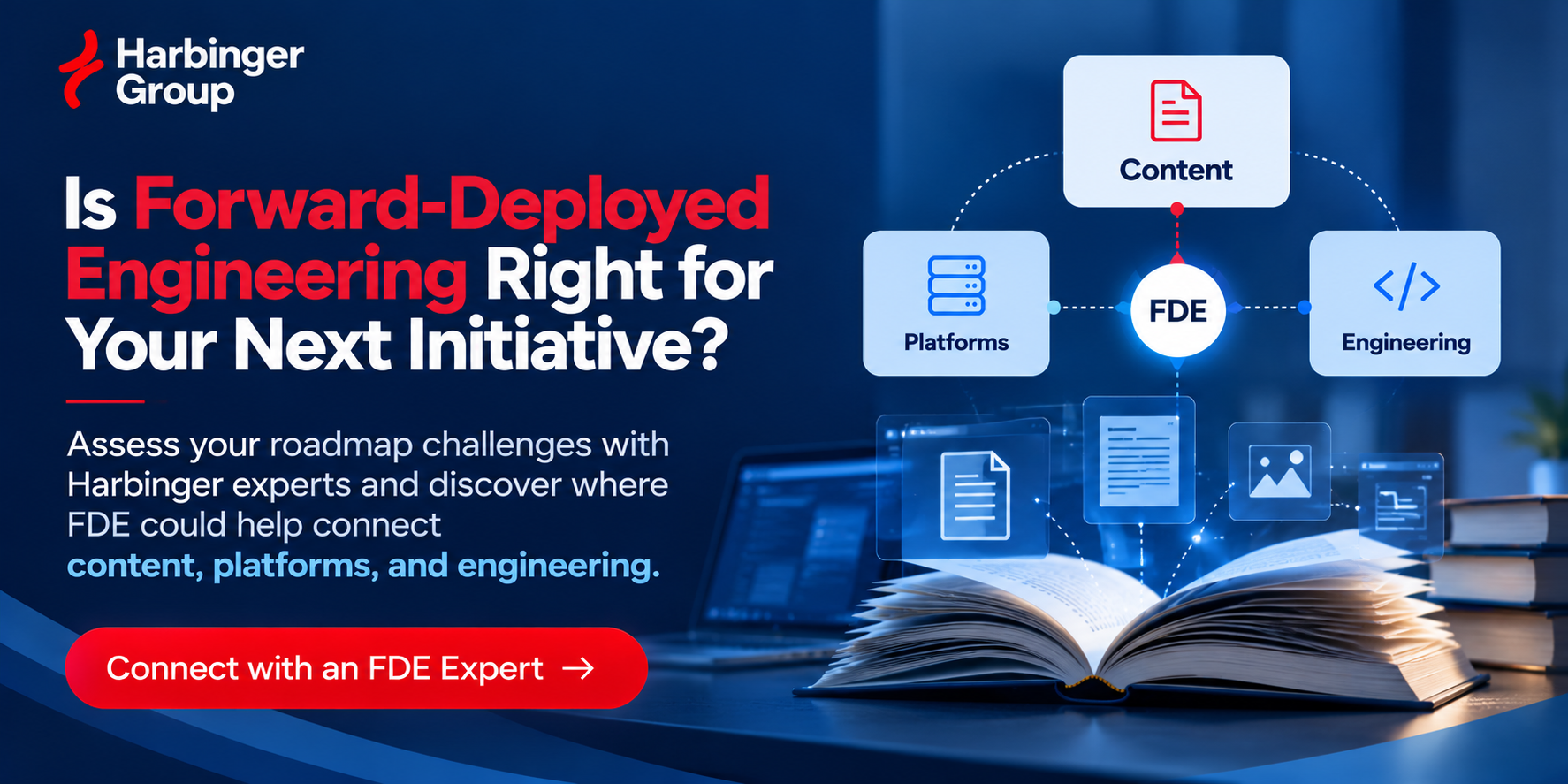
Forward-deployed engineering is gaining attention as a way to bring engineers closer to customer problems and real-world implementation. Several organizations describe this model as a way to align engineering work with customer needs, systems, and workflows. Here are a few resources that offer additional perspectives on the FDE model:https://www.griddynamics.com/glossary/forward-deployed-engineering
https://miragemetrics.com/guides/forward-deployed-engineering
https://www.cognizant.com/us/en/glossary/forward-deployed-engineer


