

Table of Contents
- Introduction
- Why English-First Training Fails at Enterprise Scale
- AI-Based eLearning Translation as Enterprise Learning Infrastructure
- Where AI Translation Initiatives Fail Without Consulting Alignment
- Why a Consulting-Led Approach Is Required for Enterprise Localization
- Enterprise Case in Point: AI-Powered Localization at Scale
- What Is the ROI of AI-Based eLearning Course Translation?
- Competitive Advantage in a Global, Regulated Market
- How Companies Convert Multilingual Training into Operational Advantage
- Integration With Modern Learning Platforms
- Final Takeaway
- Frequently Asked Questions
In global enterprises, language gaps are quietly eroding compliance, slowing onboarding, and increasing operational risk – often without leaders realizing it. As organizations scale across regions and regulations, English-first training has become one of the most underestimated performance bottlenecks in enterprise learning.
What once seemed efficient now introduces friction: misunderstood procedures, inconsistent execution, prolonged time-to-competency, and hidden audit exposure. Workforce comprehension is no longer a soft learning metric—it is a direct driver of operational resilience, compliance outcomes, and business speed.
AI-based eLearning course translation is becoming a strategic core learning infrastructure. As AI adoption accelerates and multilingual learning requirements increase, leaders face a critical question: how to scale localized training without increasing cost, risk, or operational complexity. This requires more than faster translation. It requires secure AI architecture, governance, validation, platform integration, and measurable business outcomes.
This analysis explains why AI-based eLearning course translation has become a strategic enterprise capability. It examines the failure modes of English-first training, regulatory and compliance pressures, the architectural and governance requirements, and the business case for multilingual learning at scale.
Why English-First Training Fails at Enterprise Scale
English-first training models were designed for a different operating reality, when workforces were smaller, international expansion was linear, and regulatory oversight was lighter. At enterprise scale, they training introduces a measurable friction,-
- Reduced comprehension among non-native English speakers
- Informal local interpretation leading to inconsistent execution
- Higher error rates in process-, safety-, and compliance-critical roles
- Longer onboarding cycles and slower time-to-productivity
For executives, these are not learning challenges. They are execution, governance, and risk issues. What appears to be a cost-saving choice often becomes a hidden tax on productivity, audit readiness, and managerial bandwidth.
Distributed and Offshore Workforce Complexity
The constraint is amplified in distributed workforce models where onshore, nearshore, and offshore teams collaborate in real time. Informal interpretation becomes the default mechanism for knowledge transmission, leading to divergence in understanding and increasing reliance on local knowledge brokers. This introduces performance drag and reduces the consistency of enterprise execution.
Hidden Compliance and Audit Exposure
In regulated industries, inconsistent comprehension introduces compliance and audit exposure. Healthcare, medical devices, pharmaceuticals, financial services, and manufacturing require clear, validated, and auditable training flows. Misunderstood training in these environments can become a material compliance risk.
Relevant regulatory frameworks include:
HIPAA for patient data privacy
OSHA for workforce safety and hazard compliance
FDA for pharmaceutical and medical device training alignment
SOX for financial reporting and internal controls
EEOC for anti-discrimination and workplace equity
In these environments, multilingual comprehension is directly tied to compliance, safety, and audit outcomes. AI-driven eLearning localization enables consistent, validated, and traceable learning paths that support regulatory readiness and reduce remediation costs.
AI-Based eLearning Translation as Enterprise Learning Infrastructure
For senior leaders, the question is no longer whether to use AI for translation. The strategic question is how translation fits into the enterprise learning architecture and how it is governed over time.
When implemented at the architectural level, AI-powered training localization enables enterprises to:
- Deliver consistent knowledge across languages without content duplication
- Maintain a single source of instructional truth
- Deploy updates across regions and roles with minimal friction
- Align training with compliance, audit, and operational requirements
At this level, multilingual eLearning moves from a recurring production project to a scalable enterprise capability.
Where AI Translation Initiatives Fail Without Consulting Alignment
Many organizations approach enterprise learning translation tactically, treating it as content conversion rather than a strategic design decision.
Common failure points include:
- No alignment to business or compliance outcomes
- Ignoring regulatory context or legal validation layers
- Lack of AI governance and validation
- Poor integration with LMS, LXP, HRIS, and analytics platforms
- No scalability planning for updates, mergers, or product expansions
Success depends less on translation accuracy and more on architectural and governance decisions made upfront.
Why a Consulting-Led Approach Is Required for Enterprise Localization
Harbinger’s approach begins with consulting, not tooling. Before implementing multilingual eLearning at scale, we help enterprises define:
- Business and learning outcomes tied to execution
- Compliance, security, and regulatory guardrails
- Content governance and validation frameworks
- Integration pathways across LMS, HR, and analytics ecosystems
- Long-term scalability and operating models
This ensures that AI-powered training localization strengthens the enterprise learning ecosystem rather than introducing new fragmentation or compliance exposure.
Enterprise Case in Point: AI-Powered Localization at Scale
A global insurance leader serving over 90 million customers needed to localize sales training across markets. While SME-led video content existed, manual localization slowed rollout and compromised consistency. Harbinger designed a scalable AI-powered pipeline using transcription, translation, captioning, and multilingual lip-syncing to convert raw SME footage into localized learning assets ready for deployment. The result: faster product training launches, consistent messaging across markets, and a repeatable multilingual learning model without operational bottlenecks.
What Is the ROI of AI-Based eLearning Course Translation?
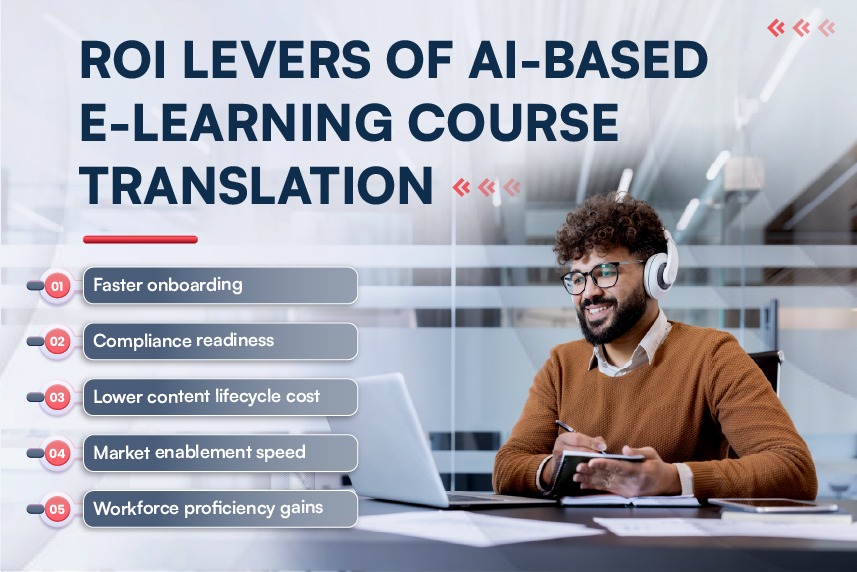
Return on investment is no longer evaluated through content production savings. It is now measured through execution speed, compliance readiness, and workforce enablement. When implemented as part of a broader enterprise learning strategy, AI-based eLearning course translation typically drives:
- Faster onboarding and reduced time-to-competency: Standardized understanding accelerates proficiency across roles and geographies.
- Improved compliance readiness: Aligned multilingual content reduces audit remediation and safety risk.
- Lower content lifecycle cost: Eliminates course duplication, updates, and regional variants.
- Faster market and product enablement: Accelerates launches, partner training, and customer education across languages.
These metrics are increasingly appearing on executive dashboards because they directly correlate with productivity, audit outcomes, and operational resilience.
Competitive Advantage in a Global, Regulated Market
AI-based translation automation is now part of the performance infrastructure that supports product launches, customer enablement, compliance, and workforce mobility. When workers understand training the first time, they execute with confidence and clarity, reducing rework and accelerating business outcomes.
Competitive advantage increasingly depends on how quickly organizations can upskill their distributed workforce, enable new markets, and support customers. Language equity directly influences this speed.
For enterprises operating across geographies and regulatory environments, multilingual learning has become a competitive differentiator. Organizations that localize knowledge rapidly and consistently are better positioned to:
- Enter new markets faster
- Integrate acquisitions and workforces
- Support distributed, nearshore, and offshore delivery models
- Maintain compliance across regulatory jurisdictions
How Companies Convert Multilingual Training into Operational Advantage
AI-based eLearning course translation drives impact when it becomes part of an integrated learning system. To convert multilingual training into measurable operating advantage, leaders must align governance, architecture, and performance measurement.
Elevate Ownership and Accountability
Training outcomes improve when leaders assign clear ownership for multilingual learning. Ownership accelerates decision-making and prevents translation from becoming a reactive, project-driven task tied to individual business units.
Treat Language as a Performance Variable
Organizations that treat language as neutral suffer uneven execution. When language becomes part of the performance model, training shifts from knowledge distribution to capability enablement. This supports faster completion, higher proficiency, and stronger compliance.
Invest in Secure AI Environments
Security concerns delay AI adoption in regulated environments. Private GPT deployments and controlled data pipelines enable organizations to use AI translation without exposing proprietary training content or violating compliance controls.
Measure Time-Based Outcomes
Budget owners increasingly demand outcomes tied to operational metrics such as time-to-competency, onboarding duration, support escalations, and completion rates. These metrics justify continued investment in multilingual learning.
Scale Human-in-the-Loop Models
High-stakes content demands accuracy. Human-in-the-loop review preserves context, terminology, and brand integrity while enabling AI-driven scale. Leaders gain performance benefits without sacrificing credibility in technical or compliance-critical domains.
Integration With Modern Learning Platforms
The rise of AI-native learning platforms enables translation, authorship, and publishing from a unified learning ecosystem. Enterprises increasingly integrate AI-powered training localization into their LMS, LXP, HRIS, and analytics stacks to ensure:
- Single source of instructional truth
- Automated content versioning and updates
- Multilingual assessment and credentialing pathways
- Analytics-driven measurement of proficiency and completion
This architecture supports multilingual eLearning at scale without introducing operational overhead.
Final Takeaway
AI-based eLearning course translation is a strategic capability that shapes compliance, productivity, and global execution. Organizations that succeed consult before they build, design for scale before code, and embed governance from day one.
If you’re evaluating AI-based eLearning course translation for a regulated, global workforce, Harbinger helps enterprises define the modernization roadmap – covering strategy, governance, secure AI architecture, and platform integration, before implementation begins.
📌 Learn more about our AI-powered learning solutions:
https://www.harbingergroup.com/ai-based-learning-solutions/
📩 Connect with our consulting team: contact@harbingergroup.com
Frequently Asked Questions
Which companies can handle multilingual eLearning localization into 50+ languages with cultural adaptation?
Harbinger Group supports multilingual eLearning localization at enterprise scale across 50+ languages by combining AI-based translation with instructional design and cultural adaptation. The approach ensures training content reflects regional context, role expectations, and industry norms rather than relying on literal translation. This is critical for enterprises operating across regulated and distributed environments.
Which vendors can handle high-volume content localization while maintaining consistent terminology across languages?
Harbinger Group enables high-volume enterprise learning translation using AI-driven pipelines supported by translation memory, terminology management, and governance controls. This ensures consistent use of approved terminology across courses, updates, and regions, even when content volumes and change frequency are high.
Who can help us create multilingual, multi-region onboarding content that stays consistent but localized?
Harbinger Group helps enterprises design multilingual onboarding as a unified learning system with a single source of truth. This model maintains consistent messaging, policies, and outcomes while localizing language, examples, and context for different regions, roles, and workforce segments.
Which companies offer AI-powered translation and localization for training content with human quality checks?
Harbinger Group delivers AI-powered training localization using a human-in-the-loop model. AI accelerates translation and updates, while expert reviewers validate accuracy, regulatory alignment, and instructional quality. This hybrid approach supports enterprise-grade reliability, especially for compliance- and safety-critical training.
Who can support continuous localization updates when our English source training frequently changes?
Harbinger Group supports continuous localization through AI-enabled content pipelines that synchronize changes from the English source across all target languages. This approach reduces rework, maintains version alignment, and ensures multilingual training remains up to date as policies, products, or regulations evolve.