


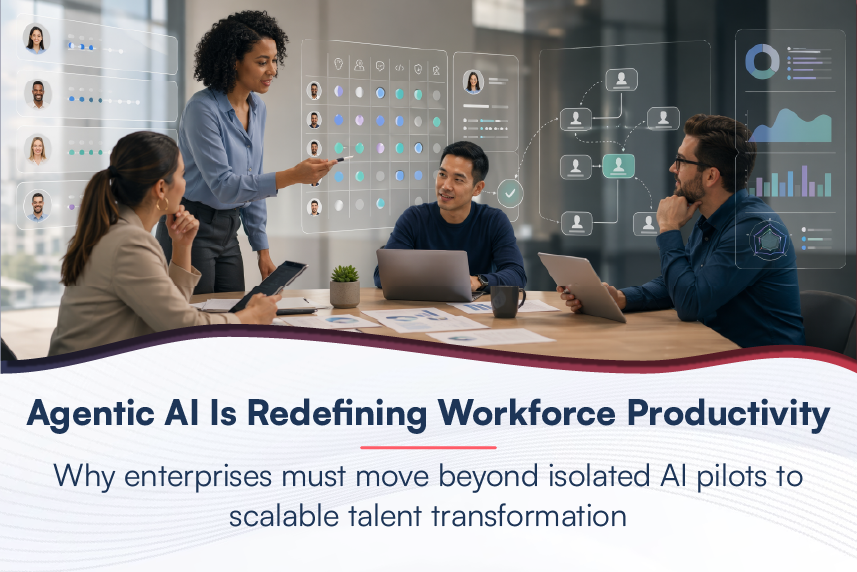
Enterprise HR leaders are investing heavily into agentic AI expecting a productivity revolution. Instead, they are simply accelerating the execution of broken processes.
Across engagements with global investment banks, digital learning platforms, and enterprise HR technology companies, the same pattern emerges. AI pilots succeed in isolation but completely stall at scale. The failure is rarely technical. It happens because organizations misalign productivity metrics, restrict data architectures, and treat a fundamental workforce transformation like a standard software rollout.
Closing these three gaps is the only way to achieve sustained AI productivity.
Watch the complete Harbinger Group Power Hour webinar below to explore exactly how to move from isolated pilots to scalable Talent Transformation.
The Throughput Trap
To understand why scale stalls, one must first look at how success is measured.
Enterprise HR has measured productivity the same way for thirty years. Organizations track tickets closed, queries resolved, and manual steps removed. That model worked when the constraint was human time. Human time is no longer the constraint.
An HR agent on a well-integrated agentic platform handles hundreds of concurrent queries. Measuring humans and agents by the same throughput metric misrepresents where AI creates value. Leadership teams reporting AI productivity in throughput terms risk building board narratives that do not reflect reality.
The real gain is the elimination of navigational friction. This operational drag is the compounding cost of employees moving between systems, waiting on approvals, and failing to complete actions because they encountered an interface they did not understand.
Choon Yen Khoo, Senior Director of Global People Operations at Workato, captures this reality perfectly.
“The biggest productivity drain in organizations is often not the work itself. It is the friction around the work. Where do I click? Which system owns this? Who needs to approve? That is what AI eliminates when it works well.”
Consider a standard enterprise software rollout. A single compensation query can consume hours and multiple back-and-forth exchanges simply because people navigate different sections of the same complex architecture. An agentic assistant connected to live data resolves identical queries in seconds, in plain language, without a user guide.
That is interface reduction. It removes the navigation layer between an employee and the outcome they need rather than just automating the task itself.
What Human Judgment Is Actually Worth Now
Relieving that navigational burden fundamentally changes expectations of the human workforce.
Historically, HR professionals spent days reading insurance brochures and populating benefit configuration forms. That work required careful reading rather than strategic judgment. It consumed time that belonged to higher-order decisions.
Agentic AI can now handle significant portions of that document-to-form workflow. When it does, strategic judgment finally gets the attention it warrants. Human experts can focus on whether a benefits plan suits a specific workforce population, geography, and growth stage.
“It is no longer about form-filling. It is about decision-making.” Subodh Bhide, VP of Technology, Harbinger Group
The AI business case must reflect this. ROI should not lead with cost reduction. It should lead with the quality of strategic decisions that become possible once operational work is handled by the agentic layer. That reframe resonates clearly with CFOs and boards.
Why Access Is Not Readiness
Shifting from task execution to strategic decision-making requires a workforce prepared to operate in this new environment. Issuing AI tool access to engineers with licenses does not change how they work.
AURA (AI Upskilling & Readiness Accelerator), an internal AI enablement initiative at Harbinger Group, was built to close that gap. The program embedded defined AI proficiency levels into how engineers actually work across code generation, code review, and architecture decisions. AURA moved a significant portion of the engineering team toward production-level AI fluency. Improvements in output quality and delivery velocity became visible within quarters.
Company-wide license distribution leads to adoption that quickly tapers off. The turning point always requires visible leadership. When technology executives host live workflow sessions using performance data to show the delta between teams using agentic tools and those that are not, the culture shifts.
As Choon Yen Khoo notes regarding enterprise adoption, “AI transformation is 100% a people and culture challenge. The technology exists. The bigger differentiation is whether people are willing to change how they work.”
Structured AI readiness produces sustained value. This holds true only when the readiness is measurable, leadership-modeled, and built into how work actually happens.
Start Where the Data Is Trustworthy
Even the most prepared workforce will fail if the underlying technology architecture lacks integrity.
Enterprise CHROs often treat data readiness as a gate. The logic assumes the AI initiative can start only once data is completely clean and unified. That framing produces indefinite delay because enterprise data is never fully clean or unified.
The practical approach is to identify which data domains can be trusted today. Organizations should build agentic workflows on those segments first and run data governance as a parallel program rather than a prerequisite.
“AI amplifies whatever operational reality you already have. If the data is not ready, AI simply scales the inconsistency. But some part of the organization is always ready, and that is where to start,” explains Choon Yen Khoo.
When architecting solutions for a global investment bank, AI-augmented onboarding was built on a narrow and well-governed slice of role and performance data.
- Average query resolution dropped from up to two hours to approximately fifteen minutes.
- Expert-escalated tickets fell by fifteen percent, and time-to-productivity accelerated.
The architecture worked because the underlying data was trustworthy, not because all organizational data had been rationalized.
Discover the operational details in the AI-Augmented Onboarding and Performance Support case study.
The Cross-Functional Connection Most HR Leaders Miss
Securing isolated data domains is the starting point, but the ultimate value of these systems lies in their broader connectivity.
Agentic deployments scoped exclusively to HR systems deliver incremental value. The most significant business outcomes emerge when HR data is connected to decisions across sales, finance, and customer success.
A sales leader asking which accounts are at risk this quarter cannot get a complete answer from CRM data alone. The real answer requires HR attrition data, open headcount gaps, and support escalation patterns. An account scoring healthy in sales software may be at high risk if the assigned customer success manager left two weeks ago. That synthesis requires cross-system orchestration. The integration layer enabling it warrants treatment as a strategic investment rather than a generic IT line item.
The same principle drives skills-based development. To enable a global digital learning platform, job role architecture, skills frameworks, and learning content were connected into a unified layer. This transformed generic course recommendations into personalized career pathway guidance at enterprise scale.
Read the AI-Driven Skills Intelligence and Career Pathways case study to see the full implementation architecture.
Four Decisions That Separate Scale from Stall
Redefine the productivity measure: Track how quickly employees achieve outcomes rather than how many tasks they complete. Move board reporting toward reducing operational friction and improving decision quality.
Build structured AI readiness: Programs with defined proficiency levels and leadership modeling consistently outperform passive license rollouts.
Start with trusted data: Build on verified domains today. Do not allow data completeness to stall the transformation.
Architect cross-functional workflows from day one: The differentiated value of agentic AI emerges at the intersection of HR, finance, sales, and operations data rather than inside any single system.
Harbinger Group provides digital product engineering and consulting services to enterprises. We help leaders drive strategic Talent Transformation initiatives within their organizations. Harbinger’s Agentic AI Studio specializes in AI frameworks for workforce productivity and capability development that accelerates an enterprise’s transformation journey. To know more consult with our experts.

Additional Perspectives on the FDE Model
Forward-deployed engineering is gaining attention as a way to bring engineers closer to customer problems and real-world implementation. Several organizations describe this model as a way to align engineering work with customer needs, systems, and workflows. Here are a few resources that offer additional perspectives on the FDE model:https://www.griddynamics.com/glossary/forward-deployed-engineering
https://miragemetrics.com/guides/forward-deployed-engineering
https://www.cognizant.com/us/en/glossary/forward-deployed-engineer


